Merck asks US FDA to authorize promising anti-COVID pill
Advertisement
Read this article for free:
or
Already have an account? Log in here »
To continue reading, please subscribe:

Digital Subscription
One year of digital access for only $205*
- Enjoy unlimited reading on winnipegfreepress.com
- Read the E-Edition, our digital replica newspaper
- Access News Break, our award-winning app
- Play interactive puzzles
*First annual payment billed as $205.00 + GST for one year. This annual subscription will automatically renew at $233.00 + GST every 52 weeks (10% off the regular annual price of $259.35). Offer available to new and qualified returning subscribers only. Cancel any time.
To continue reading, please subscribe:
Add Free Press access to your Brandon Sun subscription for only an additional
$1 for the first 4 weeks*
- Enjoy unlimited reading on winnipegfreepress.com
- Read the E-Edition, our digital replica newspaper
- Access News Break, our award-winning app
- Play interactive puzzles
*Your next Brandon Sun subscription payment will increase by $1.00 and you will be charged $17.95 plus GST for four weeks. After four weeks, your payment will increase to $24.95 plus GST every four weeks.
Read unlimited articles for free today:
or
Already have an account? Log in here »
Hey there, time traveller!
This article was published 11/10/2021 (1826 days ago), so information in it may no longer be current.
WASHINGTON (AP) — Drugmaker Merck asked U.S. regulators Monday to authorize its pill for treating COVID-19 in what would add an entirely new and easy-to-use weapon to the world’s arsenal against the pandemic.
If cleared by the Food and Drug Administration — a decision that could come in a matter of weeks — it would be the first pill shown to treat the illness. All other FDA-backed treatments against COVID-19 require an IV or injection.
An antiviral pill that people could take at home to reduce their symptoms and speed recovery could prove groundbreaking, easing the crushing caseload on U.S. hospitals and helping to curb outbreaks in poorer countries with weak health care systems. It would also bolster the two-pronged approach to the pandemic: treatment, by way of medication, and prevention, primarily through vaccinations.
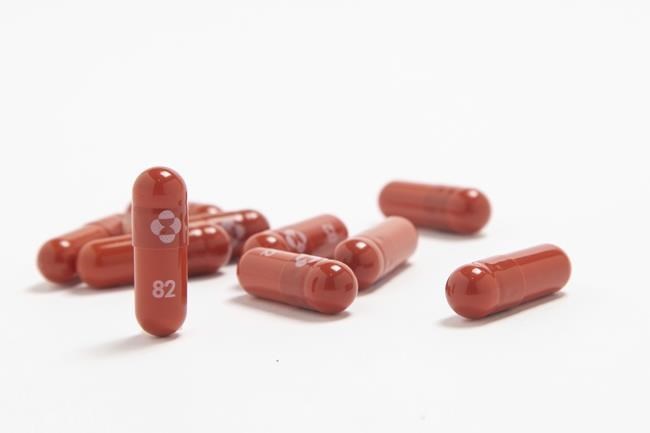
The FDA will scrutinize company data on the safety and effectiveness of the drug, molnupiravir, before rendering a decision.
Merck and its partner Ridgeback Biotherapeutic said they specifically asked the agency to grant emergency use for adults with mild-to-moderate COVID-19 who are at risk for severe disease or hospitalization. That is roughly the way COVID-19 infusion drugs are used.
“The value here is that it’s a pill so you don’t have to deal with the infusion centers and all the factors around that,” said Dr. Nicholas Kartsonis, a senior vice president with Merck’s infectious disease unit. “I think it’s a very powerful tool to add to the toolbox.”
The company reported earlier this month that the pill cut hospitalizations and deaths by half among patients with early symptoms of COVID-19. The results were so strong that independent medical experts monitoring the trial recommended stopping it early.
Side effects were similar between patients who got the drug and those in a testing group who received a dummy pill. But Merck has not publicly detailed the types of problems reported, which will be a key part of the FDA’s review.
Top U.S. health officials continue to push vaccinations as the best way to protect against COVID-19.
“It’s much, much better to prevent yourself from getting infected than to have to treat an infection,” Dr. Anthony Fauci said while discussing Merck’s drug last week.
Still, some 68 million eligible Americans remain unvaccinated, underscoring the need for effective drugs to control future waves of infection.
The prospect of a COVID-19 pill comes amid other encouraging signs: New cases per day in the U.S. have dropped below 100,000 on average for the first time in over two months, and deaths are running at about 1,700 a day, down from more than 2,000 three weeks ago.
Also, the average number of vaccinations dispensed per day has climbed past 1 million, an increase of more than 50% over the past two weeks, driven by the introduction of booster shots and workplace vaccine requirements.
Still, heath authorities are bracing for another possible surge as cold weather drives more people indoors.
Since the beginning of the pandemic, health experts have stressed the need for a convenient pill. The goal is for something similar to Tamiflu, the 20-year-old flu medication that shortens the illness by a day or two and blunts the severity of symptoms like fever, cough and stuffy nose.
Three FDA-authorized antibody drugs have proved highly effective at reducing COVID-19 deaths, but they are expensive, hard to produce and require specialty equipment and health professionals to deliver.
Assuming FDA authorization, the U.S. government has agreed to buy enough of the pills to treat 1.7 million people, at a price of roughly $700 for each course of treatment. That’s less than half the price of the antibody drugs purchased by the U.S. government — over $2,000 per infusion — but still more expensive than many antiviral pills for other conditions.
Merck’s Kartsonis said in an interview that the $700 figure does not represent the final price for the medication.
“We set that price before we had any data, so that’s just one contract,” Kartsonis said. “Obviously we’re going to be responsible about this and make this drug as accessible to as many people around the world as we can.”

Kenilworth, New Jersey-based Merck has said it is in purchase talks with governments around the world and will use a sliding price scale based on each country’s economic means. Also, the company has signed licensing deals with several Indian generic drugmakers to produce low-cost versions of the drug for lower-income countries.
Several other companies, including Pfizer and Roche, are studying similar drugs and are expected to report results in the coming weeks and months. AstraZeneca is also seeking FDA authorization for a long-acting antibody drug intended to provide months of protection for patients who have immune-system disorders and do not adequately respond to vaccination.
Some experts predict various COVID-19 therapies eventually will be prescribed in combination to better protect against the worst effects of the virus.
___
The Associated Press Health and Science Department receives support from the Howard Hughes Medical Institute’s Department of Science Education. The AP is solely responsible for all content.