

Here’s a look at the stunning northern lights spotted across Canada on Monday
Advertisement
Read this article for free:
or
Already have an account? Log in here »
To continue reading, please subscribe:

Digital Subscription
One year of digital access for only $205*
- Enjoy unlimited reading on winnipegfreepress.com
- Read the E-Edition, our digital replica newspaper
- Access News Break, our award-winning app
- Play interactive puzzles
*First annual payment billed as $205.00 + GST for one year. This annual subscription will automatically renew at $233.00 + GST every 52 weeks (10% off the regular annual price of $259.35). Offer available to new and qualified returning subscribers only. Cancel any time.
To continue reading, please subscribe:
Add Free Press access to your Brandon Sun subscription for only an additional
$1 for the first 4 weeks*
- Enjoy unlimited reading on winnipegfreepress.com
- Read the E-Edition, our digital replica newspaper
- Access News Break, our award-winning app
- Play interactive puzzles
*Your next Brandon Sun subscription payment will increase by $1.00 and you will be charged $17.95 plus GST for four weeks. After four weeks, your payment will increase to $24.95 plus GST every four weeks.
Read unlimited articles for free today:
or
Already have an account? Log in here »
Hey there, time traveller!
This article was published 12/10/2021 (1769 days ago), so information in it may no longer be current.
There was an incredible display of the northern lights this Thanksgiving weekend.
A geomagnetic storm allowed the lights to cross skies as far south as Ottawa, according to the University of Alaska Geophysical Institute.
The northern lights, also called Aurora Borealis, most often appear in northern Canada, and are brightest in areas where there is less light pollution. The lights are visible for a few hours after sunset, and are at their most intense around midnight. They appear for a few minutes before disappearing and reappearing. The lights can last between 15 and 30 minutes at a time, though they could also go on for hours.
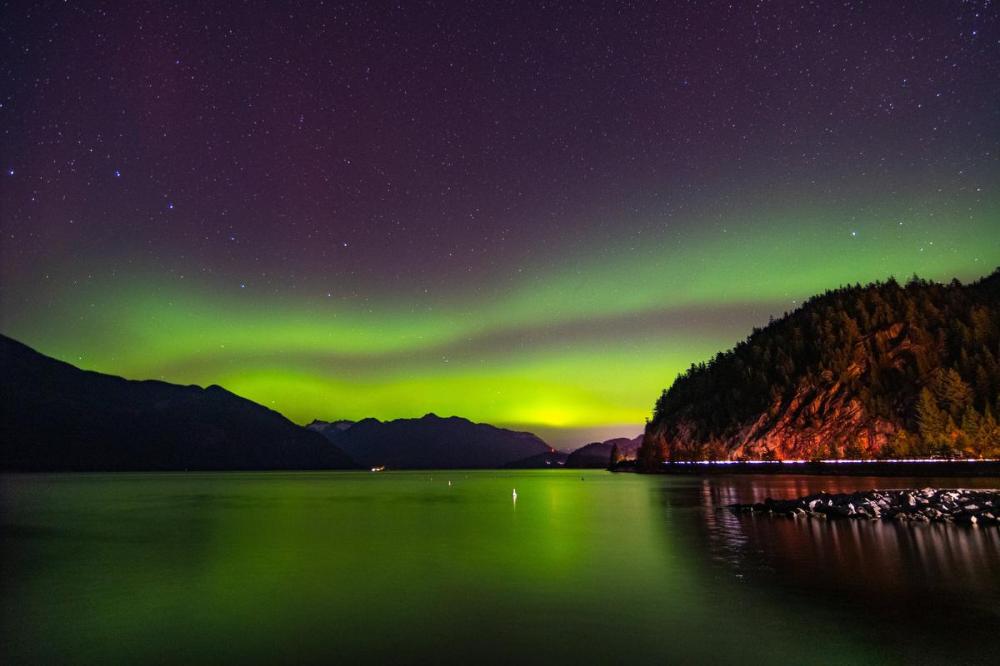
Those lucky enough to see the lights shared their breathtaking photos on Twitter.
Some of the best spots to view the northern lights in Ontario are Manitoulin Island and Pukaskwa National Park. The lights are most visible during autumn months.
The lights appear when charged particles from the sun hit the Earth’s atmosphere. It happens most often at the Earth’s poles and is why they are most visible in northern parts of Canada.
If there is a particularly intense solar flare, the lights can be seen farther south in Canada.
The northern lights take place in the Auroral Zone, the 2,500 kilometre radius around the Earth’s magnetic poles. That means Toronto is too far south for the light show to be visible.
If you weren’t able to catch the lights in your city, the AuroraMAX observatory has a website where you can view the northern lights online.
With files from Debbie Olson
Ashleigh-Rae Thomas is a reporter for the Star’s radio room based in Toronto. Reach Ashleigh-Rae via email: arthomas@thestar.ca