Q&A: What do we know about how COVID-19 rapid antigen tests work?
Advertisement
Read this article for free:
or
Already have an account? Log in here »
To continue reading, please subscribe:
Digital Subscription
One year of digital access for only $1.44 a week*
- Enjoy unlimited reading on winnipegfreepress.com
- Read the E-Edition, our digital replica newspaper
- Access News Break, our award-winning app
- Play interactive puzzles
*Billed as $5.77 plus GST every four weeks. After 52 weeks, price increases to the regular rate of $19.95 plus GST every four weeks. Offer available to new and qualified returning subscribers only. Cancel any time.
To continue reading, please subscribe:
Add Free Press access to your Brandon Sun subscription for only an additional
$1 for the first 4 weeks*
- Enjoy unlimited reading on winnipegfreepress.com
- Read the E-Edition, our digital replica newspaper
- Access News Break, our award-winning app
- Play interactive puzzles
*Your next Brandon Sun subscription payment will increase by $1.00 and you will be charged $17.95 plus GST for four weeks. After four weeks, your payment will increase to $24.95 plus GST every four weeks.
Read unlimited articles for free today:
or
Already have an account? Log in here »
Hey there, time traveller!
This article was published 14/12/2021 (1768 days ago), so information in it may no longer be current.
Rapid antigen tests that can quickly detect the COVID-19 virus have gained significant attention recently, with experts calling on some provinces to provide more of them to the public while other jurisdictions have been applauded for making their supply so accessible.
Some experts in Ontario have said rapid tests should be more widely used as a new wave of cases, partly driven by the Omicron variant, raises alarm ahead of the holiday season. Nova Scotia, meanwhile, has made rapid tests easy to obtain, handing them out free of charge at certain places including liquor stores.
While rapid tests can be useful in picking up positive cases before people unknowingly spread the virus to others, experts maintain they are just one tool in the pandemic-fighting tool box.
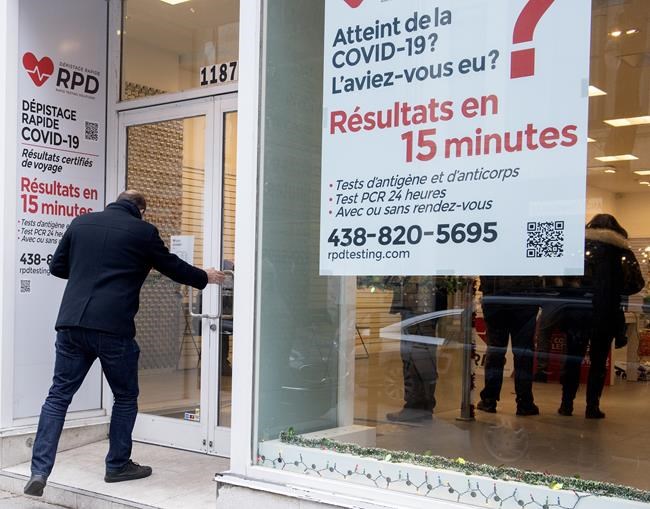
The U.S.-based Centers for Disease Control and Prevention describes self-administered rapid tests as “one of many risk-reduction measures, along with vaccination, masking and physical distancing,” that can limit the spread of COVID-19.
Dr. Theresa Tam, Canada’s chief public health expert, shared that sentiment Friday, urging anyone considering using a rapid test to “learn about it and what they can and cannot do.”
“If you use a rapid test it should be an additional layer and not let go of some of the other layers of protection that we’ve been talking about,” she said in a news conference.
Here’s what we know about rapid antigen tests:
HOW DO RAPID TESTS WORK?
The tests detect specific proteins of the virus that cause COVID-19 and can usually deliver results within an hour. Some can be done at home without the need of a lab, and others require trained operators to administer them.
The CDC says a positive self-test result means the person is “very likely to have an infection,” while a negative result means the test didn’t pick up the virus on that day.
Experts say it’s best to view rapid tests as a snapshot of a particular moment in time — they might not detect the virus in the earliest stages of infection, but a subsequent test taken a day or two later could give a different result.
Dr. Sumon Chakrabarti, an infectious disease specialist in Mississauga, Ont., said rapid tests are great for detecting a “window of contagion.”
“When you have COVID, two days before you develop symptoms, you’re starting to get contagious,” Chakrabarti said. “So finding out that window is very, very helpful, because then you can take people out of circulation (by isolating them from others).”
WHEN SHOULD I TAKE A RAPID TEST?
Chakrabarti said rapid tests are ideal for essential workers who take them regularly throughout their work week, because they canweed out possible cases that could infect colleagues.
But other peoplemay also want to take rapid tests to ensure they’re not infected before attending a holidaygathering. Chakrabarti said rapid testing in that scenario can limitrisk, but only if taken within hours of the event, rather than the day or two before.
“The amount of viral load rapidly changes, so this test works (best) if you’re using it often,” he said. “For the public, if you’re using it, it will work for you for that night.
“I do my rapid test, it’s negative, I know I’m very unlikely to be contagious on that day.”
Canada’s deputy chief public health officer Dr. Howard Njoo has pointed to limitations of rapid tests, noting they’re not as “precise” as molecular tests sent to a lab for diagnostic purposes.
He said rapid tests are best used in “certain contexts,” including schools and workplaces, or in trying to “rapidly deal with outbreaks.”
“Rapid tests have a certain use if you are ill, maybe it’s a quick way to determine whether you have COVID-19,” he said last week, noting he won’t be using them during his own holiday plans. “My first stance is that if you’re symptomatic, you have any signs of illness, no, you shouldn’t be coming to my family get-together.”
WHAT SHOULD I DO IF I TEST POSITIVE ON A RAPID TEST?
Health Canada’s website says those who get a positive result with a rapid test should get confirmation with a PCR test, which the agency considers “the gold standard” for COVID-19 testing.
Chakrabarti said that helps public health units keep track of positive cases and allows for proper contact tracing, which can limit further spread.
But as more and more cases creep up with the Omicron variant, keeping track of infections will become harder to do. He said those testing positive on a rapid test can be fairly confident they have the virus and start taking precautions.
“If you are in a high-risk workplace where you being positive can have a lot of ramifications, then yeah, it’s probably a good idea to get the confirmatory test,” Chakrabarti said.
“The second thing though is that because the amount of COVID is so big right now in the community and getting bigger, if you have a positive rapid test, the chance of this being a real true positive is much higher now than it was in June, for example.”
The rapid tests authorized for use in Canada are likely very accurate.
Health Canada says it does not authorize rapid tests that have sensitivity values below 80 per cent, saying tests that don’t meet that standard “produce too many false negative results.”
This report by The Canadian Press was first published Dec. 14, 2021.
Related Articles
Manitoba mulls free rapid COVID-19 tests
Advertisement Advertise With Us
Advertisement Advertise With Us