

Manitoba shortens quarantine period for fully vaxxed

Advertisement
Read this article for free:
or
Already have an account? Log in here »
To continue reading, please subscribe:
Monthly Digital Subscription
$1 per week for 24 weeks*
- Enjoy unlimited reading on winnipegfreepress.com
- Read the E-Edition, our digital replica newspaper
- Access News Break, our award-winning app
- Play interactive puzzles
*Billed as $4.00 plus GST every four weeks. After 24 weeks, price increases to the regular rate of $19.95 plus GST every four weeks. Offer available to new and qualified returning subscribers only. Cancel any time.
Monthly Digital Subscription
$4.99/week*
- Enjoy unlimited reading on winnipegfreepress.com
- Read the E-Edition, our digital replica newspaper
- Access News Break, our award-winning app
- Play interactive puzzles
*Billed as $19.95 plus GST every four weeks. Cancel any time.
To continue reading, please subscribe:
Add Free Press access to your Brandon Sun subscription for only an additional
$1 for the first 4 weeks*
*Your next subscription payment will increase by $1.00 and you will be charged $16.99 plus GST for four weeks. After four weeks, your payment will increase to $23.99 plus GST every four weeks.
Read unlimited articles for free today:
or
Already have an account? Log in here »
Hey there, time traveller!
This article was published 31/12/2021 (1543 days ago), so information in it may no longer be current.
Anyone who tests positive for COVID-19 in 2022 — be it via PCR test or at-home swab — will be immediately required to self-isolate, but quarantine stints will soon be cut in half for many fully vaccinated Manitobans.
On Friday afternoon, the province announced it is making changes to the self-isolation public health order to adapt to the prevalence of rapid antigen tests and address the surge in cases because of Omicron.
“We have looked at data from Manitoba and other jurisdictions, and feel these changes will balance reducing the spread of COVID-19 while ensuring critical services can continue to operate,” Dr. Brent Roussin, chief provincial public health officer, said in a prepared release.
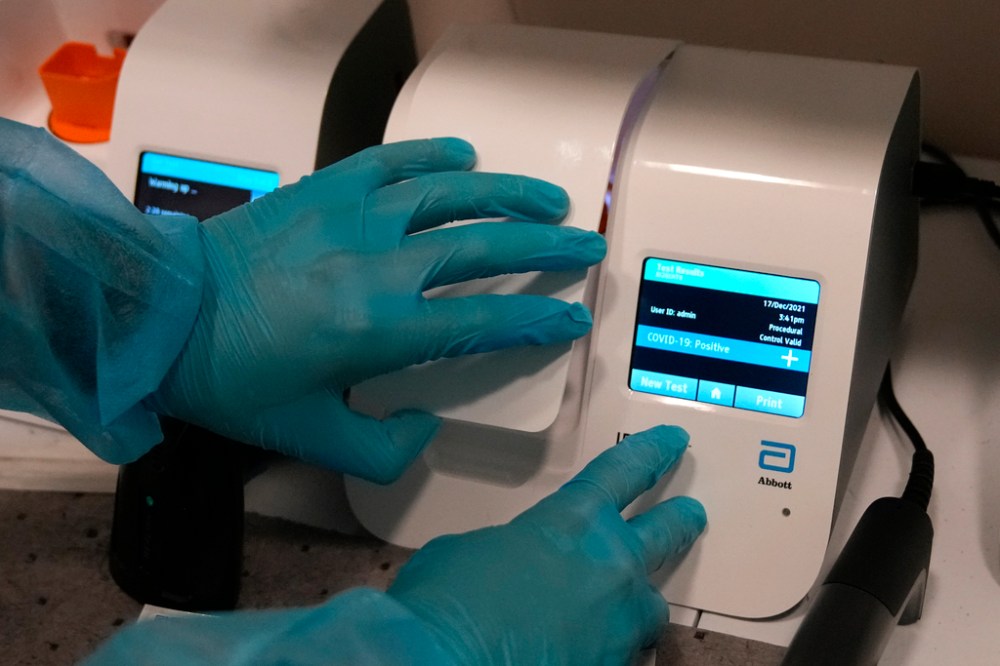
The adjustments, which come into effect after midnight on Jan. 1, 2022, will mandate all individuals who receive a positive rapid antigen test to go into quarantine.
For fully immunized people, isolation periods since the date of a test will be shortened to five days from 10 if the individual is not showing symptoms.
If an individual’s symptoms are improving and they do not have a fever, they may stop quarantine after five days since either the date their symptoms started appearing or the date of their test, whichever is later.
Manitobans who have only isolated for five days as a result of the above changes will then be required to wear medical-grade masks in public settings for five days after their quarantine.
Public health officials are asking that people leaving isolation avoid any non-essential visits to high-risk settings or non-essential contact with individuals who are high-risk for disease during that time.
For people who are not fully vaccinated, isolation will be required for 10 days after the date of their test, as long as their symptoms are improving and they do not have a fever.
Household close contacts who are exempt from self-isolation are expected to be cautious while a person is isolated and avoid non-essential visits of any kind.
Consistent with the current edition, the new order will require close contacts who are not exempt from self-isolation requirements to quarantine for 10 days and people to provide contact tracers, as required, with information about locations they have visited in the days leading up to infection.
Official public health documents and guidance related to the changes will be finalized in the coming days, according to the province.

Health Minister Audrey Gordon indicated in the New Year’s Eve release that the updates will reduce strain on both the health-system workforce and other key sectors as more workers report infections.
The province is updating its protocols in line with public health advice, she said.
On Monday, the U.S. Centers for Disease Control and Prevention shortened recommended COVID-19 isolation periods for the general population, citing science showing the majority of transmission occurs early in the course of illness — “generally in the (one to two) days prior to onset of symptoms and the (two to three) days after.”
maggie.macintosh@freepress.mb.ca
Twitter: @macintoshmaggie
Maggie Macintosh
Education reporter
Maggie Macintosh reports on education for the Free Press. Originally from Hamilton, Ont., she first reported for the Free Press in 2017. Read more about Maggie.
Funding for the Free Press education reporter comes from the Government of Canada through the Local Journalism Initiative.
Every piece of reporting Maggie produces is reviewed by an editing team before it is posted online or published in print — part of the Free Press‘s tradition, since 1872, of producing reliable independent journalism. Read more about Free Press’s history and mandate, and learn how our newsroom operates.
Our newsroom depends on a growing audience of readers to power our journalism. If you are not a paid reader, please consider becoming a subscriber.
Our newsroom depends on its audience of readers to power our journalism. Thank you for your support.
Maggie Macintosh
Education reporter
Maggie Macintosh reports on education for the Free Press. Originally from Hamilton, Ont., she first reported for the Free Press in 2017. Read more about Maggie.
Funding for the Free Press education reporter comes from the Government of Canada through the Local Journalism Initiative.
Every piece of reporting Maggie produces is reviewed by an editing team before it is posted online or published in print — part of the Free Press‘s tradition, since 1872, of producing reliable independent journalism. Read more about Free Press’s history and mandate, and learn how our newsroom operates.
Our newsroom depends on a growing audience of readers to power our journalism. If you are not a paid reader, please consider becoming a subscriber.
Our newsroom depends on its audience of readers to power our journalism. Thank you for your support.
Advertisement Advertise With Us
Advertisement Advertise With Us