

Myanmar’s Suu Kyi sentenced to 4 more years in prison
Advertisement
Read this article for free:
or
Already have an account? Log in here »
To continue reading, please subscribe:
Monthly Digital Subscription
$1 per week for 24 weeks*
- Enjoy unlimited reading on winnipegfreepress.com
- Read the E-Edition, our digital replica newspaper
- Access News Break, our award-winning app
- Play interactive puzzles
*Billed as $4.00 plus GST every four weeks. After 24 weeks, price increases to the regular rate of $19.95 plus GST every four weeks. Offer available to new and qualified returning subscribers only. Cancel any time.
Monthly Digital Subscription
$4.99/week*
- Enjoy unlimited reading on winnipegfreepress.com
- Read the E-Edition, our digital replica newspaper
- Access News Break, our award-winning app
- Play interactive puzzles
*Billed as $19.95 plus GST every four weeks. Cancel any time.
To continue reading, please subscribe:
Add Free Press access to your Brandon Sun subscription for only an additional
$1 for the first 4 weeks*
*Your next subscription payment will increase by $1.00 and you will be charged $16.99 plus GST for four weeks. After four weeks, your payment will increase to $23.99 plus GST every four weeks.
Read unlimited articles for free today:
or
Already have an account? Log in here »
Hey there, time traveller!
This article was published 09/01/2022 (1535 days ago), so information in it may no longer be current.
BANGKOK (AP) — A court in Myanmar sentenced ousted leader Aung San Suu Kyi to four more years in prison on Monday after finding her guilty of illegally importing and possessing walkie-talkies and violating coronavirus restrictions, a legal official said.
Suu Kyi was convicted last month on two other charges and given a four-year prison sentence, which was then halved by the head of the military-installed government.
The cases are among about a dozen brought against the 76-year-old Nobel Peace Prize laureate since the army seized power last February, ousting her elected government and arresting top members of her National League for Democracy party.
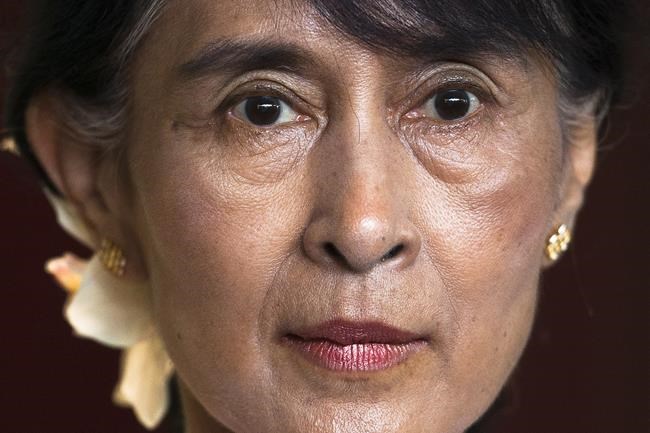
If found guilty of all the charges, she could be sentenced to more than 100 years in prison.
Suu Kyi’s supporters and independent analysts say the charges against her are contrived to legitimize the military’s seizure of power and prevent her from returning to politics.
Monday’s verdict in the court in the capital, Naypyitaw, was conveyed by a legal official who insisted on anonymity for fear of being punished by the authorities, who have restricted the release of information about Suu Kyi’s trials.
He said she was sentenced to two years in prison under the Export-Import Law for importing the walkie-talkies and one year under the Telecommunications Law for possessing them. The sentences are to be served concurrently. She also received a two-year sentence under the Natural Disaster Management Law for allegedly violating coronavirus rules while campaigning.
Suu Kyi was convicted last month on two other charges — incitement and breaching COVID-19 restrictions — and sentenced to four years’ imprisonment. Hours after that sentence was issued, the head of the military-installed government, Senior Gen. Min Aung Hlaing, reduced it by half.
Suu Kyi’s party won a landslide victory in a 2020 general election, but the military claimed there was widespread electoral fraud, an assertion that independent poll watchers doubt.
Since her first guilty verdict, Suu Kyi has been attending court hearings in prison clothes — a white top and a brown longyi skirt provided by the authorities. She is being held by the military at an unknown location, where state television reported last month she would serve her sentence.
The hearings are closed to the media and spectators and the prosecutors do not comment. Her lawyers, who had been a source of information on the proceedings, were served with gag orders in October.
The military-installed government has not allowed any outside party to meet with Suu Kyi since it seized power, despite international pressure for talks including her that could ease the country’s violent political crisis.
It would not allow a special envoy from the Association of Southeast Asian Nations, of which Myanmar is a member, to meet her. The refusal received a rare rebuke from fellow members, who barred Min Aung Hlaing from attending its annual summit meeting.
Even Cambodian Prime Minister Hun Sen, who took over as the regional group’s chair for this year and advocates engagement with the ruling generals, failed to meet her last week when he became the first head of government to visit Myanmar since the army’s takeover.
The military’s seizure of power was quickly met by nonviolent nationwide demonstrations, which security forces quashed with deadly force, killing over 1,400 civilians, according to a detailed list compiled by the Assistance Association for Political Prisoners.
Peaceful protests have continued, but amid the severe crackdown, an armed resistance has also grown, to the point that U.N. experts have warned the country could be sliding into civil war.
“Throwing a plethora of criminal charges at Aung San Suu Kyi … reeks more of desperation than confidence,” said Mark Farmaner, director of Burma Campaign UK, a democracy promotion group.
He said in an email interview after her first convictions that the military “massively miscalculated” in thinking that it could prevent protests by arresting Suu Kyi, her fellow party members and veteran independent political activists.
“A new mass movement was born which doesn’t depend on a single leader. There are hundreds of small groups organizing and resisting in different ways, from peaceful protest, boycotts and armed resistance,” Farmaner said. “Even with more than 7,000 people arrested since the coup, three times the average number detained under the previous military dictatorship, the military have been unable to suppress dissent.”
Suu Kyi was charged right after the military’s takeover with having improperly imported the walkie-talkies, which served as the initial justification for her continued detention. A second charge of illegally possessing the radios was filed the following month.
The radios were seized from the entrance gate of her residence and the barracks of her bodyguards during a search on Feb. 1, the day she was arrested.
Suu Kyi’s lawyers argued that the radios were not in her personal possession and were legitimately used to help provide for her security, but the court declined to dismiss the charges.
She was charged with two counts of violating coronavirus restrictions during campaigning for the 2020 election. She was found guilty on the first count last month.
She is also being tried by the same court on five counts of corruption. The maximum penalty for each count is 15 years in prison and a fine. A sixth corruption charge against her and ousted President Win Myint in connection with granting permits to rent and buy a helicopter has not yet gone to trial.
In separate proceedings, she is accused of violating the Official Secrets Act, which carries a maximum sentence of 14 years.
Additional charges were also added by Myanmar’s election commission against Suu Kyi and 15 other politicians in November for alleged fraud in the 2020 election. The charges by the military-appointed Union Election Commission could result in Suu Kyi’s party being dissolved and unable to participate in a new election the military has promised will take place within two years of its takeover.