Nevada geothermal power lawsuit bound for US appeals court

Advertisement

Advertise with us

RENO, Nev. (AP) — A federal appeals court will have to decide whether protecting historical tribal lands and a rare toad warrant blocking a major geothermal plant in Nevada as the nation tries to move away from fossil fuels amid a looming climate crisis.

Read this article for free:


or

Already have an account? Log in here »

To continue reading, please subscribe:

Subscribe and receive a limited-edition Free Press branded hat or tote.

Digital Subscription

One year of digital access for only $205*

  • Enjoy unlimited reading on winnipegfreepress.com
  • Read the E-Edition, our digital replica newspaper
  • Access News Break, our award-winning app
  • Play interactive puzzles

*First annual payment billed as $205.00 + GST for one year. This annual subscription will automatically renew at $233.00 + GST every 52 weeks (10% off the regular annual price of $259.35). Offer available to new and qualified returning subscribers only. Cancel any time.

To continue reading, please subscribe:

Add Free Press access to your Brandon Sun subscription for only an additional

$1 for the first 4 weeks*

  • Enjoy unlimited reading on winnipegfreepress.com
  • Read the E-Edition, our digital replica newspaper
  • Access News Break, our award-winning app
  • Play interactive puzzles
Start now

*Your next Brandon Sun subscription payment will increase by $1.00 and you will be charged $17.95 plus GST for four weeks. After four weeks, your payment will increase to $24.95 plus GST every four weeks.

Hey there, time traveller!
This article was published 20/01/2022 (1703 days ago), so information in it may no longer be current.

RENO, Nev. (AP) — A federal appeals court will have to decide whether protecting historical tribal lands and a rare toad warrant blocking a major geothermal plant in Nevada as the nation tries to move away from fossil fuels amid a looming climate crisis.

Ormat Technologies says it may abandon the project if a 90-day court order remains in place into March at the high-desert site bordering wetlands fed by hot springs about 100 miles (160 kilometers) east of Reno.

The legal battle is headed to the 9th U.S. Circuit Court of Appeals in San Francisco after a federal judge in Reno denied Ormat’s request this week to lift the temporary injunction by Feb. 28.

The Fallon Paiute-Shoshone Tribe and the Center for Biological Diversity won the Jan. 4 court order temporarily banning any activity on what they say are sacred ceremonial grounds and home to the Dixie Valley toad being considered for a U.S. endangered species listing.

They also warn that the project could end up costing ratepayers in Southern California more for electricity.

Reno-based Ormat, one of the five largest U.S. geothermal producers, says it could lose tens of millions of dollars if it can’t begin construction at the site on federal land before March.

“While this is a significant blow to the company, it may sound the death knell for the project,” its lawyers wrote in their request to cut the 90-day order in half.

Ormat said it has invested $68 million over 10 years to start construction early this year and meet a Dec. 31 deadline to begin selling power at rates above current market prices under a 2017 contract.

They told U.S. District Judge Robert C. Jones on Jan. 10 the situation makes it “virtually impossible” to meet the deadline “critical to making the project economically feasible.”

Jones said in his order late Wednesday they should take it up with the appellate court in San Francisco.

“The most efficient and direct path to resolve any party’s concerns with this court’s orders on the temporary restraining order and preliminary injunction is to pursue appeal on an expedited basis,” he wrote.

On Thursday, Ormat’s lawyers filed formal notice of their intent to appeal.

It’s the latest development in a lawsuit the opponents filed last month seeking to void an environmental review the Bureau of Land Management approved in authorizing the project in November.

The lawsuit says pumping water from beneath the earth in Dixie Meadows will harm the hot springs the tribe considers sacred and could push the toad to the brink of extinction at the only place in the world it’s known to exist.

The opponents lawyers also say in their latest court filings that while Ormat may benefit from the energy deal it cut in 2017, electric ratepayers would not.

“Ormat’s interest in profiting from above-market prices — which would likely be borne by consumers in the Los Angeles area over the length of the contract — does not constitute irreparable harm,” they wrote.

Ormat argues the ceremonial lands and the toad itself are too far from the plant to be harmed, and that the area already is developed with roads, powerlines, a wellfield and an existing gravel pit bordering the site.

Its lawyers say geothermal development is an especially important step “in the global fight to reduce greenhouse gases and slow climate change.” Unlike wind and solar, geothermal power “contributes to availability of clean energy 24 hours a day, seven days a week,” they said.

“The loss of the project would deal a massive blow to the state’s efforts to replace fossil fuel combustion with renewable energy, posing an obstacle to Nevada’s constitutional requirement to procure 50% of the state’s energy from renewable resources by 2030,” they wrote.

The tribe and conservationists say any delays in construction are largely of Ormat’s and the government’s “own making.”

Their lawyers say the bureau’s environmental assessment makes clear that from 2011-2016, Ormat failed to collect required surface water monitoring data as it had agreed to under its lease.

They said they alerted Ormat and the bureau in 2017 that they needed to prepare a more detailed environmental impact statement.

“The failure to resolve those issues over the subsequent years does not now create an emergency,” they wrote.


Report Error Submit a Tip

More Stories

Not falling back means time loop remains unclosed

Jen Zoratti 4 minute read 2:01 AM CDT

I demand restitution. Where’s my hour?

In the traditional fall-back, spring-forward time change set up — you know, ol’ trusty that’s been effect for lo these 63 years — we lost an hour in the spring that we got back in the fall.

That was the social contract: you commit to feeling like you’re on cold medication for a week in March because you know a glorious extra hour of sleep will be returned to you in November. (Unless, of course, you have little kids, but look: we all make our choices.)

Well, that transaction, flawed as it was, isn’t happening this year. That hour you sacrificed to the sun gods in the spring? Gone. Not coming back. We’ve sprung forward and we shan’t be falling back — not in November, and (possibly) not ever. The scale shall remain unbalanced and the loop shall remain unclosed as Manitoba has adopted permanent daylight time.

United Way, other charities fight for dollars as donor base shrinks

Scott Billeck 7 minute read Preview

United Way, other charities fight for dollars as donor base shrinks

Scott Billeck 7 minute read Yesterday at 2:00 AM CDT

Winnipeg’s charitable sector is being squeezed from both sides: demand for help is growing while the pool of donors to meet that need is shrinking.

The imbalance is increasingly being carried by a relatively small group of deep-pocketed donors. Last year, 600 people — about three per cent of United Way Winnipeg’s individual donors — accounted for roughly $8 million, or 55 per cent of individual donations.

The fundraising pitch isn’t getting any easier.

Homelessness and public drug use have become increasingly visible, household budgets remain strained and the problems charities are trying to address can seem so entrenched that donors may reasonably wonder what difference another contribution can make.

Read
Yesterday at 2:00 AM CDT

‘She was looking to destroy me’: convicted harasser faces new charges

Dean Pritchard 5 minute read Preview

‘She was looking to destroy me’: convicted harasser faces new charges

Dean Pritchard 5 minute read Thursday, Sep. 17, 2026

When Agnieszka Ciochon-Newton moved into the 55-plus apartment building on Stradbrook Avenue last year, she came across as “timid, soft-spoken and sensitive,” said building manager Tanya Owen.

Little did Owen know the meek-looking 58-year-old woman would soon turn her life and the lives of many of her tenants upside down and threaten her career and family.

“She was looking to destroy me for a simple tenant disagreement,” Owen said Thursday.

Court records show Ciochon-Newton was arrested earlier this month and charged with seven counts of criminal harassment, two counts of uttering threats and one count each of fraud, breaking and entering, attempting to obstruct justice, intimidation of a justice official, mischief and defamatory libel.

Read
Thursday, Sep. 17, 2026

Family account spiced with magic realism, geopolitical intrigue and a ghost story

Reviewed by Zilla Jones 4 minute read Preview

Family account spiced with magic realism, geopolitical intrigue and a ghost story

Reviewed by Zilla Jones 4 minute read 2:01 AM CDT

Tom Lin’s second novel Babylon, South Dakota moves beyond a historical account of an immigrant family’s struggle, delightfully blending and bending genres.

Lin is a Chinese-born novelist whose family emigrated to the U.S. when he was four years old. His debut novel, The Thousand Crimes of Ming Tsu, won the 2022 Andrew Carnegie Medal for Excellence in Fiction, making him the youngest ever recipient of that award. He earned a PhD in English from the University of California Davis and is currently an assistant professor of English and creative writing at the University of Iowa.

Babylon, South Dakota takes place in an unspecified time period that can be understood to be during the Mao era — likely the 1950s or ’60s. A young Chinese couple, the Hsuis, immigrate to the rural community that gives the book its title. They take the names Saul and Mei and settle on a 160-acre homestead left to them by a distant relative.

Saul’s dream is to breed and sell chrysanthemums from seeds he brought from China, while Mei wants to raise livestock. They speak no English, know nothing of life in the United States, are unprepared for the harshness of winter and the isolation of the farm and bring nothing with them except some gold, which Mei hides around the house for emergencies. Their only link to the outside world is a discarded and marginally functioning TV set, which Saul rescues and rigs up.

Read
2:01 AM CDT

A quick look at where provinces and territories stand on time changes

The Canadian Press 2 minute read Preview

A quick look at where provinces and territories stand on time changes

The Canadian Press 2 minute read Updated: Yesterday at 6:28 AM CDT

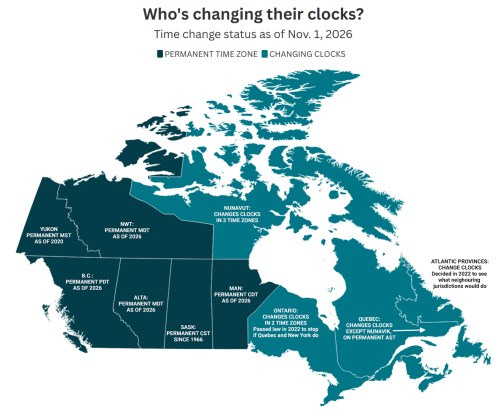
WINNIPEG - Manitoba's government said Thursday the province will be sticking with daylight time year-round, making it the latest jurisdiction to move away from twice-annual time changes. Here's a look at where things stand across Canada:

British Columbia said in March that it was moving to permanent Pacific daylight time. The change also means that parts of northeastern B.C., which have been on mountain standard time year round, are now in alignment with the rest of the province.

Alberta also switched to permanent daylight time this year in what it calls Alberta time. The change means it now has the same time as Saskatchewan year round.

Saskatchewan has been on permanent central standard time since 1966.

Read
Updated: Yesterday at 6:28 AM CDT

Not good bet to shoulder gambling issue alone

Maureen Scurfield 5 minute read 2:01 AM CDT

DEAR MISS LONELYHEARTS: We’re living a lie over at our house, but it’s holding the family together.

I know my husband is deeply into gambling. If it weren’t for my steady job I don’t know where the family would be! I insist on paying all of our bills. I also funnel some major cash off to my sister, in case my husband tries to tap into my accounts somehow when I’m out of the house.

He doesn’t know my passwords, since I keep changing them, but he sometimes shows up behind me when I’m online, like he’s dying to ask something.

I say, “What are you looking at? Stop looking over my shoulder!” Then he makes a lame joke and goes away.