

Olympic success is fleeting for Canadian women, with few options after the cheering
Advertisement
Read this article for free:
or
Already have an account? Log in here »
To continue reading, please subscribe:
Monthly Digital Subscription
$0 for the first 4 weeks*
- Enjoy unlimited reading on winnipegfreepress.com
- Read the E-Edition, our digital replica newspaper
- Access News Break, our award-winning app
- Play interactive puzzles
*No charge for 4 weeks then price increases to the regular rate of $19.00 plus GST every four weeks. Offer available to new and qualified returning subscribers only. Cancel any time.
Monthly Digital Subscription
$4.75/week*
- Enjoy unlimited reading on winnipegfreepress.com
- Read the E-Edition, our digital replica newspaper
- Access News Break, our award-winning app
- Play interactive puzzles
*Billed as $19 plus GST every four weeks. Cancel any time.
To continue reading, please subscribe:
Add Free Press access to your Brandon Sun subscription for only an additional
$1 for the first 4 weeks*
*Your next subscription payment will increase by $1.00 and you will be charged $16.99 plus GST for four weeks. After four weeks, your payment will increase to $23.99 plus GST every four weeks.
Read unlimited articles for free today:
or
Already have an account? Log in here »
Hey there, time traveller!
This article was published 30/01/2022 (1404 days ago), so information in it may no longer be current.
Claire Thompson, like many hockey-loving girls, started playing the game when she was four years old. She was 12 when she watched the Canadian women’s team win gold at the 2010 Vancouver Olympics. And that, she decided, was what she wanted to be a part of someday.
Now, having just turned 24, she’s on her way, named to the Canadian roster for the Beijing Olympics.
For her, there’s been a path to this point. She grew up in Toronto watching high-level women’s hockey — not just every four years at the Olympics, but regularly in the Canadian Women’s Hockey League.
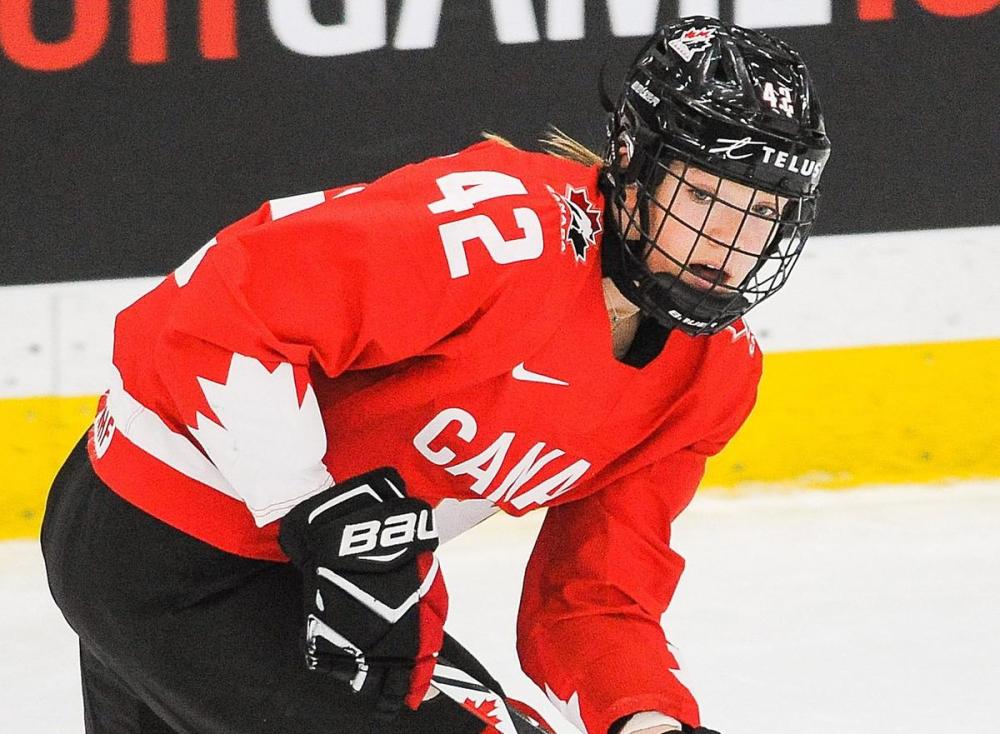
“Growing up, I had the CWHL to look up to,” says Thompson, who was a star at Princeton University until she graduated in 2020. “I remember going to Toronto Furies games with my dad and mom and my two sisters. That was really inspirational.”
Not anymore. The league she grew up watching is gone, which means the next generation of Claires — who might watch February’s Olympic tournament and come away with Olympic dreams of their own — will have a much harder time seeing a path forward.
Canadian women were fêted for their success at the Tokyo Summer Games, and are about to be celebrated once again in Beijing. For the first time in Winter Olympics history, almost half the Canadian athletes — 106 of 215 — will be competing in women’s events. But away from that spotlight, they still have a long way to go to achieve equality in sports in this country.
The shuttering of the CWHL in 2019 — without ever reaching its goal of a living wage to players — also means that after next month’s Olympics are over, Thompson will not come home to a professional domestic league where she can make a living, and keep her skills up for Team Canada’s next call.
That’s why she’s in on the ground floor with Olympic veterans and others trying once again to build up a sustainable, paying professional league for women in this country, this time through the Professional Women’s Hockey Players Association. On Friday, the Seattle Times, citing unnamed sources, reported that the PWHPA hopes to launch a new league in the fall.
(The U.S.-based Premier Hockey Federation, which has a team in Toronto and plans to expand to Montreal, hasn’t offered players a living wage to date.)
Women in hockey are not alone in struggling for a fraction of the opportunities their male counterparts get. Canada won Olympic gold in women’s soccer for the first time in Tokyo, but those players don’t have a domestic pro league, either. Canada is the only country in FIFA’s top 10 without one.
“The infrastructure for women’s sport just does not measure up,” says Allison Sandmeyer-Graves, chief executive of Canadian Women and Sport. “It is so much less for the women’s side relative to the men’s side across many of the major sports, and yet we win medals … That does distort things a little bit for the public, because they assume that if we’re winning medals everything is working right along the pathway to that point.”
Women won 75 per cent of Canada’s 24 medals at the COVID-delayed Tokyo Olympics.
The International Olympic Committee has been touting its success in reducing a long-standing gender gap. The Beijing Games, which open Feb. 4, will be the “most gender-balanced edition of the Olympic Winter Games to date,” with female athletes making up 45 per cent of the total, according to the IOC.
But that number glosses over much of the context that still leaves many female athletes, including Olympians, struggling with less funding and support, fewer opportunities to train and compete, and too few role models at all levels, athletes and advocates say.
The pandemic added to those troubles with women’s competitions — from hockey to ski jumping — cancelled and not rescheduled more often than men’s events.
The big advance for women in Beijing will be an increase to two bobsled events, something the men have long had. But they’re not getting the marquee four-person event. They’re getting monobob, for one athlete, which has led Canadian bobsled pilot Cynthia Appiah to say “women were shortchanged.”
There will be a doubles event in luge for men, but not women. Female ski jumpers will compete on the normal hill, but the large hill is off limits. Nordic combined still has no women’s events. And in biathlon, cross-country skiing and speedskating, women compete over shorter distances than men.
Much of this has to do with the state of international sports federations, which falls outside the IOC’s control. That’s why some athletes say they hope people enjoy the great women’s competition that’s on offer at the Olympics and then press for more, and better support, the rest of time.
“People tune in to us every four years and then kind of forget about us those other three years,” says Natalie Spooner, representing Canada at her third Olympics.
She has a hockey gold medal from Sochi in 2014 and silver from Pyeongchang in 2018. At 31, she’s still optimistic that someday soon she’ll get the opportunity to make a living playing the game she loves in Canada.
“There’s obviously times when you wish it was here sooner,” she says. “You wish you had somewhere to play that was like the guys.”
Watch, cheer, then demand more and better for girls and women at all levels is Sandmeyer-Graves’s advice to Canadian fans.
“We’ve come off one Olympics and we’re heading into another one. There’s such viewership and there’s such excitement for the women’s game, whatever that game might be, particularly when they do well,” she says.

“The Olympics are a really powerful tool to inspire people to take up sports, and keep going in their sport. But there isn’t enough investment and attention in the communities where the girls actually play, or where they’d like to play, to get them going and to keep them going long enough to either be active for life or to hopefully show up on the podium one day.”
When Thompson hits the ice for the Olympic tournament she’ll have personal goals, and a couple for those watching at home.
“I hope they see incredible games. I hope they see how far the game has come in recent years, and since women’s hockey first started in the Olympics,” she says.
“And honestly, I also hope they see Canada win a gold medal.”
Kerry Gillespie is a Toronto-based sports reporter for the Star. Reach her via email: kgillespie@thestar.ca
Related Articles
Olympic athletes have 1 more thing to stress about: weather Olympians worry as 'Winter' disappears from Winter Games





Advertisement Advertise With Us
Advertisement Advertise With Us