

New electric ferries could have given Toronto Island a boost. But someone should pull the plug on these boats
Advertisement
Read this article for free:
or
Already have an account? Log in here »
To continue reading, please subscribe:

Digital Subscription
One year of digital access for only $205*
- Enjoy unlimited reading on winnipegfreepress.com
- Read the E-Edition, our digital replica newspaper
- Access News Break, our award-winning app
- Play interactive puzzles
*First annual payment billed as $205.00 + GST for one year. This annual subscription will automatically renew at $233.00 + GST every 52 weeks (10% off the regular annual price of $259.35). Offer available to new and qualified returning subscribers only. Cancel any time.
To continue reading, please subscribe:
Add Free Press access to your Brandon Sun subscription for only an additional
$1 for the first 4 weeks*
- Enjoy unlimited reading on winnipegfreepress.com
- Read the E-Edition, our digital replica newspaper
- Access News Break, our award-winning app
- Play interactive puzzles
*Your next Brandon Sun subscription payment will increase by $1.00 and you will be charged $17.95 plus GST for four weeks. After four weeks, your payment will increase to $24.95 plus GST every four weeks.
Read unlimited articles for free today:
or
Already have an account? Log in here »
Hey there, time traveller!
This article was published 05/02/2022 (1651 days ago), so information in it may no longer be current.
In winter, the Toronto Island ferry plies through the harbour like a light-duty ice breaker, keeping a channel open from the mainland to the Ward’s Island dock as it goes back and forth. When the harbour does freeze over, at night or otherwise, the William Lyon Mackenzie fireboat, named after Toronto’s first mayor and Rebellion of 1837 leader, will clear the way.
The very old timey but beloved ferries are berthed for the winter, so it’s the Ongiara, the automobile ferry serving Hanlan’s Point in the summer, that runs year around. It isn’t young either, launched from an Owen Sound shipbuilder in 1963. New changes are coming though, but maybe not the right kind of changes.
Visiting the island during winter is a magical thing. There’s barely a lineup for the ferry, just some intrepid winter souls and island residents. Outside, on deck, the sound of the ferry pushing through chunks of ice is like a giant cocktail glass swirling. The skyscrapers pump out steam and the city hums, as if it’s collectively trying to keep warm.
Visiting a few weeks ago, there was a group of winter disc golfers playing the island course. When the ice is smooth, look for the islanders skating: they know when and where the ice is good and safe. There are even heated public washrooms on the island open all year and after dark, something mainland Toronto can’t seem to manage.
Whether skiing, snowshoeing or walking, the island itself is quiet, and the farther away from Ward’s, the fewer people there are. Remarkable in a metropolis of millions of people.
Those millions do come in the summertime though, some 1.4 million of them. All of them come by boat: most by ferry, others by the blessed but more expensive fleet of private water taxis that have made the island much more accessible. Still, it’s an awful lot of people to move on antique ferries.
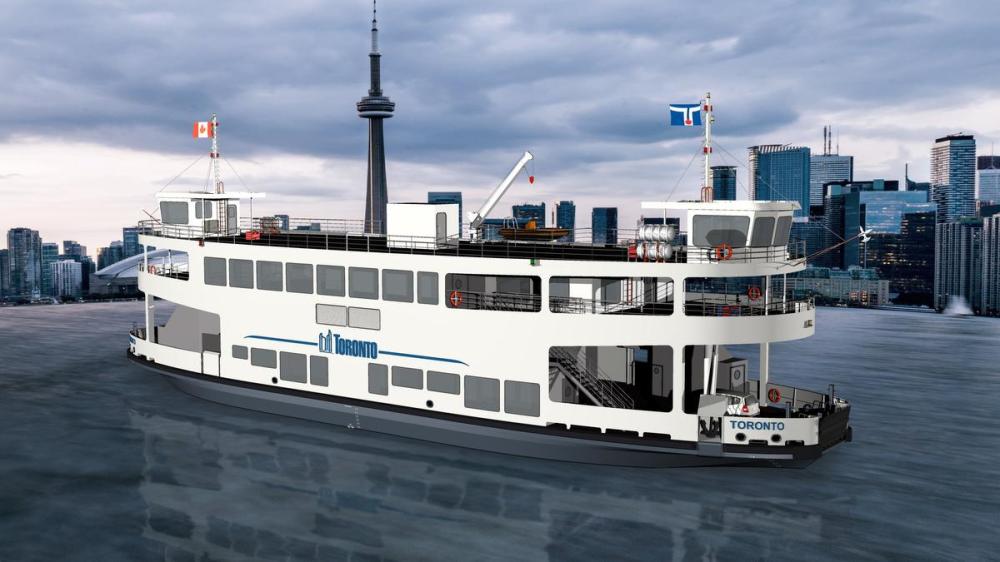
To that end, the city has engaged in an agonizingly slow process of replacing the aged ferries with new, more efficient ones. In January, city officials made a big deal about the procurement of two electric ferries that will go into service in 2024. The electric aspect was touted as contributing to the city’s Transform TO Net Zero strategy, which aims to reduce greenhouse gas emissions to zero by 2040. The purchase will be part of the city council budget debate later this month.
In isolation, electric ferries are good, but as many observers pointed out, this is a city government that chose to rebuild a short section of the carbon-intense Gardiner Expressway for billions of dollars and still has a fleet of diesel-belching buses. But it is a start and that’s good.
What isn’t so great is the design. It looks just like one of the century-old ferries. That will appeal to nostalgia, but anyone who’s taken these ferries to the island regularly knows they aren’t efficient in ways other than just propulsion.
Docking is extraordinarily slow, with the crew required to moor the boats with ropes each time. Even slower are boarding and disembarking. The old boats, as well as the new ones, are pinched at either end, so all the passengers (and the new boats are planned to hold even more) will take a long time to get on and off because of the bottleneck. So, beyond the feel-good electric power, they don’t solve much for getting people to and from the island on ever-busier summer days.
One reason for this pinched shape is the ferry docks themselves, designed to accommodate the old style. In 2015, the city announced the winners of a dock redesign competition, but in classic Toronto low-tax style, there’s no money allocated in the budget to actually rebuild the docks. What was the point of it all?

It’s as if the people in charge don’t see the island as an essential part of city life, governed as we are largely by people with their own backyards and cottages.
There are quick and efficient ferry systems elsewhere that could be a model. Wide-body ferries crisscross Halifax Harbour with multiple side-loading doors and ramps so it isn’t like Noah’s Ark, two by two, when disembarking as in Toronto. They also have an upper deck with great views.
In Amsterdam, ferries cross the IJ River every few minutes, connecting the city, and have wide ramps that allow pedestrians, bikes and scooters quickly on and off. Better yet, the engine holds the ferry in the dock, no ropes required, and the ferry is in and out of the dock extremely quickly. Oh, and they’re free.
By all means keep one of the antiques running, and new ferries could even be antique-looking and electric, but for the love of the island and Torontonians’ easy access to it, we must have ferries that serve more than just nostalgia, they must be very fast and very frequent. A rethink here is needed.
Shawn Micallef is a Toronto-based writer and a freelance contributing columnist for the Star. Follow him on Twitter: @shawnmicallef