Public transit gets $3.7B to woo riders, adopt green fleets

Advertisement

Advertise with us

WASHINGTON (AP) — As cities seek to fully reopen, public transit systems straining to win back riders after being crushed by the COVID-19 pandemic are getting a big funding boost to help stay afloat and invest in new fleets of electric buses.

Read this article for free:


or

Already have an account? Log in here »

To continue reading, please subscribe:

Subscribe and receive a limited-edition Free Press branded hat or tote.

Digital Subscription

One year of digital access for only $205*

  • Enjoy unlimited reading on winnipegfreepress.com
  • Read the E-Edition, our digital replica newspaper
  • Access News Break, our award-winning app
  • Play interactive puzzles

*First annual payment billed as $205.00 + GST for one year. This annual subscription will automatically renew at $233.00 + GST every 52 weeks (10% off the regular annual price of $259.35). Offer available to new and qualified returning subscribers only. Cancel any time.

To continue reading, please subscribe:

Add Free Press access to your Brandon Sun subscription for only an additional

$1 for the first 4 weeks*

  • Enjoy unlimited reading on winnipegfreepress.com
  • Read the E-Edition, our digital replica newspaper
  • Access News Break, our award-winning app
  • Play interactive puzzles
Start now

*Your next Brandon Sun subscription payment will increase by $1.00 and you will be charged $17.95 plus GST for four weeks. After four weeks, your payment will increase to $24.95 plus GST every four weeks.

Hey there, time traveller!
This article was published 07/03/2022 (1665 days ago), so information in it may no longer be current.

WASHINGTON (AP) — As cities seek to fully reopen, public transit systems straining to win back riders after being crushed by the COVID-19 pandemic are getting a big funding boost to help stay afloat and invest in new fleets of electric buses.

The Biden administration said Monday it was awarding $2.2 billion in coronavirus relief money from the American Rescue Plan to 35 financially strapped transit agencies in 18 states. The money would be used to prop up day-to-day operations, including staffing and payroll as well as cleaning and sanitization to limit the spread of illness in public transportation. A federal mask mandate for public transit remains in effect until at least March 18.

Another $1.5 billion in grants will be made available under President Joe Biden’s infrastructure law — a total of $7.5 billion over five years — for transit agencies to purchase low- or no-emission buses made by U.S. workers and to build bus facilities. That’s more than double the combined amount from the previous year.
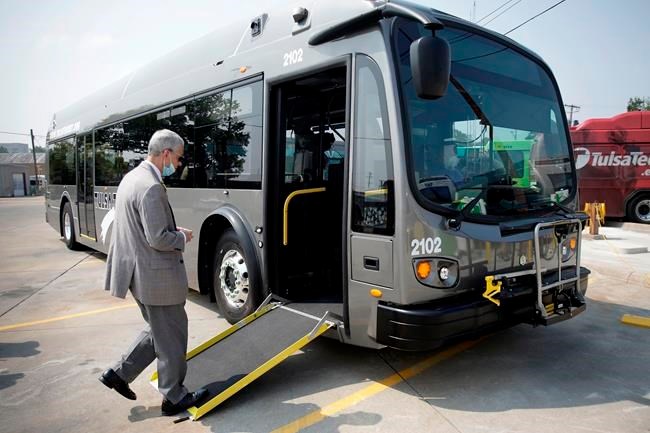
FILE - Tulsa Transit General Manager Ted Rieck boards a new electric bus on Aug. 3, 2021 in Tulsa, Okla. Tulsa Transit has 4 new electric buses in their fleet. Public transit systems straining to win back riders after crushing waves of the COVID-19 pandemic are getting a $3 billion boost to stay afloat and invest in electric buses. It's part of several initiatives being announced by the Biden administration March 7, 2022, to promote green-friendly mass transit as workers begin returning to offices (Mike Simons/Tulsa World via AP, File)

The cash infusion comes as mask requirements and other COVID-19 restrictions are fading in much of the U.S. With many workers beginning a return to offices, the administration is promoting zero-emission transit as families reestablish new commuting routes to work and school.

Transit agencies as well are anxious to boost ridership, which sits at about 55% of pre-pandemic levels. Many, from Washington to Boston to Chicago, have slashed prices or offered free fares to attract suburban commuters and better serve lower-income communities more dependent on public transportation. Others are adjusting bus and subway routes to offer less service during traditional workday rush-hour periods in favor of more trips at other times, such as for people seeking medical care or traveling to sports and entertainment events.

“Our transportation sector has reached a turning point,” said Vice President Kamala Harris, who unveiled Monday’s actions at the White House.

“We can clean our air and protect the health of our children,” she said. “We can connect all of our communities with affordable, accessible and reliable public transportation. We can address the climate crisis and grow our economy at the same time.”

Harris was joined by Transportation Secretary Pete Buttigieg and Environmental Protection Agency Administrator Michael Regan. They also announced proposed pollution regulations for new tractor-trailer rigs that would clean up smoky diesel engines as well as $17 million in funding for school districts to buy electric zero-emission and low-emission school buses. The emissions can cause respiratory problems in humans.

Buttigieg said public transit is a key component to reducing air pollution, describing it as win-win because it is affordable for commuters and also reduces congestion on the roads. Transportation, mostly from car and truck tailpipe emissions, is the biggest U.S. contributor to global warming.

“We’re making the largest ever investment in this program for buses and bus facilities, helping to deliver better commutes and cleaner air to American communities,” Buttigieg said.

Transit agencies will have until May to apply for the grants, which will be awarded by fall. About 5% of the money must be used for workforce training to help transit workers prepare for the technological change.

Transit systems already have begun moving toward electric buses. California has committed to all-electric bus fleets by 2040, as well as New York City and Boston. Washington, D.C., has set a target of 2045.
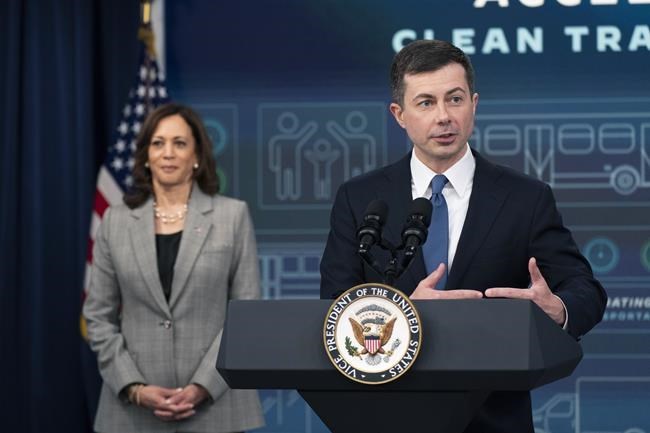
Secretary of Transportation Pete Buttigieg, with Vice President Kamala Harris, speaks, at the Eisenhower Executive Office Building on the White House complex, in Washington, Monday, March 7, 2022. (AP Photo/Manuel Balce Ceneta)

The effort comes at a challenging time for public transit.

Transit agencies say it could take years to return to pre-pandemic ridership levels, if ever, putting operations at risk. The biggest losses have been in commuter rail systems serving white-collar suburbanites traveling to downtown workplaces.

As COVID-19 cases decline, Biden has urged Americans to shed remote work, describing a return to offices as necessary to boost economic growth.

“It’s time for America to get back to work and fill our great downtowns again with people,” Biden said in his State of the Union address.

Among the recipients of COVID-19 relief funds Monday were big-city transit systems. New York City’s Metropolitan Transportation Authority, the nation’s largest, garnered $769 million to steady its operations, and San Francisco’s Bay Area Rapid Transit received $270 million to bolster service and safety protocols.

MTA said it will use the money to offset lost passenger revenue created during the pandemic, when subway ridership plummeted by over 90%. New York City’s subway riders have returned gradually, but ridership is projected to lag behind pre-pandemic levels by 10% to 20% by the end of 2024.

The funds announced Monday pushed the MTA’s total federal aid to $15 billion, which it hopes will stave off having to use deficit financing to close a budget gap that is expected to reach well over $1 billion after 2025 when COVID relief money will have run out.

San Francisco’s BART says its COVID-relief grant will add to $1.3 billion in federal aid it has already, allowing it to extend operations by one year through 2025. Ridership during the work week is about 30% of pre-pandemic levels. But there has been a more noticeable increase on weekends, with about 50% of pre-pandemic passengers now using the transit system, said BART spokeswoman Alicia Trost.
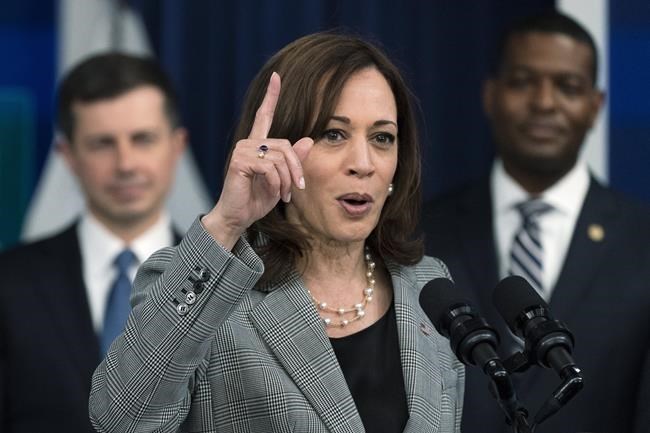
Vice President Kamala Harris with Secretary of Transportation Pete Buttigieg, left, and Administrator of the Environmental Protection Agency Michael Regan, right, announces major federal actions that will expand clean public transit and school buses, reduce emissions from diesel trucks, and create good-paying jobs, at the Eisenhower Executive Office Building on the White House complex, in Washington, Monday, March 7, 2022. (AP Photo/Manuel Balce Ceneta)

Others receiving aid were the Washington, D.C., metro system at $120 million, as it anticipates a return of federal employees to offices, and Houston’s public transit at $137 million, as it has significantly added rapid transit bus lines.

“These funds are crucial to avoid drastic service cuts and layoffs that would damage the economy and public health,” said Nuria Fernandez, head of the Federal Transit Administration, which oversees the grants.

At the start of the pandemic, transit agencies cut payroll and slashed services. That came even as essential workers, who are disproportionately nonwhite and lower income, continued to rely on public transportation to get to work. But three rounds totaling nearly $70 billion in federal COVID-19 emergency assistance, including $30.5 billion that Biden signed into law last year, pulled transit agencies from the brink of financial collapse.

___

Associated Press writers David Porter in New York and Olga Rodriguez in San Francisco contributed to this report.
Report Error Submit a Tip

More Stories

Public transit gets $3.7B to woo riders, adopt green fleets

Hope Yen, The Associated Press 7 minute read Preview

Public transit gets $3.7B to woo riders, adopt green fleets

Hope Yen, The Associated Press 7 minute read Monday, Mar. 7, 2022

WASHINGTON (AP) — As cities seek to fully reopen, public transit systems straining to win back riders after being crushed by the COVID-19 pandemic are getting a big funding boost to help stay afloat and invest in new fleets of electric buses.

The Biden administration said Monday it was awarding $2.2 billion in coronavirus relief money from the American Rescue Plan to 35 financially strapped transit agencies in 18 states. The money would be used to prop up day-to-day operations, including staffing and payroll as well as cleaning and sanitization to limit the spread of illness in public transportation. A federal mask mandate for public transit remains in effect until at least March 18.

Another $1.5 billion in grants will be made available under President Joe Biden’s infrastructure law — a total of $7.5 billion over five years — for transit agencies to purchase low- or no-emission buses made by U.S. workers and to build bus facilities. That’s more than double the combined amount from the previous year.

The cash infusion comes as mask requirements and other COVID-19 restrictions are fading in much of the U.S. With many workers beginning a return to offices, the administration is promoting zero-emission transit as families reestablish new commuting routes to work and school.

Read
Monday, Mar. 7, 2022

Tenants slam Alta.-based landlord, protest rent increases

Scott Billeck 6 minute read Preview

Tenants slam Alta.-based landlord, protest rent increases

Scott Billeck 6 minute read Friday, Sep. 25, 2026

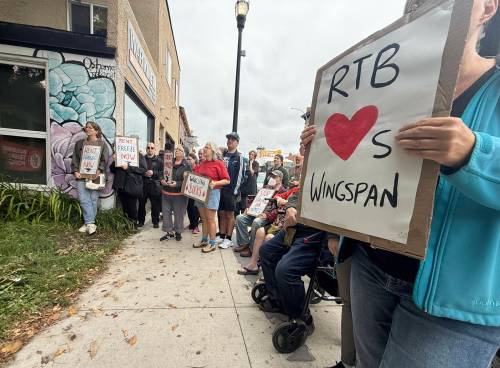
Charlie Medd wasn’t ready for another adventure last October, when she moved out of the Wolseley Avenue apartment she had called home for 15 years.

Medd said life at Lincoln Apartments began to change after Wingspan Properties, an Alberta-based landlord, bought the building, made minor cosmetic changes and increased rent. She felt the changes were intended to push renters — many of them on fixed incomes — out the door.

“At some point, I got scared. I’d been there 15 years,” Medd said about the threat of rent increases. “I’d just painted my whole apartment. But when I heard that there’s going to be that many people homeless, I thought, ‘I’m too old for another adventure.’

“It felt like you were getting a nudge out the door. Like, ‘Yeah, we’re going to be doing this, and your rent is going to go up every year.’”

Read
Friday, Sep. 25, 2026

Jets’ brass warming up to El Nino?

Mike McIntyre 7 minute read Preview

Jets’ brass warming up to El Nino?

Mike McIntyre 7 minute read Friday, Sep. 25, 2026

Decisions, decisions.

The Winnipeg Jets held their final dress rehearsal Friday night before the curtain rises next week on the new NHL season.

Unlike their first three exhibitions, this one in Denver featured competitive lineups that looked an awful lot like what we’ll see when the games start counting, with plenty of star power and veteran presence on both sides.

So what are we to make of the Jets’ 5-2 loss to the mighty Colorado Avalanche, who captured the Presidents’ Trophy last year and are once again a legitimate Stanley Cup contender?

Read
Friday, Sep. 25, 2026

Letters, Sept 26

7 minute read Yesterday at 2:01 AM CDT

Important lessons lostRe: Parents still in charge amid health curriculum overhaul: premier, Sept. 23

The premier’s assurance that parents could continue to “opt-out” their children from health education classes on the premise that specific topics clash with their “personal beliefs” is, at once, disappointing and concerning.

To be blunt, such an approach is Trumpian. It condones “othering.”

The new curriculum content is intended to provide students with factual information that will help keep them safe from myriad physical, emotional and mental harms while also providing opportunities to develop understanding, respect and compassion for their fellow humans.

Today’s horoscope

Georgia Nicols 4 minute read Preview

Today’s horoscope

Georgia Nicols 4 minute read Yesterday at 2:01 AM CDT

MOON ALERT: Avoid shopping (except food and gas) and important decisions from 3 a.m. until 6 a.m. The full moon in Aries peaks at 11:49 p.m.

ARIES (March 21-April 19)

This is a restless day for you because the full moon is in your sign. (This happens once a year and it can create tension between you and those close to you.) Patience is your best ally. Give yourself the freedom to change plans.

TAURUS (April 20-May 20)

Read
Yesterday at 2:01 AM CDT

Signs of local neo-Nazi recruiting efforts spark concern

Conrad Sweatman 7 minute read Preview

Signs of local neo-Nazi recruiting efforts spark concern

Conrad Sweatman 7 minute read Yesterday at 2:00 AM CDT

A far-right canvassing push in Manitoba this month is raising concerns among Winnipeg residents.

Stickers promoting Nationalist-13, a men’s-only neo-Nazi group also known as NS-13 based primarily in Hamilton, Ont., have appeared in Winnipeg and parts of southern Manitoba. The stickers bear national socialist branding and messages such as “White Man, Fight Back” and “White Community, Political Action, Training and Fitness.”

Winnipeg writer Jess Woolford recently encountered an NS-13 poster on Pembina Highway.

“It was appalling,” Woolford said. “It has the Nazi death heads covering people’s faces. It was pretty disturbing to come across this … I just didn’t expect to see it so blatantly displayed in my neighbourhood.”

Read
Yesterday at 2:00 AM CDT