

As Zelenskyy set to speak to Parliament, a look at other leaders who have spoken
Advertisement
Read this article for free:
or
Already have an account? Log in here »
To continue reading, please subscribe:

Digital Subscription
One year of digital access for only $205*
- Enjoy unlimited reading on winnipegfreepress.com
- Read the E-Edition, our digital replica newspaper
- Access News Break, our award-winning app
- Play interactive puzzles
*First annual payment billed as $205.00 + GST for one year. This annual subscription will automatically renew at $233.00 + GST every 52 weeks (10% off the regular annual price of $259.35). Offer available to new and qualified returning subscribers only. Cancel any time.
To continue reading, please subscribe:
Add Free Press access to your Brandon Sun subscription for only an additional
$1 for the first 4 weeks*
- Enjoy unlimited reading on winnipegfreepress.com
- Read the E-Edition, our digital replica newspaper
- Access News Break, our award-winning app
- Play interactive puzzles
*Your next Brandon Sun subscription payment will increase by $1.00 and you will be charged $17.95 plus GST for four weeks. After four weeks, your payment will increase to $24.95 plus GST every four weeks.
Read unlimited articles for free today:
or
Already have an account? Log in here »
Hey there, time traveller!
This article was published 15/03/2022 (1618 days ago), so information in it may no longer be current.
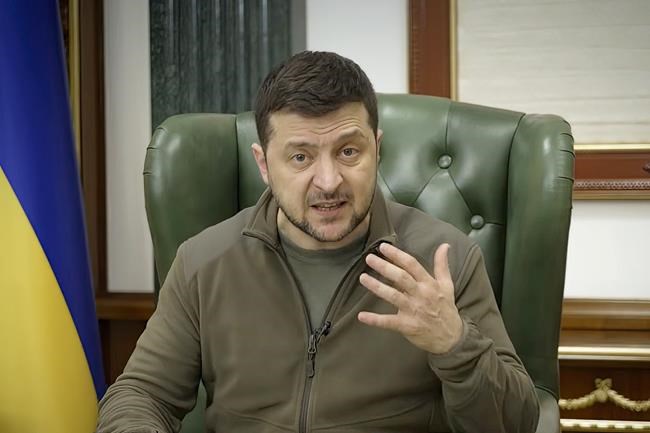
OTTAWA – Ukraine’s President Volodymyr Zelenskyy is scheduled to deliver a virtual address to Canada’s Parliament on Tuesday as his country resists a brutal invasion from Russia.
He is not the first international leader to speak to Parliament, and in fact, he is the third Ukrainian president to address Canadian MPs and senators. In 2008, Viktor Yushchenko received several standing ovations as he spoke about his country’s struggle to assert its sovereignty and its push to join the NATO alliance. In 2014, after Russia annexed the Crimean Peninsula, Petro Poroshenko told Parliament that Ukraine had “crossed the Rubicon” to a new westward-looking future with the signing of a co-operation agreement with the European Union.
Canada has been home to other historic speeches from leaders during times of crisis. United Kingdom prime minister Winston Churchill delivered an electrifying address in the House of Commons in December 1941, just weeks after the attack on Pearl Harbor. He first spoke to the American Congress before arriving in Ottawa, where throngs of people gathered on Parliament Hill to hear his remarks through a loudspeaker. Referencing past comments by a French general who had said that England would have her neck wrung like a chicken, Churchill scoffed, “Some chicken! Some neck!”
And in 1990, Nelson Mandela, then the deputy president of the African National Congress and only recently freed from prison after 27 years, appeared in Parliament where he thanked Canada for supporting the anti-apartheid movement and urged the country not to lift trade sanctions on South Africa. Mandela returned as his country’s president in 1998, when he said there had been a great transformation in South Africa in the past eight years and it is forever indebted to Canada for its help.
Despite Canada’s long history of hosting foreign leaders in Parliament, Zelenskyy will be the first to deliver his address virtually.
Here’s a look at the foreign dignitaries who have delivered joint addresses to Canadian senators and MPs:
Dec. 30, 1941: Winston Churchill, prime minister, United Kingdom
June 16, 1943: Madame Chiang Kai-shek, spouse of the leader of the Republic of China
June 1, 1944: John C. Curtin, prime minister, Australia
June 30, 1944: Peter Fraser, prime minister, New Zealand
Nov. 19, 1945: Clement R. Attlee, prime minister, United Kingdom
June 11, 1947: Harry S. Truman, president, United States
Oct. 24, 1949: Pandit Jewaharlal Nehru, prime minister, India
May 31, 1950: Liaquat Ali Khan, prime minister, Pakistan
April 5, 1951: Vincent Auriol, president, French Republic
Nov. 14, 1953: Dwight D. Eisenhower, president, United States
Feb. 6, 1956: Sir Anthony Eden, prime minister, United Kingdom
March 5, 1956: Giovanni Gronchi, president, Republic of Italy
June 5, 1956: Achmed Sukarno, president, Republic of Indonesia
March 4, 1957: Guy Mollet, prime minister, French Republic
June 2, 1958: Theodor Heuss, president, Federal Republic of Germany
June 13, 1958: Harold Macmillan, prime minister, United Kingdom
July 9, 1958: Dwight D. Eisenhower, president, United States
July 21, 1958: Kwame Nkrumah, prime minister, Ghana
May 17, 1961: John F. Kennedy, president, United States
May 26, 1964: U Thant, secretary-general, United Nations
April 14, 1972: Richard M. Nixon, president, United States
March 30, 1973: Luis Echeverria, president, Mexico
June 19, 1973: Indira Gandhi, prime minister, India
May 5, 1980: Masayoshi Ohira, prime minister, Japan
May 26, 1980: José Lopez Portillo, president, Mexico
March 11, 1981: Ronald W. Reagan, president, United States
Sept. 26, 1983: Margaret Thatcher, prime minister, United Kingdom
Jan. 17, 1984: Zhao Ziyang, premier, State Council, People’s Republic of China
May 8, 1984: Miguel de la Madrid, president, Mexico
March 7, 1985: Javier Perez de Cuellar, secretary-general, United Nations
Jan. 13, 1986: Yasuhiro Nakasone, prime minister, Japan
April 6, 1987: Ronald W. Reagan, president, United States
May 25, 1987: François Mitterand, president, French Republic
May 10, 1988: Queen Beatrix of the Netherlands
June 16, 1988: Helmut Kohl, chancellor, Federal Republic of Germany
June 22, 1988: Margaret Thatcher, prime minister, United Kingdom
Feb. 27, 1989: Chaim Herzog, president, State of Israel
Oct. 11, 1989: King Hussein Bin Talal of Jordan
June 18, 1990: Nelson Mandela, deputy president, African National Congress
April 8, 1991: Carlos Salinas de Gortari, president, Mexico
June 19, 1992: Boris Yeltsin, president, Federation of Russia
Feb. 23, 1995: William J. Clinton, president, United States
June 11, 1996: Ernesto Zedillo, president, Mexico
Sept. 24, 1998: Nelson Mandela, president, Republic of South Africa
April 29, 1999: Vaclav Havel, president, Czech Republic
Feb. 22, 2001: Tony Blair, prime minister, United Kingdom
March 9, 2004: Kofi Annan, secretary-general, United Nations
Oct. 25, 2004: Vicente Fox Quesada, president, Mexico
May 18, 2006: John Howard, prime minister, Australia
Sept. 22, 2006: Hamid Karzaï, president, Islamic Republic of Afghanistan
May 26, 2008: Viktor Yushchenko, president, Ukraine
May 27, 2010: Felipe Calderón, president, Mexico
Sept. 22, 2011: David Cameron, prime minister, United Kingdom
Feb. 27, 2014: The Aga Khan, imam of the Shia Imami Ismaili Muslims
Sept. 17, 2014: Petro Poroshenko, president, Ukraine
Nov. 3, 2014: François Hollande, president, French Republic
June 29, 2016: Barack H. Obama, president, United States
April 12, 2017: Malala Yousafzai, recipient of the Nobel Peace Prize
This report by The Canadian Press was first published March 15, 2022.