The Big Sneeze: Climate change to make pollen season nastier

Advertisement

Advertise with us

Climate change has already made allergy season longer and pollen counts higher, but you ain’t sneezed nothing yet.

Read this article for free:


or

Already have an account? Log in here »

To continue reading, please subscribe:

Subscribe and receive a limited-edition Free Press branded hat or tote.

Digital Subscription

One year of digital access for only $205*

  • Enjoy unlimited reading on winnipegfreepress.com
  • Read the E-Edition, our digital replica newspaper
  • Access News Break, our award-winning app
  • Play interactive puzzles

*First annual payment billed as $205.00 + GST for one year. This annual subscription will automatically renew at $233.00 + GST every 52 weeks (10% off the regular annual price of $259.35). Offer available to new and qualified returning subscribers only. Cancel any time.

To continue reading, please subscribe:

Add Free Press access to your Brandon Sun subscription for only an additional

$1 for the first 4 weeks*

  • Enjoy unlimited reading on winnipegfreepress.com
  • Read the E-Edition, our digital replica newspaper
  • Access News Break, our award-winning app
  • Play interactive puzzles
Start now

*Your next Brandon Sun subscription payment will increase by $1.00 and you will be charged $17.95 plus GST for four weeks. After four weeks, your payment will increase to $24.95 plus GST every four weeks.

Hey there, time traveller!
This article was published 15/03/2022 (1649 days ago), so information in it may no longer be current.

Climate change has already made allergy season longer and pollen counts higher, but you ain’t sneezed nothing yet.

Climate scientists at the University of Michigan looked at 15 different plant pollens in the United States and used computer simulations to calculate how much worse allergy season will likely get by the year 2100. It’s enough to make allergy sufferers even more red-eyed.

As the world warms, allergy season will start weeks earlier and end many days later — and it’ll be worse while it lasts, with pollen levels that could as much as triple in some places, according to a new study Tuesday in the journal Nature Communications.
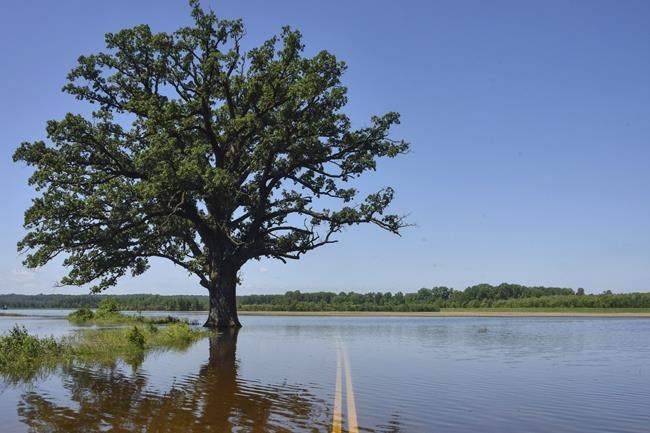
FILE - Floodwaters surround a bur oak tree southwest of Columbia, Mo., on Wednesday, June 5, 2019. A study published Tuesday, March 15, 2022, in the journal Nature Communications details how warmer temperatures and extra carbon dioxide in the air will make pollen season even more of a bother than it is now. (Kate Seaman/Missourian via AP, File)

Warmer weather allows plants to start blooming earlier and keeps them blooming later. Meanwhile, additional carbon dioxide in the air from burning fuels such as coal, gasoline and natural gas helps plants produce more pollen, said study co-author Allison Steiner, a University of Michigan climate scientist.

It’s already happening. A study a year ago from different researchers found that from 1990 to 2018, pollen has increased and allergy season is starting earlier, with much of it because of climate change.

Allergists say that pollen season in the U.S. used to start around St. Patrick’s Day and now often starts around Valentine’s Day.

The new study found that allergy season would stretch even longer and the total amount of pollen would skyrocket. How long and how much depends on the particular pollen, the location and how much greenhouse gas emissions are put in the air.

With moderate cuts in greenhouse gas emission from coal, oil and natural gas, pollen season would start 20 days earlier by the end of the century. In the most extreme and increasingly unlikely warming scenario, pollen season in much of America will start 40 days earlier than when it has generally started in recent decades.

Already about 30% of the world and 40% of American children suffer pollen allergies, which hurt the economy through lost work days and medical costs, said University of Michigan climate researcher Yingxiao Zhang, lead author of the new study.

Allergies are especially difficult for the 25 million Americans with asthma. This could make the problem much worse for them, said Amir Sapkota, a University of Maryland environmental health professor, who wasn’t part of the research.

While allergy suffering will increase across the United States, the Southeast will get hit hardest, said Steiner.

The start of alder tree pollen season will move most dramatically, an issue in the Pacific Northwest. Cypress tree pollen — which is especially bad in Texas — will see among the biggest increases.

Ragweed and grasses — common pollen allergies — will also have longer seasons and higher pollen counts in the future, Zhang said.

The University of Michigan team’s projections projects would be about twice as large a jump in pollen problems as has happened since 1990, said University of Utah biologist and climate scientist Bill Anderegg.

“Overall, this is an incredibly important study,” said Anderegg, who wasn’t involved in the new research. “It tells us that the historical trends of longer and more severe pollen seasons are likely to continue, driven by climate change, and this will absolutely have substantial health consequences in allergies and asthma for Americans.”

___

Read stories on climate issues by The Associated Press at https://apnews.com/hub/climate

___

Follow Seth Borenstein on Twitter at @borenbears.

___

The Associated Press Health and Science Department receives support from the Howard Hughes Medical Institute’s Department of Science Education. The AP is solely responsible for all content.

Report Error Submit a Tip

More Stories

A Winnipeg lawyer has been disbarred after admitting to six counts of professional misconduct and two counts of providing incompetent service involving eight clients.

The career-ending decision marks the sixth time Gisele Champagne has been disciplined by the Law Society of Manitoba since she was called to the bar in 1992.

“Disbarment is the appropriate remedy when a lawyer has demonstrated a repeated pattern of conduct that violates professional standards,” a law society panel said in a written decision released Wednesday.

“A lawyer who has been unable to learn from past discipline proceedings to fulfill his or her obligation to provide ethical and high-quality legal services must at some point lose the privilege of practising law.”

Not good bet to shoulder gambling issue alone

Maureen Scurfield 5 minute read 2:01 AM CDT

DEAR MISS LONELYHEARTS: We’re living a lie over at our house, but it’s holding the family together.

I know my husband is deeply into gambling. If it weren’t for my steady job I don’t know where the family would be! I insist on paying all of our bills. I also funnel some major cash off to my sister, in case my husband tries to tap into my accounts somehow when I’m out of the house.

He doesn’t know my passwords, since I keep changing them, but he sometimes shows up behind me when I’m online, like he’s dying to ask something.

I say, “What are you looking at? Stop looking over my shoulder!” Then he makes a lame joke and goes away.

Jets GM insists club’s not working under any deadline in netminder’s trade request

Mike McIntyre 7 minute read Preview

Jets GM insists club’s not working under any deadline in netminder’s trade request

Mike McIntyre 7 minute read Thursday, Sep. 17, 2026

Connor Hellebuyck and his family were subject to so much post-Olympic vitriol that both the Winnipeg Jets security team and even police had to get involved.

Read
Thursday, Sep. 17, 2026

Jets vets weigh in on franchise goalie Hellebuyck not reporting to training camp

Mike McIntyre 7 minute read Preview

Jets vets weigh in on franchise goalie Hellebuyck not reporting to training camp

Mike McIntyre 7 minute read Thursday, Sep. 17, 2026

Hockey is the ultimate team sport, where it’s supposed to be about the crest on your chest rather than the name on your back.

So how is Connor Hellebuyck’s trade request and subsequent training camp strike playing out inside the Winnipeg Jets locker room — particularly among other core players he’s gone to battle with over the years?

“Obviously the news is heartbreaking,” Jets forward Kyle Connor said Thursday.

“It feels like we had such a special group here and for whatever reason — I can’t speak to the reason until we hear from the man, I’m not going to speculate on what it is but I know that a lot of guys in that room that are heartbroken.”

Read
Thursday, Sep. 17, 2026

United Way, other charities fight for dollars as donor base shrinks

Scott Billeck 7 minute read Preview

United Way, other charities fight for dollars as donor base shrinks

Scott Billeck 7 minute read Yesterday at 2:00 AM CDT

Winnipeg’s charitable sector is being squeezed from both sides: demand for help is growing while the pool of donors to meet that need is shrinking.

The imbalance is increasingly being carried by a relatively small group of deep-pocketed donors. Last year, 600 people — about three per cent of United Way Winnipeg’s individual donors — accounted for roughly $8 million, or 55 per cent of individual donations.

The fundraising pitch isn’t getting any easier.

Homelessness and public drug use have become increasingly visible, household budgets remain strained and the problems charities are trying to address can seem so entrenched that donors may reasonably wonder what difference another contribution can make.

Read
Yesterday at 2:00 AM CDT

Give-and-take relationship of Roman leaders takes centre stage in Harris’s historical fiction

Reviewed by Kathryne Cardwell 4 minute read Preview

Give-and-take relationship of Roman leaders takes centre stage in Harris’s historical fiction

Reviewed by Kathryne Cardwell 4 minute read 2:01 AM CDT

British novelist Robert Harris’s latest work is a reflection on tyranny, corruption and betrayal among all-powerful political leaders.

You might be forgiven for thinking it’s a contemporary thriller — it’s actually historical fiction set in ancient Rome.

A former BBC journalist, Harris debuted as a novelist in 1992 with Fatherland, an alternative history where Nazi Germany won the Second World War.

Since then, the prolific author has become best-known for his works of historical fiction, especially his ancient Rome trilogy released from 2006-2015 and the novel Conclave, which was published in 2016 and was made into the film of the same name in 2024.

Read
2:01 AM CDT