Nourishing self-image
Lockdowns, social-media pressures amplify impacts of disordered eating, lack of body acceptance

Advertisement
Read this article for free:
or
Already have an account? Log in here »
To continue reading, please subscribe:

Digital Subscription
One year of digital access for only $205*
- Enjoy unlimited reading on winnipegfreepress.com
- Read the E-Edition, our digital replica newspaper
- Access News Break, our award-winning app
- Play interactive puzzles
*First annual payment billed as $205.00 + GST for one year. This annual subscription will automatically renew at $233.00 + GST every 52 weeks (10% off the regular annual price of $259.35). Offer available to new and qualified returning subscribers only. Cancel any time.
To continue reading, please subscribe:
Add Free Press access to your Brandon Sun subscription for only an additional
$1 for the first 4 weeks*
- Enjoy unlimited reading on winnipegfreepress.com
- Read the E-Edition, our digital replica newspaper
- Access News Break, our award-winning app
- Play interactive puzzles
*Your next Brandon Sun subscription payment will increase by $1.00 and you will be charged $17.95 plus GST for four weeks. After four weeks, your payment will increase to $24.95 plus GST every four weeks.
Read unlimited articles for free today:
or
Already have an account? Log in here »
Hey there, time traveller!
This article was published 21/03/2022 (1668 days ago), so information in it may no longer be current.
Given the mental-health issues teenagers face every day, it should come as no surprise that the pandemic has elevated their stressors to new levels.
Pandemic lockdowns have led to substantial changes for young people, such as disruptions to eating, physical activity and social patterns, which can be risk factors for developing an eating disorder.
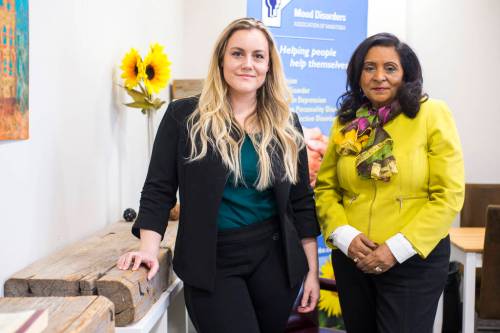
The Mood Disorders Association of Manitoba (MDAM) wanted to know more, so they piloted a disordered-eating program last spring.

“(The program) started off with a heavy disordered-eating focus but then we really tried to incorporate body image, diet culture, stereotypes, beauty, all of those things — because there’s so many other components to it,” says Andrea Smith, facilitator of the Disordered Eating and Body Image Workshop at MDAM.
Since the program’s inception, MDAM has run three six-week women’s workshops — one in-person and two virtually. All of MDAM’s women’s programming, including the new workshop, is supported by Shoppers Drug Mart.
They’re also launching a disordered-eating workshop specifically aimed at youth aged 12-21 at the end of the month, with more dates coming up in May.
“(In the program), we define the difference between eating disorders and disordered eating. We also discuss nutrition and nourishing your body — as opposed to dieting, which has a very low success rate,” says Smith. “We focus on mindful movement instead of exercise and we have a diet culture component, where we define what diet culture is, beauty standards and stereotypes.”
MDAM says disordered eating, obsessive dieting, low self-esteem and diagnosable eating disorders are all part of a mental-health space that doesn’t have provincial support to sustain the growing demands of the community.
“Our own research indicates there were long waiting lists for programs for eating disorders,” says Rita Chahal, executive director at MDAM. “After speaking with other women’s health providers, we felt this program would be helpful pre- and post-treatment.”
Smith agrees that the demand is high.
“What (the program) started off as was a soft place for people waiting for treatment. And then it blew up into something that’s more preventative. Eating disorders are clinical and we’re not clinical. We (offer support) and talk about disordered eating.”– Andrea Smith, facilitator of the Disordered Eating and Body Image Workshop at MDAM
“What (the program) started off as was a soft place for people waiting for treatment. And then it blew up into something that’s more preventative,” says Smith. “Eating disorders are clinical and we’re not clinical. We (offer support) and talk about disordered eating.”
The need has always been greater than the resources available, says Lori Peters, a counsellor with the Provincial Eating Disorder Prevention and Recovery Program at the Women’s Health Clinic in Winnipeg.
“In the first year of the pandemic, we had a 30 per cent increase in calls for service and that trend has continued throughout the second year of the pandemic,” she says. “Our wait list has almost doubled.”
Pre-pandemic, the wait time for the Women’s Health Clinic program was between six and 12 months. Today, it has increased to 18 to 24 months. On the positive side, Peters says their program received provincial funding last fall, which will directly address those wait times.
“(The funding) has given us a few more staff members so we are going to be able to address some of those needs. But again, it doesn’t meet all of them. Eating disorders need increased funding across the board,” she says.
A silver lining, Peters says, is that the pandemic has allowed the Women’s Health Clinic to move its program to a virtual platform, something it plans to maintain in the future.
“Now, all Manitobans who have access to technology can access our entire program. We can help people remotely in all areas of the province, which is great.”
Eating disorders, such as anorexia nervosa, binge-eating and bulimia nervosa, have very specific diagnostic criteria, often evidenced by extreme concerns related to eating behaviours, body weight and body image. An eating disorder can happen to anyone, regardless of gender, age or background.
According to Statistics Canada, the leading cause of premature death in Canada is mental illness and, of this population, eating disorders have the highest overall mortality rate.
Disordered eating is not an eating disorder per se — it’s an umbrella term that includes disordered relationships with food, exercise and one’s body. These irregular behaviour patterns may or may not warrant a diagnosis. If not treated, it can lead to eating disorders, but not every person with a disordered eating pattern will develop a clinical eating disorder.
“A lot of people don’t know what disordered eating is. It’s any behaviour around food and body image– it’s like severe body dysmorphia — that will result in you changing the way that you eat.” — Andrea Smith
“A lot of people don’t know what disordered eating is. It’s any behaviour around food and body image — it’s like severe body dysmorphia — that will result in you changing the way that you eat,” says Smith. “Skipping breakfast in the hopes of losing weight is a form of disordered eating.”
The MDAM disordered-eating workshops also discuss ways to work on body image.
“We give everyone tools on how to work on self-love and change your mindset,” she says. “We focus on real health and not just ‘I need to lose weight because society values thinner bodies,’” Smith says.
A recent study found that cases of anorexia among children and adolescents increased in Canada during the first wave of the pandemic.

The study, published in the Journal of the American Medical Association, found that the number of newly diagnosed anorexia nervosa or atypical anorexia nervosa for Canadians aged nine to 18 increased 60 per cent over pre-pandemic levels. They jumped from 24.5 per month to 40.6 cases per month between March and November 2020.
The major difference between the two disorders is that people with atypical anorexia don’t experience the dramatic and sudden weight loss associated with anorexia nervosa.
Smith, who was a fitness model for more than a decade, has a history with disordered eating, going back to high school and her years in the fitness industry.
“I was living in Los Angeles and in the top 10 in the world for bikini modelling. Every year, I would just get worse and worse with my disordered eating and I didn’t realize it because it was so normal in that industry,” she says. “I was so celebrated because I was what society wanted me to be looks-wise.”
In 2014, she was on the cover of a magazine and recalls how she felt when she first saw it.
“I was the sickest I had ever been, as far as disordered eating goes, and I remember looking at the cover and thinking, ‘wow, I actually look sick. I look sad,’” she says. “I thought that having a perfect body would make me happy and it made me miserable.”
Smith left the industry and met her husband a year later. They now have two children and Smith has formed a healthy relationship with her body. In addition to her work at MDAM, she’s completing her studies in psychology at the University of Manitoba.
“I might be 30 pounds heavier than I was when I was 21 but I can confidently say I love myself so much more.”– Andrea Smith
“I might be 30 pounds heavier than I was when I was 21 but I can confidently say I love myself so much more.”
Smith says social media has played a large role in the way children and adolescents perceive themselves, especially with increased screen time during the pandemic.
“Tik Tok, things like that. As an adult, I compare myself to people on social media — I think we all do. Kids obviously do that, too. They’re comparing themselves and their bodies to all these people on social media. I think that has contributed,” she says.
To reach a younger demographic, MDAM also conducts presentations about disordered eating to schools across the city, talking to kids as young as six years old.
“(We discuss) how to move your body, how to nourish your body and to eat as many colours as you can. And we do affirmations together — we’ll say ‘I am beautiful. I am kind.’ That’s what we do with the Grade 1 students. And then it just gets more detailed as we increase in the grades,” Smith says.
Smith says the students are actively engaged in the material, including boys and younger men.

“Because of toxic masculinity, it’s hard for (boys) to reach out about this issue. But when we’re having discussions and we ask what the ideal man looks like, they answer with Superman and the Marvel comic guys who take steroids and do all these things to look like that,” she says. “There’s so many things that guys are going through, too. But they can’t talk about it.”
As important as it is to inform and support young kids, self-love is just as imperative for parents and caregivers.
“We all get our inner voices from our parents when it comes to our bodies. We do our best as parents and we try to instil self-love in our kids, but we need to do it with ourselves, too” she says. “It’s just as important for parents and teachers to be aware of constantly equating dieting with health. That’s just false.”
sabrinacarnevale@gmail.com
@SabrinaCsays
Sabrina Carnevale is a freelance writer and communications specialist, and former reporter and broadcaster who is a health enthusiast. She writes a twice-monthly column focusing on wellness and fitness.
Our newsroom depends on a growing audience of readers to power our journalism. If you are not a paid reader, please consider becoming a subscriber.
Our newsroom depends on its audience of readers to power our journalism. Thank you for your support.
Sabrina Carnevale is a freelance writer and communications specialist, and former reporter and broadcaster who is a health enthusiast. She writes a twice-monthly column focusing on wellness and fitness.
Our newsroom depends on a growing audience of readers to power our journalism. If you are not a paid reader, please consider becoming a subscriber.
Our newsroom depends on its audience of readers to power our journalism. Thank you for your support.
Advertisement Advertise With Us
Advertisement Advertise With Us