Ukrainian, Russian refugee dancers find help in Berlin

Advertisement

Advertise with us

BERLIN (AP) — Dancers who have fled Ukraine — and Russia — due to the war have found a new temporary home in Berlin's top ballet company, which helps with practice space, housing, and even shoes.

Read this article for free:


or

Already have an account? Log in here »

To continue reading, please subscribe:

Subscribe and receive a limited-edition Free Press branded hat or tote.

Digital Subscription

One year of digital access for only $205*

  • Enjoy unlimited reading on winnipegfreepress.com
  • Read the E-Edition, our digital replica newspaper
  • Access News Break, our award-winning app
  • Play interactive puzzles

*First annual payment billed as $205.00 + GST for one year. This annual subscription will automatically renew at $233.00 + GST every 52 weeks (10% off the regular annual price of $259.35). Offer available to new and qualified returning subscribers only. Cancel any time.

To continue reading, please subscribe:

Add Free Press access to your Brandon Sun subscription for only an additional

$1 for the first 4 weeks*

  • Enjoy unlimited reading on winnipegfreepress.com
  • Read the E-Edition, our digital replica newspaper
  • Access News Break, our award-winning app
  • Play interactive puzzles
Start now

*Your next Brandon Sun subscription payment will increase by $1.00 and you will be charged $17.95 plus GST for four weeks. After four weeks, your payment will increase to $24.95 plus GST every four weeks.

Hey there, time traveller!
This article was published 23/03/2022 (1635 days ago), so information in it may no longer be current.

BERLIN (AP) — Dancers who have fled Ukraine — and Russia — due to the war have found a new temporary home in Berlin’s top ballet company, which helps with practice space, housing, and even shoes.

About 200 dancers in all, including many who are considering fleeing to Germany, have turned for assistance to the capital’s famous State Ballet.

Christiane Theobald, the company’s acting artistic director, said Wednesday that it is crucial for those refugees to keep up their regular practice, even if they don’t have any public performances right now.
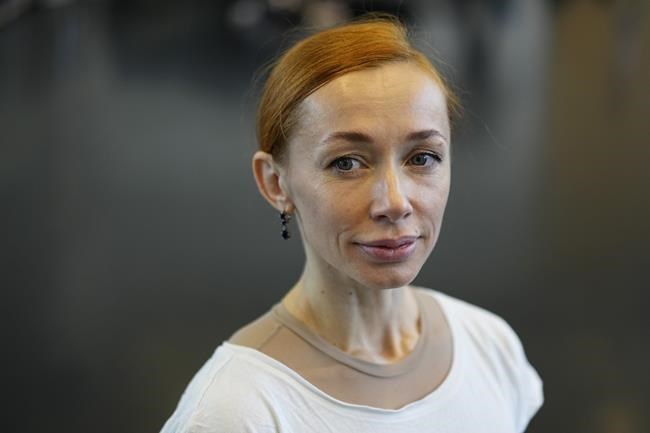
State Ballet's principal dancer Iana Salenko poses during an interview at the State Ballet in Berlin, Germany, Wednesday, March 23, 2022. About 200 dancers from Ukraine and Russia have recently requested help from Berlin’s famous State Ballet after having fled or considering to run away to Germany. Salenko, who is from Ukraine herself but came to Germany in 2005, has also been trying to help with the new arrivals. (AP Photo)

“The important thing is that the daily training can be completed, because training is like brushing your teeth,” she told The Associated Press. “And the tragedy is that if you have phases where you can’t do that at all, then you can never make up for it.”

At the same time, Theobald said she’s been contacting other company directors across Europe to see if she can help find the uprooted dancers new jobs.

“What we need now, of course, are positions in ensembles, and those who are coming … are mainly classically, highly classically trained dancers,” Theobald said.

While there are about 70 dance ensembles in Germany, not all of them are so exclusively focused on classical dance like most of the companies in eastern Europe, but often practice modern dance too. So it will take adaptation by the new dancers to study and get used to the different, western European styles.

On Wednesday morning, more than 30 dancers were practicing their moves at a workout room in Berlin — among them eight refugees, including two Brazilian dancers who had fled from Russia recently.

Many arrive in Berlin without anything and are now getting lots of practical help from the Berlin ensemble — anything from dance shoes to housing.

“You have to imagine, these are people who have left everything behind, they have very little with them. That starts with the pointed shoes,” Theobald said.

Because the situation is so dynamic, with many dancers reaching Berlin and then some quickly moving on to other destinations, the company said it was difficult to say how many exactly had received help already.

Those escaping Ukraine include people from all over the world who used to dance at ballet companies there. Those from Russia no longer want to be exposed to President Vladimir Putin’s increasingly oppressive regime.

State Ballet’s principal dancer Iana Salenko, who is from Ukraine herself but came to Germany in 2005, has also been helping the new arrivals. Through her personal network, she’s been trying to get them auditions at ballet companies across Europe, but also has shown them opportunities in other fields of employment such as the opera.

“Of course, it’s not me alone — many other principals in Europe are trying to help this group,” the 38-year-old said.

More than 3.5 million people have been flooding into Europe escaping the war, and almost everywhere they’ve been welcomed by an outpouring of help and solidarity.

Germany has registered almost 240,000 Ukrainian refugees, although the real numbers are expected to be much higher since they don’t need a visa to enter the country and federal police only keep records of refugees arriving by train or bus. Those entering from Poland by car usually are not registered.

Salenko, the principal dancer, has also been sharing the refugees’ worries about their families back home in the war. While she and her mother are safe in Berlin, she worries about her father and brothers back in Ukraine and talks to them on a daily basis — just like the dancers who recently fled to Berlin.

Theobald said even though there were dancers from many different nations practicing together in Berlin, including Ukrainians and Russians, there were no tensions within the ensemble as a result of the war.

Salenko, too, stressed that the war did not manage to divide the dancers but instead drew them together as they try to maneuver the horrible situation.

“This situation, I find that it’s made us move closer, more together,” she said.

___

Kirsten Grieshaber in Berlin contributed.

___

Follow the AP’s coverage of the war at https://apnews.com/hub/russia-ukraine

Report Error Submit a Tip

More Stories

Bombers exact revenge in Banjo Bowl, lose Collaros to injury

Taylor Allen 6 minute read Preview

Bombers exact revenge in Banjo Bowl, lose Collaros to injury

Taylor Allen 6 minute read Yesterday at 9:20 PM CDT

Redha Kramdi downplayed the significance of his return for the Winnipeg Blue Bombers.

“I don’t think I have that big of an impact,” said Kramdi on Tuesday, who watched the club go 2-4 while he was sidelined with a cast on his left hand.

It sounded silly at the time, and it’s even sillier now considering how exceptional the 29-year-old safety from Montreal was in Saturday’s 22nd edition of the Banjo Bowl.

Kramdi caused two turnovers — a forced fumble and an interception — to lead the Bombers to a 19-6 victory over the Saskatchewan Roughriders in front of a sell-out crowd at Princess Auto Stadium.

Read
Yesterday at 9:20 PM CDT

Citizen reports help highlight connectivity issues across southwest Manitoba

Nicole Buffie 5 minute read Preview

Citizen reports help highlight connectivity issues across southwest Manitoba

Nicole Buffie 5 minute read Updated: Yesterday at 10:43 AM CDT

A southwestern Manitoba man has created a map to document cell service blackout spots in an effort to push for better access in rural areas.

Mark Custance compiled more than 300 citizen reports over the last few months to document where service in southwest Manitoba is strong, spotty or doesn’t exist at all.

“I’ve heard people complain and say, ‘cell service sucks’ or ‘this is not working.’ But what does the data actually say?” Custance said from his office in Melita, where he has installed a cell-service booster to maintain connectivity with the rest of the world.

Analyzing where service is good and poor, he cross-references it with the location of cellphone towers across the region.

Read
Updated: Yesterday at 10:43 AM CDT

Injuries reported after police pursuit on Broadway

Free Press staff 2 minute read Preview

Injuries reported after police pursuit on Broadway

Free Press staff 2 minute read Friday, Sep. 11, 2026

Winnipeg police are investigating a “serious incident” in which people were injured following a police pursuit near Broadway and Young Street Friday afternoon.

Police said the scene would remain secured as officers investigate. No details about the number or severity of injuries were released.

Broadway was closed between Furby and Young streets until further notice and motorists were asked to avoid the area.

Shaelyn Desmarais McLeod, whose car sustained minor damage, said she witnessed the end of the police pursuit.

Read
Friday, Sep. 11, 2026

Downtown no place to be after dark, huge majority of Winnipeggers say in survey

Joyanne Pursaga 8 minute read Preview

Downtown no place to be after dark, huge majority of Winnipeggers say in survey

Joyanne Pursaga 8 minute read Friday, Sep. 11, 2026

Most Winnipeggers are afraid to walk alone downtown and believe the city needs more police officers, a new survey finds.

Winnipeg Police Service released its 2026 citizen survey Friday.

Downtown safety appears to remain a major concern, with just 44 per cent saying they feel very or reasonably safe walking alone in the area during the day. The number plummets to eight per cent overall at night, down from nine per cent in 2024, the last time the survey was conducted.

This year, 14 per cent of men felt very or reasonably safe walking alone downtown at night, compared to just three per cent of women.

Read
Friday, Sep. 11, 2026

The port of Churchill — but done right

Editorial 4 minute read Preview

The port of Churchill — but done right

Editorial 4 minute read Yesterday at 2:00 AM CDT

The seagoing grain carrier wasn’t christened with a champagne bottle. There was no confetti or streamers. Nevertheless, the Aug. 31 event marking the first shipment of grain to be loaded at the Port of Churchill since 2020 was celebrated like the launch of a brand new vessel.

The presence of the federal minister of northern and arctic affairs, provincial cabinet ministers and leaders and elders from several northern First Nations signalled that the fast-tracked process of refurbishing and buffing up Manitoba’s deep-water seaport gem is gaining momentum.

For OneNorth, the partnership of 29 First Nations and 12 northern communities which owns the Port of Churchill and the Hudson Bay Railway (both operated by the Arctic Gateway Group) the event heralded a new beginning. It’s been eight years since OneNorth purchased the port and railroad, and six years since grain was moved by rail through Manitoba and then by ship to European markets. Two more grain shipments, plus shipments of potash and critical minerals, will continue through the fall.

When Prime Minister Mark Carney solicited the premiers to suggest “nation-building” projects following his election in 2025, Premier Wab Kinew pitched a Manitoba trade corridor that would move wheat, critical minerals, potash and energy (oil or liquid natural gas) through the Port of Churchill.

Read
Yesterday at 2:00 AM CDT

Highway-safety upgrades in progress after tragic Interlake crash

Chris Kitching 5 minute read Preview

Highway-safety upgrades in progress after tragic Interlake crash

Chris Kitching 5 minute read Friday, Sep. 11, 2026

Provincial workers have started to update or install safety measures at a rural Interlake intersection where four teenage friends died in a crash on Labour Day weekend.

Pavement markings were repainted at Highway 8 and Provincial Road 229, just west of Winnipeg Beach, ahead of work to refresh worn-down rumble strips, starting Monday, and install flashing lights atop two stop signs, following an assessment earlier this week.

“They will also need to incorporate any information from the RCMP report that might be helpful if we were to consider any additional safety measures at this intersection,” Transportation and Infrastructure Minister Lisa Naylor said of department staff.

“The most important thing is safety, and any kinds of changes we make at any intersection actually have to make it safer.”

Read
Friday, Sep. 11, 2026