Downtown no place to be after dark, huge majority of Winnipeggers say in survey
Read this article for free:
or
Already have an account? Log in here »
To continue reading, please subscribe:

Digital Subscription
One year of digital access for only $205*
- Enjoy unlimited reading on winnipegfreepress.com
- Read the E-Edition, our digital replica newspaper
- Access News Break, our award-winning app
- Play interactive puzzles
*First annual payment billed as $205.00 + GST for one year. This annual subscription will automatically renew at $233.00 + GST every 52 weeks (10% off the regular annual price of $259.35). Offer available to new and qualified returning subscribers only. Cancel any time.
To continue reading, please subscribe:
Add Free Press access to your Brandon Sun subscription for only an additional
$1 for the first 4 weeks*
- Enjoy unlimited reading on winnipegfreepress.com
- Read the E-Edition, our digital replica newspaper
- Access News Break, our award-winning app
- Play interactive puzzles
*Your next Brandon Sun subscription payment will increase by $1.00 and you will be charged $17.95 plus GST for four weeks. After four weeks, your payment will increase to $24.95 plus GST every four weeks.
Read unlimited articles for free today:
or
Already have an account? Log in here »
Most Winnipeggers are afraid to walk alone downtown and believe the city needs more police officers, a new survey finds.
Winnipeg Police Service released its 2026 citizen survey Friday.
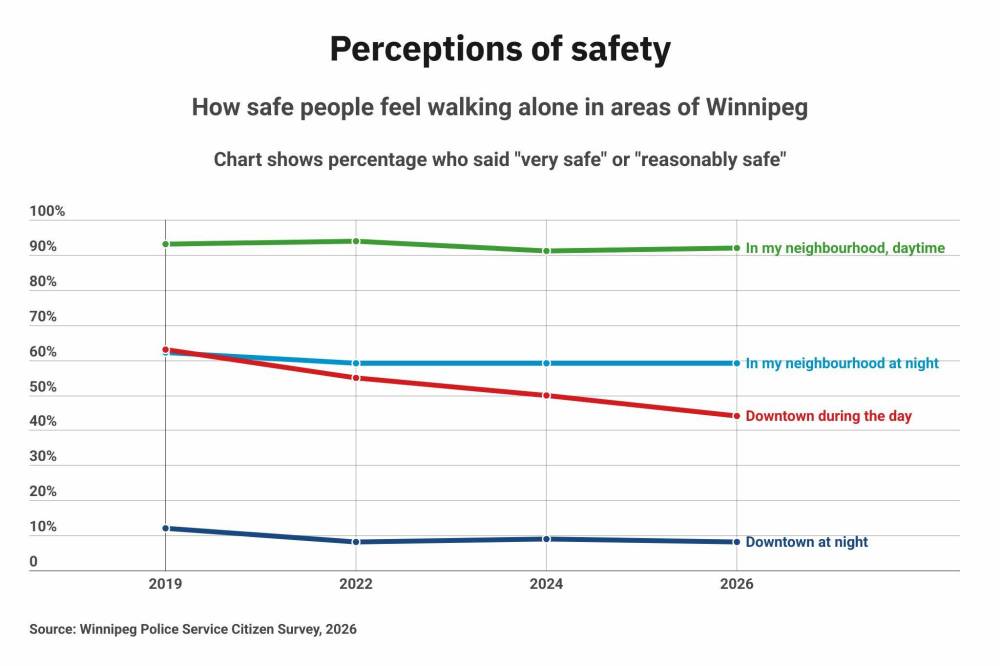
Downtown safety appears to remain a major concern, with just 44 per cent saying they feel very or reasonably safe walking alone in the area during the day. The number plummets to eight per cent overall at night, down from nine per cent in 2024, the last time the survey was conducted.
This year, 14 per cent of men felt very or reasonably safe walking alone downtown at night, compared to just three per cent of women.
MIKAELA MACKENZIE / FREE PRESS FILES WPS Chief Gene Bowers
WPS Chief Gene Bowers said the survey shows there’s more work to do to build confidence in the area.
“Overall crime downtown (year-to-date is) down 10 per cent, violent crime is down 19 per cent downtown,” Bowers said. “Those are significant numbers…. Hopefully, the perception will change and people will feel safer.”
Police foot patrols are frequent in the city centre, and the Downtown Community Safety Partnership and Downtown Winnipeg BIZ also provide a visible security presence, all of which must continue, he said.
“By no means, is (this) a victory per se, but… I think I feel we’re moving in the right direction, and I think our members are working hard,” he said.
“I think I feel we’re moving in the right direction, and I think our members are working hard.”
Despite the data, most Winnipeggers (58 per cent) believe crime has increased over the past year, but the number shows an improvement from 72 per cent who felt that way in 2024.
“I think (people are) seeing more of us,” Bowers said. “I think that we’re being more responsive to calls for service, so I think a lot of that is hitting home for people.”
Meanwhile, 93 per cent of those surveyed said a quick response to calls for service is a very or extremely important aspect of policing, though just 44 per cent rated WPS as excellent or good in that regard (up from 39 per cent in 2024).
Bowers said police are making strides in reducing that wait; detectives and members of other specialized units are helping answer calls, rather than leaving that task to general patrol officers to handle alone.
“There’s a lot of work being done as far as attending to that queue. It just shouldn’t be on the (general patrol) members. It’s a service-wide initiative and I think we’re seeing some change there,” he said.
Body-worn cameras ‘huge win’
Winnipeg Police Service says a pilot project that equipped 40 front-line officers with body-worn cameras has seen success in its first three months, gathering important evidence.
Winnipeg Police Service says a pilot project that equipped 40 front-line officers with body-worn cameras has seen success in its first three months, gathering important evidence.
George Labossière, WPS deputy chief of operations, said the six-month pilot project is going smoothly, with 3,923 separate incidents recorded and a total of 6,263 video files.
“(This) has a significant impact on evidence that will be available in court. This is a huge win for all parties involved,” Labossière told members of the Winnipeg Police Board Friday.
He said WPS has not received a complaint about the program since it began in June.
Labossière said the quantity of video files indicates police will need to devote more staff to assess and review footage when all officers have the cameras.
“What we’re getting back in return… is transparency, accountability (and) court-related evidence that we otherwise would not be able to obtain,” he said.
A police citizen survey, which was also released Friday, indicates there is public support for the project. It found 97 per cent of the people surveyed somewhat or strongly support having all officers wear the cameras if the pilot project “shows clear benefits.”
And 96 per cent strongly or somewhat agreed the cameras improve police accountability.
This was the first year residents were asked about the technology in the WPS survey.
The pilot project ends Dec. 31. Police expect to create a report on adding the technology permanently early in the new year.
— Joyanne Pursaga
Fifty-seven per cent of those surveyed said Winnipeg has too few police officers, while 28 per cent thought the number was about right, four per cent said there are too many and 11 per cent had no opinion.
Bowers said his past request for the city to fund more officers stands, as the WPS officer-to-population ratio is “quite low” compared to other cities.
“We would like another two cruiser cars, which is 36 members…. I’d like to see that number, of course, move up, because the city has grown,” he said.
Drug use was deemed an extremely or very serious neighbourhood problem by 30 per cent of those surveyed, while 32 per cent expressed the same level of concern about vandalism, graffiti or other deliberate damage to property or vehicles.
MIKAELA MACKENZIE / FREE PRESS FILES Results from the citizen survey show downtown safety appears to remain a major concern, with just 44 per cent saying they feel very or reasonably safe walking alone in the area during the day.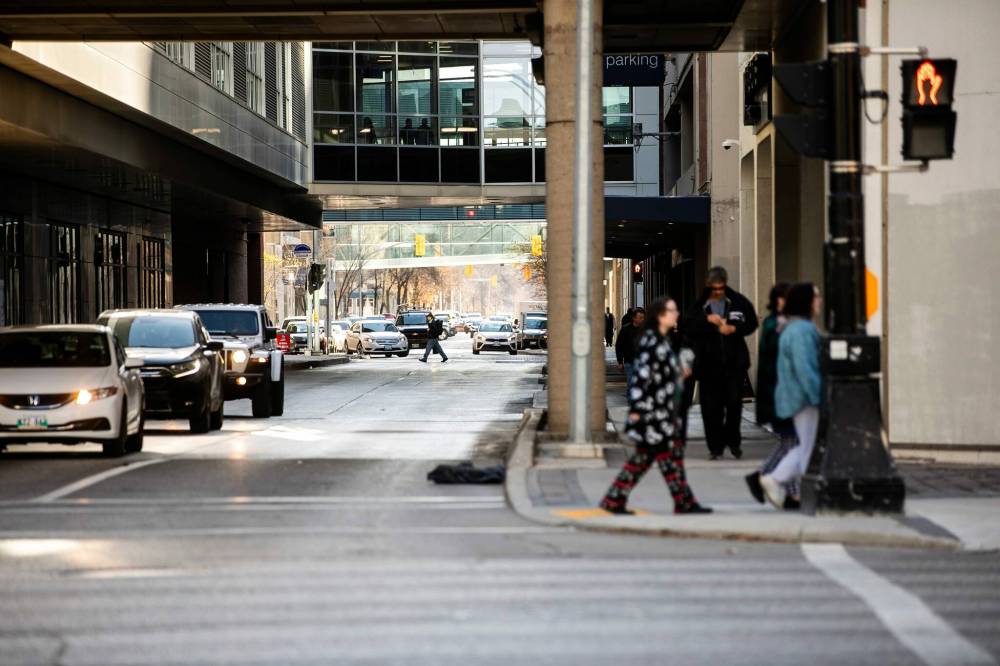
Overall, the perception of police improved slightly over the 2024 poll. This year, 56 per cent of respondents rated the service as excellent or good, up from 54 per cent two years earlier.
A total of 600 Winnipeg adults took part in the survey, which was conducted by Prairie Research Associates. They were interviewed by phone between July 23 and Aug. 14, via both landlines and cellphone numbers. The survey used quotas to ensure a representative sample by age, gender and region.
The margin for error is plus or minus four per cent, 19 times out of 20.
— With files from Erik Pindera
joyanne.pursaga@freepress.mb.ca
X: @joyanne_pursaga
Mixed reviews on downtown
Winnipeggers who were downtown Friday had mixed responses when asked about security and safety in the area.
“In the daytime, I can say it’s 90 per cent safe,” Tsehaie Gmariam said as he was walking down Portage Avenue in the afternoon.
“At the night time, it depends. If you are talking about this one,” he said, pointing to Portage Avenue. “Because I live around here, I’ll try to be fair. At night, it’s like 50 per cent (safe).”
The 65-year-old, who has lived downtown since 1993, said the city has to address the root problems of social strife, such as addiction and poverty, the make the area safer.
“We have to help them,” he said about people in need, saying what’s needed is “tough love.”
“There’s people with knives and stuff,” said Komal Sran, a student at the University of Winnipeg Collegiate, who said she doesn’t feel safe downtown.
Sran said she is not surprised a survey found many Winnipeggers don’t feel secure in the area.
“I was walking to Starbucks after school and there were people (urinating) on the ground,” Sran said, giving an example of why she doesn’t feel safe.
She said more support for those who are living on streets might help improve safety in the area, alongside more security.
Her schoolmate, Arjun Gill, agrees, saying there’s got to be support for people who have nowhere to go or suffer from addictions.
Walking down Portage Avenue on Friday, Queen Kelly, who lives in Osborne Village, said she never feels unsafe downtown and is in the area on pretty much a daily basis. 
Queen Kelly, who lives in Osborne Village, but walks downtown every day, said she never feels unsafe.
“It’s my first time to hear that, because I usually feel safe in the downtown,” she said when asked about the survey results.
Kelly said while she understands some people may feel unsafe at night, especially if drugs are being used in the open, the area has changed.
“Nowadays, on Portage Avenue, it’s different,” Kelly said.
Mandi Caine, 32, said downtown is not a scary spot.
“It’s home. I live downtown,” she said. “There’s more vehicles, more people around, so if anything is going down, nobody is going to want to be doing anything wrong.”
She said the majority of time she spends downtown is at night, and at times, the area gets a bad rap.
“If they don’t like it, they should just stay home,” she said.
For some who were just passing through, such as Michael Pfaffenger from Munich, Germany, Winnipeg’s downtown feels safe.
“There’s not as many weird creatures as in other cities in Canada,” he said. “I think it’s pretty safe compared to other cities we’ve visited, especially downtown.”
— Morgan Modjeski

Joyanne is city hall reporter for the Winnipeg Free Press. A reporter since 2004, she began covering politics exclusively in 2012, writing on city hall and the Manitoba Legislature for the Winnipeg Sun before joining the Free Press in early 2020. Read more about Joyanne.
Every piece of reporting Joyanne produces is reviewed by an editing team before it is posted online or published in print — part of the Free Press‘s tradition, since 1872, of producing reliable independent journalism. Read more about Free Press’s history and mandate, and learn how our newsroom operates.
Our newsroom depends on a growing audience of readers to power our journalism. If you are not a paid reader, please consider becoming a subscriber.
Our newsroom depends on its audience of readers to power our journalism. Thank you for your support.
History
Updated on Friday, September 11, 2026 5:12 PM CDT: Updates with final version
Updated on Friday, September 11, 2026 7:22 PM CDT: Adds comments from people on the street.