

Automated ticketing good for city coffers, report shows

Advertisement
Read this article for free:
or
Already have an account? Log in here »
To continue reading, please subscribe:
Digital Subscription
One year of digital access for only $1.44 a week*
- Enjoy unlimited reading on winnipegfreepress.com
- Read the E-Edition, our digital replica newspaper
- Access News Break, our award-winning app
- Play interactive puzzles
*Billed as $5.77 plus GST every four weeks. After 52 weeks, price increases to the regular rate of $19.95 plus GST every four weeks. Offer available to new and qualified returning subscribers only. Cancel any time.
To continue reading, please subscribe:
Add Free Press access to your Brandon Sun subscription for only an additional
$1 for the first 4 weeks*
- Enjoy unlimited reading on winnipegfreepress.com
- Read the E-Edition, our digital replica newspaper
- Access News Break, our award-winning app
- Play interactive puzzles
*Your next Brandon Sun subscription payment will increase by $1.00 and you will be charged $17.95 plus GST for four weeks. After four weeks, your payment will increase to $24.95 plus GST every four weeks.
Read unlimited articles for free today:
or
Already have an account? Log in here »
Hey there, time traveller!
This article was published 01/04/2022 (1663 days ago), so information in it may no longer be current.
Automated ticketing has helped the City of Winnipeg speed up and spread out its enforcement of residential parking bans linked to snow clearing.
It has also resulted in more $200 tickets being issued.
The city first used automated licence plate recognition to enforce this type of parking ban between Dec. 30, 2021 and Jan. 2, 2022, which made checking each area for scofflaws much quicker, the Winnipeg Parking Authority says.
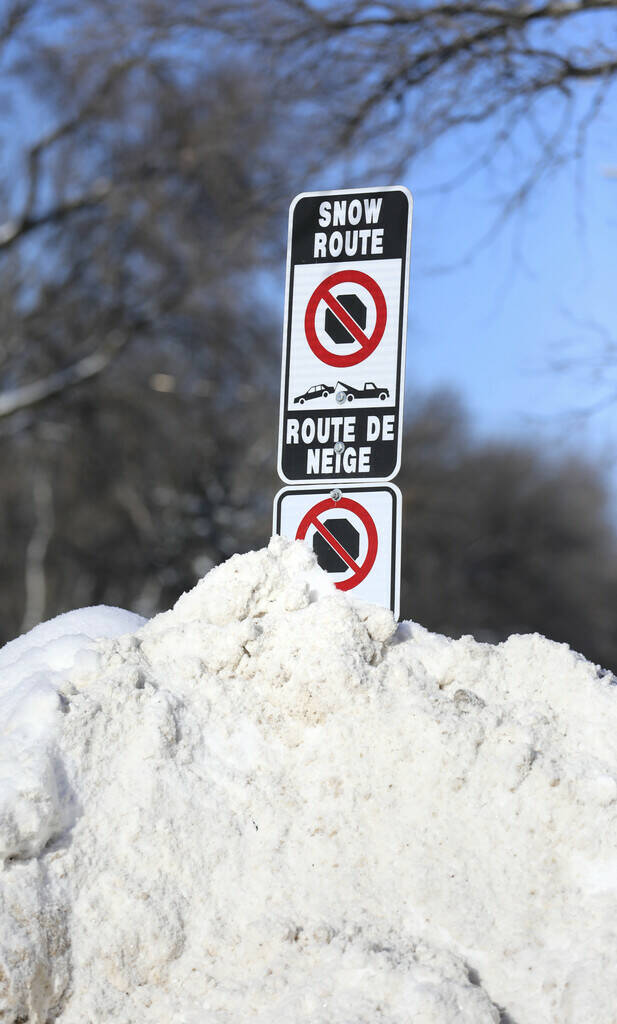
“It allows enforcement officers to generate penalty notices automatically and serve them by mail, rather than following a multi-step process of producing the penalty notice manually and serving it onto a vehicle,” writes Randy Topolniski, the authority’s general manager, in the city report.
To dole out tickets the traditional way, parking officers had to leave their cars, photograph the licence plate of each vehicle, then write up a penalty notice and place it on the vehicle.
Automated licence plate recognition uses a vehicle-mounted camera system and GPS to record each offence automatically, so tickets can be mailed out to the registered owner instead.
During the first ban, when the new system was added to manual ticketing, officers completed enforcement on 79 per cent of affected streets, up from 18 per cent during a ban in November that relied solely on manual enforcement, Topolniski wrote.
“It makes things happen faster. The (enforcement) person doesn’t have to sit in the car, write the ticket, put it on the car, get back in the car. So it allows them to accelerate (ticketing for) violations,” said Coun. Janice Lukes.
While the broader enforcement increases the risk of receiving a penalty notice in your mailbox, Lukes said the ramped-up enforcement is good news and supports her recent calls to crackdown on rule-breakers.
“If people are violating the rules of the road, then they need obviously to be notified of that,” she said. “Our (city is) growing denser and denser and we need to make sure that our roadways are open and accessible for emergency vehicles (and snow plows) and not plugged up and used as parking lots.”
The automated ticketing option will reduce the risk of confrontations.
While the system has only been used for three residential parking bans so far, initial ticket numbers for each ban are on the rise. City data shows 2,475 tickets were given out during a November 2021 residential parking ban, before the new technology was added. Once the automated system was added to manual enforcement, 2,907 tickets were issued during a December parking ban. The number rose to 3,738 during a January ban and 4,116 during one in February.

However, the city report predicts driver compliance with parking bans will increase due to the broader enforcement, which could reduce the need to ticket and/or tow vehicles.
The city now uses licence plate technology to enforce most parking and stopping restrictions.
Lukes said municipal officials could also explore if the technology can be used to track bylaw offences, such as when residents improperly drain their sump pumps onto neighbouring properties, streets or boulevards, instead of their own yards.
The city has 15 vehicles equipped with automated licence plate recognition systems but doesn’t have a budget set aside to buy more, so manual enforcement will also continue, said city spokesperson Adam Campbell, in an emailed statement.
About 50 per cent of parking penalties are expected to be handled through automated enforcement by the end of this year.
A breakdown of the Dec. 30, 2021 to Jan. 2, 2022 parking ban enforcement notes the number of tickets issued and tows completed varies widely by ward.
Lukes said some neighbourhoods have far fewer garages than others, which makes residents more likely to require street parking and more likely to get ticketed.
She said the city is exploring options to help people find alternative parking spots during residential parking bans, such as by letting them park on roads that have been plowed.


During the December ban, 2,907 tickets were issued and 13,664 vehicles were towed.
Campbell said more vehicles are towed than ticketed, since moving the vehicles can immediately clear a route for snow plows.
“In some cases, vehicles may need to be towed to allow plows to pass before enforcement officers have had an opportunity to visit a street (when they have not been ticketed yet),” wrote Campbell.
Joyanne.pursaga@freepress.mb.ca
Twitter: @joyanne_pursaga
Joyanne is city hall reporter for the Winnipeg Free Press. A reporter since 2004, she began covering politics exclusively in 2012, writing on city hall and the Manitoba Legislature for the Winnipeg Sun before joining the Free Press in early 2020. Read more about Joyanne.
Every piece of reporting Joyanne produces is reviewed by an editing team before it is posted online or published in print — part of the Free Press‘s tradition, since 1872, of producing reliable independent journalism. Read more about Free Press’s history and mandate, and learn how our newsroom operates.
Our newsroom depends on a growing audience of readers to power our journalism. If you are not a paid reader, please consider becoming a subscriber.
Our newsroom depends on its audience of readers to power our journalism. Thank you for your support.
Joyanne is city hall reporter for the Winnipeg Free Press. A reporter since 2004, she began covering politics exclusively in 2012, writing on city hall and the Manitoba Legislature for the Winnipeg Sun before joining the Free Press in early 2020. Read more about Joyanne.
Every piece of reporting Joyanne produces is reviewed by an editing team before it is posted online or published in print — part of the Free Press‘s tradition, since 1872, of producing reliable independent journalism. Read more about Free Press’s history and mandate, and learn how our newsroom operates.
Our newsroom depends on a growing audience of readers to power our journalism. If you are not a paid reader, please consider becoming a subscriber.
Our newsroom depends on its audience of readers to power our journalism. Thank you for your support.
Advertisement Advertise With Us
Advertisement Advertise With Us