Feds try to avoid Australian pitfalls in online news bill
Advertisement
Read this article for free:
or
Already have an account? Log in here »
To continue reading, please subscribe:

Digital Subscription
One year of digital access for only $205*
- Enjoy unlimited reading on winnipegfreepress.com
- Read the E-Edition, our digital replica newspaper
- Access News Break, our award-winning app
- Play interactive puzzles
*First annual payment billed as $205.00 + GST for one year. This annual subscription will automatically renew at $233.00 + GST every 52 weeks (10% off the regular annual price of $259.35). Offer available to new and qualified returning subscribers only. Cancel any time.
To continue reading, please subscribe:
Add Free Press access to your Brandon Sun subscription for only an additional
$1 for the first 4 weeks*
- Enjoy unlimited reading on winnipegfreepress.com
- Read the E-Edition, our digital replica newspaper
- Access News Break, our award-winning app
- Play interactive puzzles
*Your next Brandon Sun subscription payment will increase by $1.00 and you will be charged $17.95 plus GST for four weeks. After four weeks, your payment will increase to $24.95 plus GST every four weeks.
Read unlimited articles for free today:
or
Already have an account? Log in here »
Hey there, time traveller!
This article was published 06/04/2022 (1651 days ago), so information in it may no longer be current.
OTTAWA – The Canadian government says it has learned from Australia’s experience when it comes to requiring online giants to pay news outlets to use their journalism, and has framed its bill to avoid the country’s pitfalls.
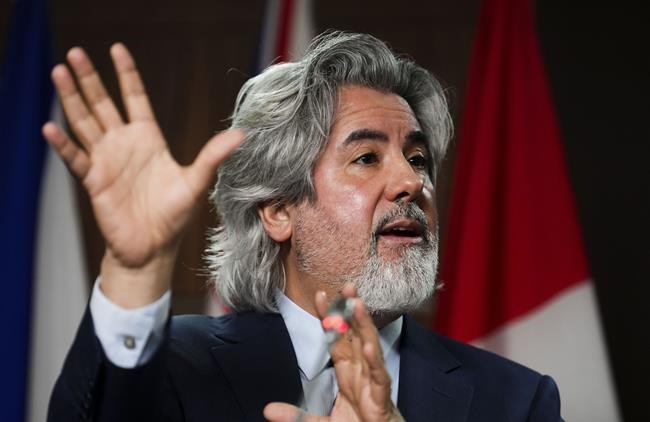
Heritage Minister Pablo Rodriguez on Tuesday introduced a bill modelled on an Australian law making digital platforms such as Google pay Canadian media outlets for reusing their journalism.
Digital giants will have six months to negotiate private deals to compensate Canadian media outlets or be forced to reach an agreement, under the terms of the bill.
The tech giants could face fines of up to $15 million a day if they fail to comply.
Australia’s law prompted a fierce backlash last year, including from Facebook, which protested by blocking news on its platform across Australia.
The social media platform lifted the ban on Australians viewing and sharing news after striking a deal with the country’s government.
One official in Rodriguez’s Heritage Department, who spoke on condition of anonymity to discuss matters not public, said the government has studied the Australian bill and has spoken repeatedly to Australian officials.
The Heritage official said that, though using Australia’s law as a model, the government is taking a more hands-off approach with Bill C-18, as it is known in Parliament.
Canada’s bill, government officials say, will give less power to ministers than in Australia, with more decisions handed to an independent regulator, the Canadian Radio-television and Telecommunications Commission.
They say Canada’s bill makes it clear digital companies will have the freedom to strike private deals with papers and other media outlets, which must fulfil set criteria.
The Canadian bill also defines terms more clearly — such as what kind of platforms and news outlets the law will apply to — to leave less space for ambiguity and make the system more transparent than in Australia, the Heritage official said.
But experts say Canada’s bill is more heavy-handed in some respects and will make platforms also pay for audiovisual news content, unlike in Australia.
Michael Geist, the University of Ottawa’s Canada Research Chair in internet and e-commerce law, predicts Meta, which owns Facebook and Instagram, and Google will fiercely resist efforts to make them pay for links to news sites posted on their platforms.
He suggested that if a price tag is attached to internet links, the online companies could demand that news platforms compensate them for posting links to their journalism — not the other way around.
“The bill is requiring mandatory payments for links, but links should not be compensable at all,” he said. “This hurts the dissemination of information in Canada.”
Geist said the bill creates an incentive for news organizations to post more and more links on Facebook because they could get more compensation for doing so.
He said it could also give digital giants power over the way media organizations spend their money.
The Canadian bill says a portion of compensation should be used to support the production of local, regional and national news, as well as Indigenous and racialized content. Geist said platforms could insist a set proportion of funds back these objectives.
Meta and Google said they are still reviewing the bill and declined to comment.
Meta said Tuesday links to news articles and previews make up only four per cent of what people see on their Facebook feed, and that the company has committed $18 million in the last seven years to programs and partnerships with media in Canada.
Launching the bill, Rodriguez said it will bolster Canada’s news industry which is at risk with 451 news outlets closing their doors since 2008.
At least one-third of Canadian journalism jobs have disappeared since 2010, he added.
Meanwhile, billions of advertising dollars have migrated from traditional news sources to tech platforms.
Online advertising revenue reached $9.7 billion in 2020 with Google and Facebook taking 80 per cent, the Heritage Department said.
The bill will also enhance media organizations’ bargaining power and address a market imbalance. It will permit news organizations, big and small, to team up to bargain collectively with digital giants for compensation.
If they cannot reach a deal within six months, the tech platforms would be forced into mediation with news outlets and, if that doesn’t work, then binding arbitration.
The bill has been welcomed by News Media Canada, which represents more than 500 print and digital titles across Canada, saying it “levels the playing field and gives Canada’s news publishers a fair shot and doesn’t require additional taxpayer funds.”
“This approach has been a shining success in Australia, where publishers large and small are inking meaningful content licensing agreements,” said Jamie Irving, chair of News Media Canada, on Tuesday.
“Trusted information is needed more today than ever before, and real news reported by real journalists costs real money.”
This report by The Canadian Press was first published April 6, 2022.
———
Meta funds a fellowship that supports journalism positions at The Canadian Press.