Protect the body: Ukraine volunteers craft armor, camouflage

Advertisement

Advertise with us

ZAPORIZHZHIA, Ukraine (AP) — Sparks fly as a circular saw slices into metal, while welders nearby work feverishly to the sound of blaring heavy metal. Upstairs, sewing machines clatter as women mark patterns on cloth being shaped into bulletproof vests.

Read this article for free:


or

Already have an account? Log in here »

To continue reading, please subscribe:

Subscribe and receive a limited-edition Free Press branded hat or tote.

Digital Subscription

One year of digital access for only $205*

  • Enjoy unlimited reading on winnipegfreepress.com
  • Read the E-Edition, our digital replica newspaper
  • Access News Break, our award-winning app
  • Play interactive puzzles

*First annual payment billed as $205.00 + GST for one year. This annual subscription will automatically renew at $233.00 + GST every 52 weeks (10% off the regular annual price of $259.35). Offer available to new and qualified returning subscribers only. Cancel any time.

To continue reading, please subscribe:

Add Free Press access to your Brandon Sun subscription for only an additional

$1 for the first 4 weeks*

  • Enjoy unlimited reading on winnipegfreepress.com
  • Read the E-Edition, our digital replica newspaper
  • Access News Break, our award-winning app
  • Play interactive puzzles
Start now

*Your next Brandon Sun subscription payment will increase by $1.00 and you will be charged $17.95 plus GST for four weeks. After four weeks, your payment will increase to $24.95 plus GST every four weeks.

Hey there, time traveller!
This article was published 08/05/2022 (1616 days ago), so information in it may no longer be current.

ZAPORIZHZHIA, Ukraine (AP) — Sparks fly as a circular saw slices into metal, while welders nearby work feverishly to the sound of blaring heavy metal. Upstairs, sewing machines clatter as women mark patterns on cloth being shaped into bulletproof vests.

An old industrial complex in the southeastern Ukrainian riverside city of Zaporizhzhia has become a hive of activity for volunteers producing everything from body armor and anti-tank obstacles to camouflage nets, portable heating stoves and rifle slings for Ukrainian soldiers fighting Russia’s invasion. One section specializes in vehicles, armor-plating some, converting others into ambulances. Another organizes food and medical deliveries.

With the front line about 50 kilometers (30 miles) from the city, some sections of the operation, such as the stitching of bulletproof vests, are working around the clock in shifts to meet demand. Crowdfunding has brought in enough money to buy steel from Sweden, Finland and Belgium, which is lighter than local steel, organizers say, a crucial quality for body armor.
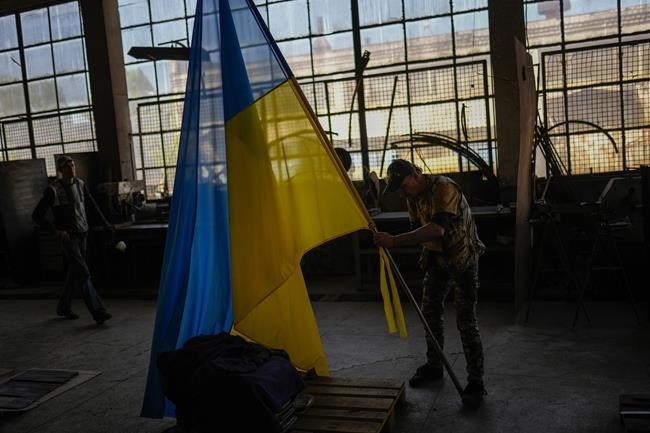
A volunteer places a Ukraine flag on a metal bar at a facility producing material for Ukrainian soldiers in Zaporizhzhia, Ukraine, Friday, May 6, 2022. An old industrial complex in the southeastern Ukrainian riverside city of Zaporizhzhia has become a hive of activity for volunteers producing everything from body armor to camouflage nets, anti-tank obstacles to heating stoves and rifle slings for Ukrainian soldiers fighting the Russian invasion. (AP Photo/Francisco Seco)

The operation is the brainchild of local celebrity Vasyl Busharov and his friend Hennadii Vovchenko, who ran a furniture-making business. They named it Palianytsia, a type of Ukrainian bread whose name many Ukrainians say cannot be pronounced properly by Russians.

The operation relies entirely on volunteers, who now number more than 400 and come from all walks of life, from tailors to craftsmen to lawyers. Apart from those involved in production, there are also drivers delivering humanitarian aid and medical equipment bought through donated funds.

“I feel I am needed here,” said fashion designer Olena Grekova, 52, taking a brief break from marking fabric for vests.

When Russia invaded on Feb. 24, she was in Thailand seeking inspiration for her spring collection. Initially, she said, she wondered whether it was a sign from God that she shouldn’t return. Her husband and two adult sons urged her not to.

“But I made a decision that I had to go back,” she said.

She had known Busharov for years. Arriving home on March 3, she gathered her equipment the next day and by March 5 was at Palianytsia. She’s been working there every day since, bar one, sometimes even at night.

Shifting from designing backless ballgowns to creating functional bulletproof vests was “a new experience for me,” Grekova said. But she sought feedback from soldiers for her designs, which have armor plates added. Now she is helping to produce several versions, including a prototype summer vest.

In another section of the industrial complex, 55-year-old Ihor Prytula was busy making a new camouflage net, winding pieces of dyed fabric through a string frame. A furniture-maker by trade, he joined Palianytsia at the start of the war. He had some military experience, he said, so it was easy to get feedback from soldiers on what they needed.

“We speak the same language,” he said.

For Prytula, the war is personal. His 27-year-old son was killed in late March as he helped evacuate people from the northern town of Chernihiv.

“The war and death, it’s bad, trust me, I know this,” he said. “It’s bad, it’s tears, it’s sorrow.”

The call for volunteers went out as soon as the war began. Busharov announced his project on Facebook on Feb. 25. The next day, 50 people turned up. “Next day 150 people, next day 300 people. … And all together, we try (to) protect our city.”

They started out making Molovov cocktails in case Russian soldiers advanced on Zaporizhzhia. In 10 days, they produced 14,000, he said. Then they turned to producing anti-tank obstacles known as hedgehogs — three large metal beams soldered together at angles — used as part of the city’s defenses. Soon, Busharov and Vovchenko said, they discovered another pressing need: there weren’t enough bulletproof vests for Ukraine’s soldiers.

But learning how to make something so specialized wasn’t easy.
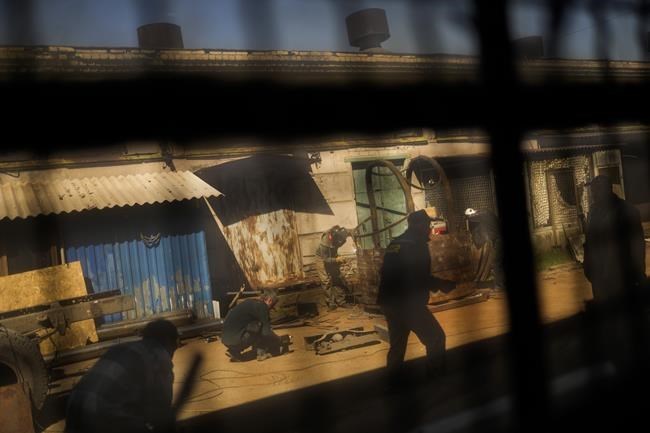
Volunteer welders work on metal pieces at a facility producing material for Ukrainian soldiers in Zaporizhzhia, Ukraine, Friday, May 6, 2022. An old industrial complex in the southeastern Ukrainian riverside city of Zaporizhzhia has become a hive of activity for volunteers producing everything from body armor to camouflage nets, anti-tank obstacles to heating stoves and rifle slings for Ukrainian soldiers fighting the Russian invasion. (AP Photo/Francisco Seco)

“I wasn’t actually connected with the military at all,” said Vovchenko. “It took two days and three sleepless nights to understand what needs to be done.”

The team went through various types of steel, making plates and testing them to check bullet penetration. Some didn’t offer enough protection, others were too heavy to be functional. Then they had a breakthrough.

“It turns out that steel used for car suspension has very good properties for bullet penetration,” Vovchenko said, standing in front of four shelves of test plates with varying degrees of bullet damage. The one made of car suspension steel showed dozens of bullet marks but none that penetrated.

The vests and everything else made at Palianytsia are provided free to soldiers who request them, so long as they can prove they are in the military. Each plate is numbered and each vest has a label noting it is not for sale.

So far, Palianytsia has produced 1,800 bulletproof vests in two months, Busharov said, adding there was a waiting list of around 2,000 more from all over Ukraine.

Vovchenko said they have heard about up to 300 people whose lives have been saved by the vests.

Knowing that is “incredibly inspiring and it keeps us going,” he said.

____

Inna Varenytsia in Zaporizhzhia, Ukraine, contributed.

___

Follow all AP stories on the war in Ukraine at https://apnews.com/hub/russia-ukraine

Report Error Submit a Tip

More Stories

Is this the season of secession?

David McLaughlin 5 minute read Preview

Is this the season of secession?

David McLaughlin 5 minute read 2:01 AM CDT

Canada has entered its season of secession. Like El Nino, the currents of grievance can blow hot and cold. Today, they are hot. But how hot for how long? The odds of Alberta and now Quebec separating from Canada are not high, but they are never zero.

After a year of waving the flag in a surge of national patriotism to confront Donald Trump’s attacks on Canada — economic and verbal — it is both jarring and frustrating for most Canadians to be reminded of the pervasive and persistent tensions that come with governing our federation.

When we need new national purpose to confront big economic sovereignty and security challenges from outside, that purpose is undermined and diminished by having to confront homegrown grievances.

We’ve seen and seen off two separation referendums in Quebec. Now we have a newly elected separatist party coming to power. In Alberta, voters will soon decide whether the independence road is one they want to travel.

Read
2:01 AM CDT

Police on scene at Fairmont hotel construction site

1 minute read Updated: Yesterday at 12:19 AM CDT

At least three police cars were present at the under-construction Fairmont Winnipeg Thursday evening.

The nature of the response was unclear, but officers were guiding traffic outside of the construction zone at 2 Lombard Place while the response was underway. At 6:50 p.m., traffic was flowing normally.

Security on site provided no information on the response, but an individual working behind site fencing told the Free Press there’d be no comment from anyone on site as to why police were on scene at this time.

An SUV with a Government of Manitoba logo on its side was also present alongside personnel from Manitoba Workplace Safety and Health. However, it’s unknown if it’s connected to the police response.

Chopped trees will leave a ‘blight’ on Windsor Park

Kelly-Anne Riess 3 minute read Preview

Chopped trees will leave a ‘blight’ on Windsor Park

Kelly-Anne Riess 3 minute read Yesterday at 8:04 PM CDT

Robert Gordon has watched the trees grow along a popular Windsor Park walking path for nearly six decades.

Now, as Manitoba Hydro cuts them down to protect nearby power lines, he says a familiar part of his childhood neighbourhood is disappearing.

Although he no longer lives in the area, Gordon regularly returns to walk or cycle along the tree-lined path, which runs parallel to Archibald Street.

He was concerned when he recently spotted crews clearing vegetation near the entrance to the path, but initially assumed they were removing brush. When he returned, he discovered the clearing had extended farther along the corridor.

Read
Yesterday at 8:04 PM CDT

Musk’s meddlesome trolling

Editorial 4 minute read Preview

Musk’s meddlesome trolling

Editorial 4 minute read 2:01 AM CDT

It seems obvious the world’s first trillionaire thought he was helping separatists within the Canadian federation when he encouraged three provinces — Alberta, Saskatchewan and Quebec — to leave Canada.

Unfortunately for Elon Musk, a man suffering from a profound deficit of self-awareness, his comments may only help those who want to keep the country together.

Musk entered the national unity debate on Wednesday, two days after the pro-independence Parti Quebecois was returned to power in Quebec with a minority mandate. The PQ has promised to hold a third referendum on separation at some point in its current term.

Musk — who has a Canadian mother and attended university in Ontario — took to X, the social media platform formerly known as Twitter (which he owns) and encouraged Quebec to forge ahead with plans to separate. He said Alberta — which will hold a vote this fall on whether to hold a binding referendum on separation — and Saskatchewan should follow suit.

Read
2:01 AM CDT

Jets’ game flies south against Ducks

Mike McIntyre 7 minute read Preview

Jets’ game flies south against Ducks

Mike McIntyre 7 minute read Yesterday at 10:38 PM CDT

The Winnipeg Jets sure looked like a team that was running on fumes Friday night.

Playing for the fifth time in eight days, the club suffered its first regulation loss of the young season — a lacklustre 5-1 showing against the Anaheim Ducks at Canada Life Centre.

While we won’t question the effort, the execution was a different story. Sloppy plays, missed passes, porous defensive-zone coverage and iffy goaltending made this a tough watch for the 13,693 fans in attendance.

“Just some mental things that happened. Obviously some physical things as well,” said head coach Scott Arniel.

Read
Yesterday at 10:38 PM CDT

A Life's Story: Writer built bridges with genuine curiosity, compassion for diversity of religious practices

Janine LeGal 6 minute read Preview

A Life's Story: Writer built bridges with genuine curiosity, compassion for diversity of religious practices

Janine LeGal 6 minute read 6:00 AM CDT

Brenda Suderman knew how to make people feel comfortable. For a journalist, that character trait is a real strength, and it made people trust and appreciate her.

Whether covering musicals, worship spaces, the effects of pandemic shutdowns, death rituals and practices of different traditions, the discovery of the burial of 2,284 infants in unmarked graves, or any other of the countless topics she wrote about in her four- decade career, Suderman did it with genuine interest and care.

Born and raised in Winkler, Suderman grew up on a farm. Much of her childhood was spent in gardens and sugar beet fields.

Baptized at 16, she became a member of the Winkler Bergthaler Mennonite Church. The restrictions against women at the time contributed to planting the seeds of Suderman’s feminist perspective.

Read
6:00 AM CDT