Forces of nature

Barnes’ exploration of our planet’s animals a wildly brilliant reference

Advertisement

Advertise with us

‘What a piece of work is a man… the beauty of the world! the paragon of animals…” Hamlet says, mixing irony with (perhaps) madness. Taken at face value, his assessment is easy to disagree with, as a quick glance around the globe will quickly prove.

Read this article for free:


or

Already have an account? Log in here »

To continue reading, please subscribe:

Subscribe and receive a limited-edition Free Press branded hat or tote.

Digital Subscription

One year of digital access for only $205*

  • Enjoy unlimited reading on winnipegfreepress.com
  • Read the E-Edition, our digital replica newspaper
  • Access News Break, our award-winning app
  • Play interactive puzzles

*First annual payment billed as $205.00 + GST for one year. This annual subscription will automatically renew at $233.00 + GST every 52 weeks (10% off the regular annual price of $259.35). Offer available to new and qualified returning subscribers only. Cancel any time.

To continue reading, please subscribe:

Add Free Press access to your Brandon Sun subscription for only an additional

$1 for the first 4 weeks*

  • Enjoy unlimited reading on winnipegfreepress.com
  • Read the E-Edition, our digital replica newspaper
  • Access News Break, our award-winning app
  • Play interactive puzzles
Start now

*Your next Brandon Sun subscription payment will increase by $1.00 and you will be charged $17.95 plus GST for four weeks. After four weeks, your payment will increase to $24.95 plus GST every four weeks.

Hey there, time traveller!
This article was published 25/06/2022 (1549 days ago), so information in it may no longer be current.

‘What a piece of work is a man… the beauty of the world! the paragon of animals…” Hamlet says, mixing irony with (perhaps) madness. Taken at face value, his assessment is easy to disagree with, as a quick glance around the globe will quickly prove.

Simon Barnes quotes Hamlet’s statement late in his impressive and engaging new book whose vignettes set out to prove that in spite of human deficits in reason and care for the earth, we are capable of getting something done caring for other species.

Making the point that “we humans are as much members of the animal kingdom as” 10 million or so other species, Barnes states that human “lives, our history and our thoughts are inextricably entwined with our fellow animals.”
Ashlee Rezin / The Associated Press files
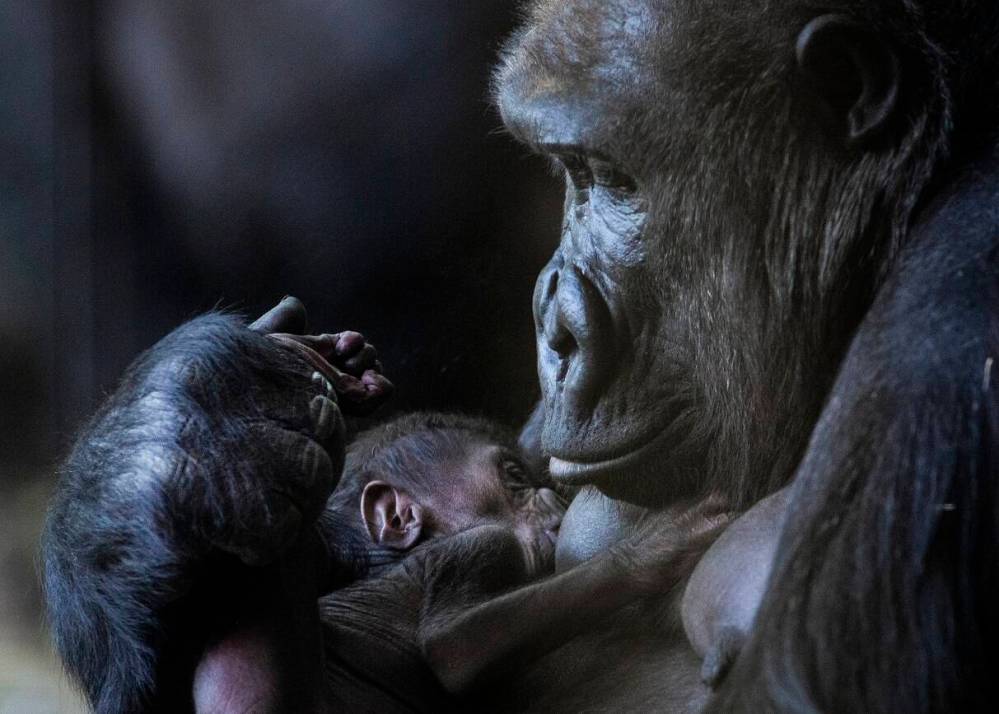
Among the misconceptions author Simon Barnes tries to dispel are those about gorillas and their supposed violent nature.
Ashlee Rezin / The Associated Press files Among the misconceptions author Simon Barnes tries to dispel are those about gorillas and their supposed violent nature.

A History of the World in 100 Animals sets out to explain and analyze that symbiosis in short essays about creatures great and small, dangerous and cute (often at the same time), living and extinct.

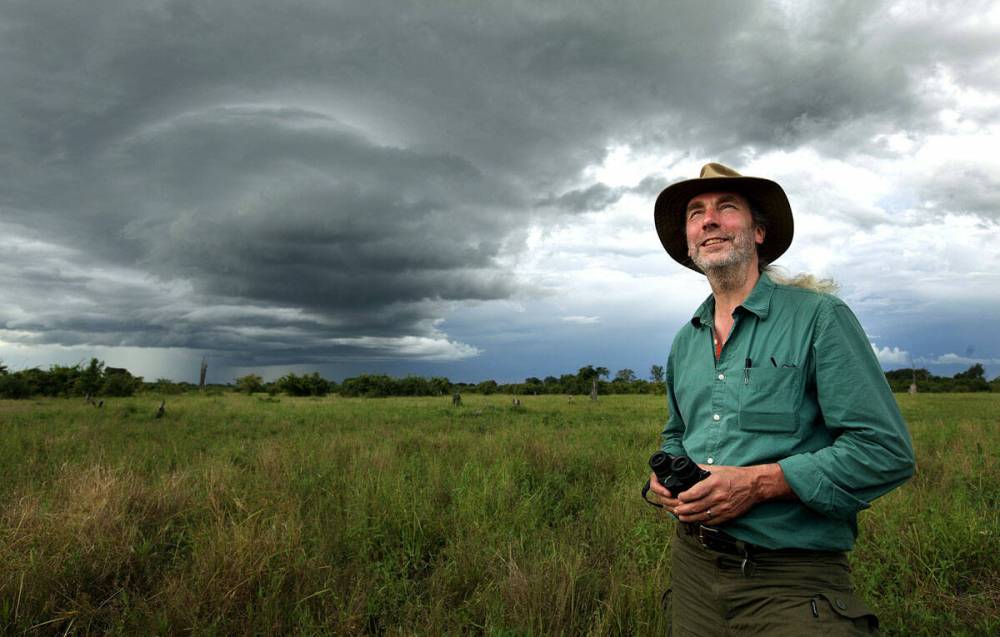
Barnes is an English sportswriter and naturalist who has also written a “wildlife opinion column” for the Times of London. He has written over 20 books and novels, such as The Meaning of Birds, How to Wild Yourself and How to Be a Bad Birdwatcher.

Barnes manages to rival perhaps the greatest naturalist writer, Gerald Durrell, and the polymathic Bill Bryson’s breadth of knowledge and examples.

Epigraphs from literature, film, history, religion, and popular culture introduce each chapter, on species familiar (lion, cat, horse) and exotic (thylacine, saola, vaquita). From the whale and elephant to the head louse and Oriental rat flea in size, and from the beauty of nightingales and butterflies to the horrors of cockroaches, tsetse flies and loa loa worms, Barnes presents both positive and negative aspects, sympathetic to each species.

While he doesn’t give human attitudes pride of place, Barnes is not preaching or scolding. Rather, he merely presents the evidence as he places each species into human perspective. Misconceptions (like the violence of gorillas, the repulsiveness of snakes and piranhas) and human fickleness (as in our ambivalent attitudes toward bears, pigs, monkeys and rabbits) are treated dispassionately.
David Bebber photo
Simon Barnes
David Bebber photo
Simon Barnes
David Bebber photo Simon Barnes David Bebber photo Simon Barnes

Chapters average four or five pages each, not arranged in any particular order. The book is lavishly illustrated. Barnes’ musings are liable to go anywhere, often making points that the reader might not expect.

Evidence of human depredations builds over the course of the book, and toward the end Barnes often tries to stem the reader’s growing despair about many “creatures, great and small.”

Admitting that the accumulation of evidence can be “a bit glum,” Barnes says, “It’s become a routine question when I give a talk: are you an optimist? I am tempted to respond: do I look stupid?” But he points toward his epilogue, where he insists “that every habitat on Earth is saveable, and that every species is saveable.”

Durrell is quoted in the epigraph on the pink pigeon, whose status on an island off the coast of Africa has begun to climb back on the endangered species list from Critically Endangered to Vulnerable: “Many people think conservation is just about saving fluffy animals… what they don’t realize is that we’re trying to prevent the human race from committing suicide.”

Whether one believes that humans deserve to consider themselves “the paragon of animals,” models of excellence or perfection, A History of the World in 100 Animals can start to instill the humility, and perhaps the will, required to motivate our species to treat other animals more as deserving fellow travelers on the planet.

A History of the World in 100 Animals

Bill Rambo teaches at The Laureate Academy in St. Norbert.

Report Error Submit a Tip

More Stories

New Jets show promise despite loss to experienced Oilers

Mike McIntyre 8 minute read Preview

New Jets show promise despite loss to experienced Oilers

Mike McIntyre 8 minute read Updated: 9:34 AM CDT

Preseason hockey games are always more about the process than the result, and that’s especially true when the opposing rosters appear to be a major mismatch on paper.

So a 5-2 loss by an inexperienced group of Winnipeg Jets skaters against a star-studded Edmonton Oilers squad on Saturday night in the Alberta capital was neither surprising nor alarming.

There was, however, plenty to like from the visitors’ perspective despite the outcome.

Let’s break it down.

Read
Updated: 9:34 AM CDT

Former Bombers linebacker Gauthier enjoying career as electrician

Taylor Allen 7 minute read Preview

Former Bombers linebacker Gauthier enjoying career as electrician

Taylor Allen 7 minute read Friday, Sep. 18, 2026

Most professional football players don’t ride off into the sunset on their own terms.

Shayne Gauthier was well aware of that, but it didn’t make it sting any less when the Winnipeg Blue Bombers informed the veteran linebacker that they weren’t bringing him back for 2026.

“I was really hoping to play one more (season) because it would have been my 10th season, so, I’d say it didn’t really end the way I wanted,” Gauthier recently told the Free Press.

“It left a little sour taste in my mouth, but that’s part of pro sports. If everybody got the ending that they wanted, then it wouldn’t really work.”

Read
Friday, Sep. 18, 2026

Klein has burned bridges with PM, Gillingham says

Joyanne Pursaga 3 minute read Preview

Klein has burned bridges with PM, Gillingham says

Joyanne Pursaga 3 minute read Friday, Sep. 18, 2026

One mayoral candidate accused another of writing a column so critical it could compromise his ability to work with the federal government.

Read
Friday, Sep. 18, 2026

Serious crash at West Kildonan intersection known for collisions

Nicole Buffie 3 minute read Preview

Serious crash at West Kildonan intersection known for collisions

Nicole Buffie 3 minute read Updated: 6:09 PM CDT

Residents in West Kildonan say an intersection that was the site of a serious car crash Sunday morning is notoriously dangerous.

Rob Lick heard a loud bang around 7 a.m. and rushed out of his home on Leila to see what the commotion was. He saw two crushed SUVs, a white and black one, in the intersection. Police vehicles arrived shortly after.

“It sounded like when (garbage trucks) drop a big dumpster,” he said. “I heard somebody crying or wailing, they were standing by the vehicle so I don’t know who exactly it was or if someone was injured.”

The sound of sirens followed shortly after when emergency crews came to the scene. The intersection was immediately blocked off.

Read
Updated: 6:09 PM CDT

Grieving child builds backyard rocket ship

Harriet Zaidman 4 minute read Yesterday at 2:01 AM CDT

I Built a Rocket Ship (Kids Can Press, 32 pages, hardcover, $22) by Winnipegger Anna Lazowski is a tender story for children ages 4-8 about a little girl trying to make sense of her mother’s death. The child engages in conversation with her late mom, agreeing and disagreeing about things said as she carries objects (and of course, the cat) to the backyard. There, she is building a rocket ship she will pilot into the skies to find her mom again.

Jennica Lounsbury’s varied perspectives show the range of emotions the little girl experiences.

● ● ●

Northwoods Lullaby by Mary Casanova (University of Minnesota Press, 32 pages, hardover, $25) is a bedtime book for readers up to age eight, perfect to bring a busy, happy day to a close. Just like children who are listening to adults reading the book, all the animal babies are being tucked into their nests and burrows by loving parents: “Thump and scamper,/nimble clover./ Soon it’s time to rest. Baby loon/ nestles in/as Papa floats along.”

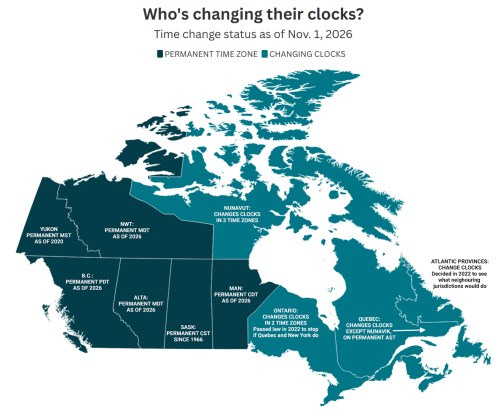
A quick look at where provinces and territories stand on time changes

The Canadian Press 2 minute read Preview

A quick look at where provinces and territories stand on time changes

The Canadian Press 2 minute read Friday, Sep. 18, 2026

WINNIPEG - Manitoba's government said Thursday the province will be sticking with daylight time year-round, making it the latest jurisdiction to move away from twice-annual time changes. Here's a look at where things stand across Canada:

British Columbia said in March that it was moving to permanent Pacific daylight time. The change also means that parts of northeastern B.C., which have been on mountain standard time year round, are now in alignment with the rest of the province.

Alberta also switched to permanent daylight time this year in what it calls Alberta time. The change means it now has the same time as Saskatchewan year round.

Saskatchewan has been on permanent central standard time since 1966.

Read
Friday, Sep. 18, 2026