Ruling could dampen government efforts to rein in Big Tech

Advertisement

Advertise with us

The Supreme Court’s latest climate change ruling could dampen efforts by federal agencies to rein in the tech industry, which went largely unregulated for decades as the government tried to catch up to changes wrought by the internet.

Read this article for free:


or

Already have an account? Log in here »

To continue reading, please subscribe:

Subscribe and receive a limited-edition Free Press branded hat or tote.

Digital Subscription

One year of digital access for only $205*

  • Enjoy unlimited reading on winnipegfreepress.com
  • Read the E-Edition, our digital replica newspaper
  • Access News Break, our award-winning app
  • Play interactive puzzles

*First annual payment billed as $205.00 + GST for one year. This annual subscription will automatically renew at $233.00 + GST every 52 weeks (10% off the regular annual price of $259.35). Offer available to new and qualified returning subscribers only. Cancel any time.

To continue reading, please subscribe:

Add Free Press access to your Brandon Sun subscription for only an additional

$1 for the first 4 weeks*

  • Enjoy unlimited reading on winnipegfreepress.com
  • Read the E-Edition, our digital replica newspaper
  • Access News Break, our award-winning app
  • Play interactive puzzles
Start now

*Your next Brandon Sun subscription payment will increase by $1.00 and you will be charged $17.95 plus GST for four weeks. After four weeks, your payment will increase to $24.95 plus GST every four weeks.

Hey there, time traveller!
This article was published 03/07/2022 (1512 days ago), so information in it may no longer be current.

The Supreme Court’s latest climate change ruling could dampen efforts by federal agencies to rein in the tech industry, which went largely unregulated for decades as the government tried to catch up to changes wrought by the internet.

In the 6-3 decision that was narrowly tailored to the Environmental Protection Agency, the court ruled Thursday that the EPA does not have broad authority to reduce power plant emissions that contribute to global warming. The precedent is widely expected to invite challenges of other rules set by government agencies.

“Every agency is going to face new hurdles in the wake of this confusing decision,” said Alexandra Givens, the president and CEO of the Center for Democracy and Technology, a Washington-based digital rights nonprofit. “But hopefully the agencies will continue doing their jobs and push forward.”
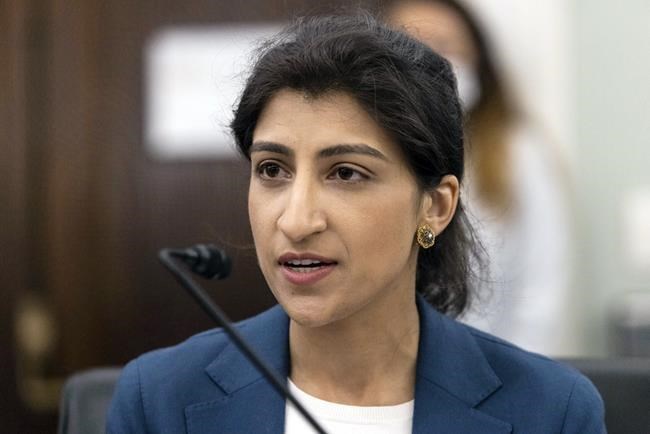
FILE - Lina Khan, nominee for Commissioner of the Federal Trade Commission, speaks during a Senate Committee on Commerce, Science, and Transportation confirmation hearing on Capitol Hill in Washington, April 21, 2021. The Supreme Court’s latest climate change ruling could dampen efforts by federal agencies to rein in the tech industry, which went largely unregulated for decades as the government tried to catch up to changes wrought by the internet. Under Chair Khan, the FTC also has widened the door to more actively writing new regulations in what critics say is a broader interpretation of the agency’s legal authority. (Graeme Jennings/Washington Examiner via AP, Pool, File)

The Federal Trade Commission, in particular, has been pursuing an aggressive agenda in consumer protection, data privacy and tech industry competition under a leader appointed last year by President Joe Biden.

Biden’s picks for the five-member Federal Communications Commission have also been pursuing stronger “net neutrality” protections banning internet providers from slowing down or blocking access to websites and applications that don’t pay for premium service.

A former chief technologist at the FTC during President Donald Trump’s administration said the ruling is likely to instill some fear in lawyers at the FTC and other federal agencies about how far they can go in making new rules affecting businesses.

The court “basically said when it comes to major policy changes that can transform entire sectors of the economy, Congress has to make those choices, not agencies,” said Neil Chilson, who is now a fellow at libertarian-leaning Stand Together, founded by the billionaire industrialist Charles Koch.

Givens disagreed, arguing that many agencies, especially the FTC, have clear authority and should be able to withstand lawsuits inspired by the EPA decision. She noted that Chief Justice John Roberts, who wrote the opinion, repeatedly described it as an “extraordinary” situation.

Givens is among the tech advocates calling for Congress to act with urgency to make laws protecting digital privacy and other tech matters. But she said laws typically stay on the books for decades, and it’s unrealistic to expect Congress to weigh in on every new technical development that questions an agency’s mandate.

“We need a democratic system where Congress can give expert agencies the power to address issues when they arise, even when those issues are unforeseen,” she said. “The government literally can’t work with Congress legislating every twist and turn.”

Empowered by Congress in the 1970s to tackle “unfair or deceptive” business practices, the FTC has been in the vanguard of Biden’s government-wide mandate to promote competition in some industries, including Big Tech, health care and agriculture. A panoply of targets include hearing aid prices, airline baggage fees and “product of USA” labels on food.

Under Chair Lina Khan, the FTC also has widened the door to more actively writing new regulations in what critics say is a broader interpretation of the agency’s legal authority. That initiative could run into stiff legal challenges in the wake of the high court decision. The ruling could call into question the agency’s regulatory agenda — leading it to either tread more cautiously or face tougher and more expensive legal challenges.

Khan “hasn’t really been someone who pursues soft measures, so it may be a damn-the-torpedoes approach,” Chilson said.

University of Massachusetts internet policy expert Ethan Zuckerman said it would be hard to gauge any potential impact of the court’s ruling on existing tech regulation. That’s partly because “there’s just not that much tech regulation to undo,” he said.

He said one target could be the Consumer Financial Protection Bureau, “a bête noire for many conservatives.” Big companies such as Facebook parent Meta could also potentially appeal tough enforcement actions on the idea that federal agencies weren’t explicitly authorized to regulate social media.

“We’re in uncharted territory, with a court that’s taking a wrecking ball to precedent and seems hell-bent on implementing as many right-wing priorities as possible in the shortest possible time,” Zuckerman said.

The ruling could dampen the appetite for agencies like the FTC to act to limit harm from artificial intelligence and other new technologies. It could have less effect on new rules that are more clearly in the realm of the agency imposing them.

Michael Brooks, chief counsel for the nonprofit Center for Auto Safety, said the ruling isn’t likely to change the government’s ability to regulate auto safety or self-driving vehicles, although it does open the door to court challenges.

For instance, the National Highway Traffic Safety Administration has clear authority to regulate auto safety from a 1966 motor vehicle safety law, Brooks said.

“As long as the rules they are issuing pertain to the safety of the vehicle and not anything that’s outside of their authority, as long as it’s related to safety, I don’t see how a court could do an end run around the safety act,” he said.

Unlike the EPA, an agency with authority granted by multiple, complex laws, NHTSA’s “authority is just so crystal clear,” Brooks said.

NHTSA could have problems if it strayed too far from regulating safety. For example, if it enacted regulations aimed to shift buyers away from SUVs to more fuel-efficient cars, that might be struck down, he said. But the agency has historically stuck to its mission of regulating auto safety with some authority on fuel economy, he said.

However, it’s possible that a company such as Tesla, which has tested the limits of NHTSA’s powers, could sue and win due to an unpredictable Supreme Court, Brooks said.

___

Associated Press writers Marcy Gordon in Washington, Frank Bajak in Boston and Tom Krisher in Detroit contributed to this report.

Report Error Submit a Tip

More Stories

Canada vows dollar-for-dollar tariff retaliation, suspends trade talks with U.S.

Catherine Morrison, The Canadian Press 7 minute read Preview

Canada vows dollar-for-dollar tariff retaliation, suspends trade talks with U.S.

Catherine Morrison, The Canadian Press 7 minute read Updated: Yesterday at 8:27 AM CDT

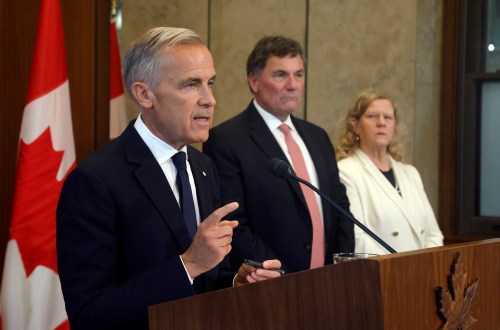
OTTAWA - A last-ditch effort to reach a new trade deal before a midnight tariff deadline failed Friday, as Prime Minister Mark Carney suspended talks with the United States and summoned his negotiators back to Ottawa.

The decision meant new 50 per cent tariffs on billions of dollars in Canadian exports to the U.S. took effect at 12:01 a.m., and Carney vowed Canada would retaliate with equal measures of its own.

"In recent weeks, we made important progress toward improving Canada's position as having the best deal in the world with the U.S.," Carney said in a statement just before Trump's tariff deadline.

"However, that progress has not been enough to meet our objectives for Canadians."

Read
Updated: Yesterday at 8:27 AM CDT

Wooed by wood, Cedarella founder takes pride in handcrafted designs

David Sanderson 8 minute read Preview

Wooed by wood, Cedarella founder takes pride in handcrafted designs

David Sanderson 8 minute read Yesterday at 6:00 AM CDT

Marina Bulan is the founder of Cedarella, a two-year-old venture that turns out eye-catching wood products such as jewelry, kitchen decor, children’s toys and, most recently, metre-high outdoor planters that double as home street-number indicators.

Ahead of immigrating to Winnipeg a decade ago from their native Russia, Bulan and her partner thought it would be prudent to conduct some research on their soon-to-be new home, a city they knew next to nothing about.

Imagine their surprise as they were viewing the 2007 surrealist film My Winnipeg, which comically blends historical facts about our burg with what Winnipeg-born writer/director Guy Maddin has termed “mystical hypothesizing.”

(For instance, there is no proof that, as reported in the award-winning flick, Winnipeg is the sleepwalking capital of the world, and that residents keep keys to their former abodes on their person in the event they turn up there during a bout of somnambulism.)

Read
Yesterday at 6:00 AM CDT

Kinew’s message for PM: don’t back down

Niigaan Sinclair 5 minute read Preview

Kinew’s message for PM: don’t back down

Niigaan Sinclair 5 minute read Friday, Aug. 21, 2026

Let it be known that when Canada’s provinces and alcohol industries needed a defender, Canada’s first First Nations provincial premier was their greatest warrior.

This is, admittedly, a provocative opening line — referencing historical and cultural intersections and relying on a stereotype or two.

It’s impossible, however, not to see how important the nearly Canada-wide provincial-led ban on the sale of U.S. alcohol is to Manitoba Premier Wab Kinew.

It’s due to his stand on national matters like these that he’s become very popular — according to polls, the most popular premier in Canada — and has been empowered to take on the mantle of one of the captains of “Team Canada” on economic, political and domestic issues.

Read
Friday, Aug. 21, 2026

Wait times for MRIs getting worse in Brandon, Dauphin

Rylee Gerrard 4 minute read Yesterday at 2:01 AM CDT

BRANDON — Wait times for MRI scans have surged in the Prairie Mountain Health region during the last two years.

Despite a campaign promise by the NDP in September 2023 to increase the number of allied health professionals capable of administering diagnostic imaging in northern and rural areas, wait times for MRIs have increased dramatically in Brandon and Dauphin.

Median imaging wait times tripled at Dauphin Regional Health Centre between 2024 and 2026, increasing from eight to 24 weeks, according to the province’s wait time dashboard.

The Brandon Regional Health Centre median wait times for MRI scans more than doubled during the same period, from nine to 23 weeks.

‘Strong sense of unity’

By Melissa Martin 6 minute read Preview

‘Strong sense of unity’

By Melissa Martin 6 minute read Yesterday at 5:14 PM CDT

Manitoba government and business leaders are rallying behind Prime Minister Mark Carney’s plan to fight back, after a sudden collapse of trade talks between the U.S. and Canada sparked a new salvo of U.S. tariffs on some Canadian goods.

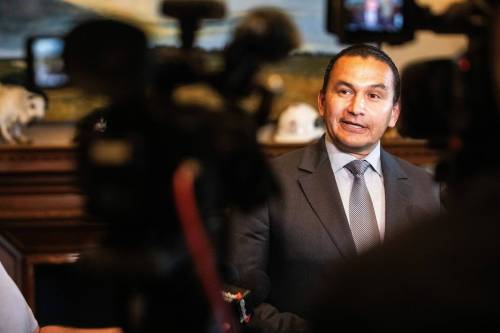
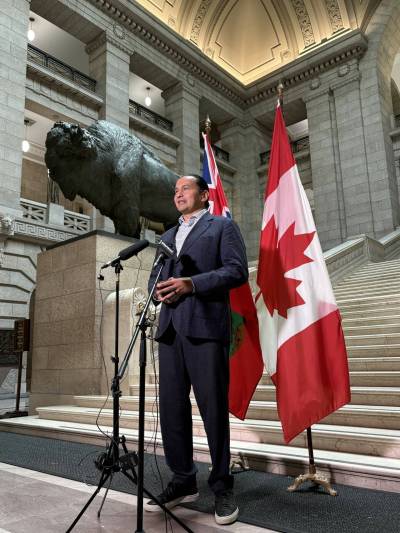
On Saturday, after Carney vowed to respond with retaliatory tariffs, Manitoba premier Wab Kinew said his government stood “100 per cent” behind the prime minister’s plan to respond to what Kinew called U.S. president Donald Trump’s “unjustified and immoral” tariffs.

“History will not be kind to Donald Trump, so we should never appease him,” Kinew said. “We should fight back, which is what Canada is doing today.”

Kinew met reporters for a brief news conference at the legislature on Saturday afternoon, about an hour after finishing a call with Carney and the other premiers. There was a “really strong sense of unity” on that call, Kinew said, and emphasized that he backs the federal decision to “walk away from what would have been a bad deal.”

Read
Yesterday at 5:14 PM CDT

Five Things: PM Carney explains why Canada left the U.S. negotiating table

David Baxter, The Canadian Press 5 minute read Preview

Five Things: PM Carney explains why Canada left the U.S. negotiating table

David Baxter, The Canadian Press 5 minute read Updated: Yesterday at 1:58 PM CDT

OTTAWA - Canada is preparing to hit the U.S. with dollar-for-dollar tariffs in response to new 50 per cent duties on $28 billion worth of Canadian products that took effect when talks between the two nations collapsed as negotiations neared the finish line. 

Prime Minister Mark Carney was quiet publicly during the final days of negotiations, but now has now explained his rationale for telling the Canadian negotiating team, led by Canada-U.S. Trade Minister Dominic LeBlanc and chief negotiator Janice Charette, to leave the table.

Restrictions on further trade deals

"The U.S. Introduced at the last hours, in the last hours, efforts to restrict our ability to have other trade deals. You heard me say a moment ago, what we've accomplished in the past year, 20 new deals, economic and security partnerships, the prospect of doubling our market access because we believe in free trade. We're the partner of choice in many respects for countries around the world and the Americans wanted to restrict that. They had language that what they wanted to restrict that, unacceptable," Carney said during a press conference on Parliament Hill.

Read
Updated: Yesterday at 1:58 PM CDT