Higher gas prices hurt pockets, make small dent in emissions

Advertisement

Advertise with us

As Congress and now the Supreme Court stymie the Biden administration’s efforts to curb climate change, one thing the president doesn’t want - sky high gas prices - actually is nibbling away at emissions of heat-trapping gas.

Read this article for free:


or

Already have an account? Log in here »

To continue reading, please subscribe:

Subscribe and receive a limited-edition Free Press branded hat or tote.

Digital Subscription

One year of digital access for only $205*

  • Enjoy unlimited reading on winnipegfreepress.com
  • Read the E-Edition, our digital replica newspaper
  • Access News Break, our award-winning app
  • Play interactive puzzles

*First annual payment billed as $205.00 + GST for one year. This annual subscription will automatically renew at $233.00 + GST every 52 weeks (10% off the regular annual price of $259.35). Offer available to new and qualified returning subscribers only. Cancel any time.

To continue reading, please subscribe:

Add Free Press access to your Brandon Sun subscription for only an additional

$1 for the first 4 weeks*

  • Enjoy unlimited reading on winnipegfreepress.com
  • Read the E-Edition, our digital replica newspaper
  • Access News Break, our award-winning app
  • Play interactive puzzles
Start now

*Your next Brandon Sun subscription payment will increase by $1.00 and you will be charged $17.95 plus GST for four weeks. After four weeks, your payment will increase to $24.95 plus GST every four weeks.

Hey there, time traveller!
This article was published 07/07/2022 (1529 days ago), so information in it may no longer be current.

As Congress and now the Supreme Court stymie the Biden administration’s efforts to curb climate change, one thing the president doesn’t want – sky high gas prices – actually is nibbling away at emissions of heat-trapping gas.

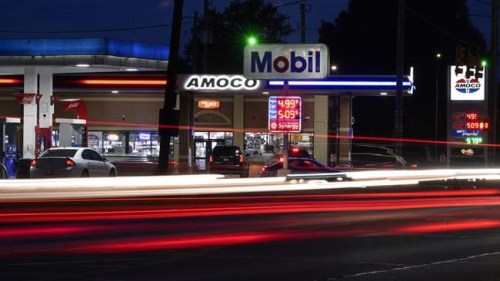
Gas prices in much of the United States shot past the $5 a gallon mark last month before a slight drop, and Americans have responded by driving a bit less, two sets of data show. June gas sales are about 5% below pre-pandemic 2019 levels and 2.6% below a year ago, according to the U.S. Energy Information Administration.

Americans in April, the last month data was available, drove 6% fewer miles than the same month in 2019, according to transportation analyst Michael Sivak, a former University of Michigan professor who is a long-time tracker of driving and car-buying habits. That 6% drop is tiny compared to the 40% plunge in driving miles in April 2020 as the pandemic kicked in.

Motorists stop for fuel at gas stations in Detroit, Tuesday, July 5, 2022. As Congress and now the Supreme Court stymie the Biden administration’s efforts to curb climate change, one thing the president doesn’t want - sky high gas prices - actually is nibbling away at emissions of heat-trapping gas. (AP Photo/Paul Sancya)

Yet, a 6% drop in driving roughly translates to only a 1% drop in overall U.S. carbon emissions, Sivak said. The U.S. climate goal is to cut carbon emissions in half by 2030 compared to 2005 levels.

“High fuel prices are a really difficult thing because they’re a double-edged sword,” said Samantha Gross, director of the energy security and climate initiative at the centrist Brookings Institution. “So prices that are high and expected to stay that way have more of a longer term ability to cut demand and my guess is the administration wouldn’t mind seeing that, but the problem is that people hate it.”

High gas prices are “unequivocally” good for fighting climate change because people use less fossil fuel and emissions go down, but the poorest people, who don’t have other options also “suffer the most,” said climate economist Solomon Hsiang, director of the Climate Impact Lab at the University of California, Berkeley. Carbon emissions are causing harm, especially to future generations, but for decades cheap gas has meant “no one is paying for that harm,” he said.

Now people are paying more when they hit the gas station and some are changing their habits.

Richard Gowan, 56, of Brighton, Michigan, used to commute 26 miles to his Ann Arbor workplace twice per week in a 2021 Ford F-150 pickup. But with gas close to $5 per gallon, he’s cut one-quarter of the truck trips. “That one doesn’t come out of the driveway near as much as it used to,” he said while pumping gas near work.

To save money, he has subbed a small Jeep Renegade SUV, which gets substantially better fuel economy than the 24 miles per gallon he gets with the pickup, which he bought to tow a travel trailer. The towing still takes place because he doesn’t want to give up family vacations, Gowan said.

He blamed the high gasoline prices on President Joe Biden’s policies. He wants Biden to open up more drilling and predicts that engineering will eventually solve climate change.

In San Diego, where gasoline runs more than $6 per gallon, Simmi Paul said her family also has reduced driving. Her daughter, a college student, now walks 10 minutes to work and takes public transportation to school rather than driving.

Even though the July 4th holiday weekend saw record number of people on the road, they were not driving as far “because they can’t afford the cost of gas,” said American Automobile Association spokesperson Devin Gladden. People who must drive, he said, “are trying to find ways they can combine some of their errands or perhaps if they are able to carpool for work they’re finding ways to reduce the amount of gas they have to buy and put in their vehicles.”

Biden has frequently said he doesn’t want high gas prices, attacked oil companies ’ multi-billion dollar profits, proposed new offshore oil and gas drilling despite campaign promises and proposed a gas tax holiday, which congressional leaders said won’t fly. Asked whether conservation should play a greater role in adjusting to high prices, White House press secretary Karine Jean-Pierre said: “Americans are going to do what they feel is right for themselves and for their family. That’s not something for us to make a judgment on.”

Biden confidants know high gas prices hurt people and the president politically.

“The fact is there’s been a lot of studies on this — it’s just psychologically that how people tend to view the economy is through inflation,” said John Anzalone, a Democratic pollster who has worked for Biden. “People tend to focus on the pain points.”

Look at the pump for the pain point.

It’s about $200 a week for Pat Blevins, 42, a carpenter from Waterville, Ohio, who was filling the tank of his 2016 Chevrolet Silverado at a gas station west of Toledo, Ohio, on Tuesday. “It likes to eat gas,” he said of his truck, which he said gets around 15 miles per gallon.

When gasoline went past $4 per gallon in the summer of 2008, American auto buyers quickly switched away from pickup trucks and large SUVs to smaller, more efficient vehicles. But when it hit that level again in early March, there was little impact on new-vehicle sales in the U.S., where about three-quarters of vehicles sold are SUVs and trucks.

“Even at $5 per gallon, it’s hard to find evidence of changing habits” and buying smaller gas-efficient cars, said Jeff Schuster, president of global forecasting for the LMC Automotive consulting firm.

It’s partly because of the global computer chip shortage. Automakers have been sending the chips they get to factories that build larger, more profitable vehicles, Schuster said.

Still, if smaller cars and SUVs were more readily available, Schuster says he is confident that people would buy them.

Pat Blevins, of Waterville, Ohio, fills the tank of his 2016 Chevrolet Silverado at an S&G gas station in Sylvania Township west of Toledo on Tuesday, July 5, 2022. “It likes to eat gas,” he said of his truck, which he said gets around 15 miles per gallon. As Congress and now the Supreme Court stymie the Biden administration’s efforts to curb climate change, one thing the president doesn’t want - sky high gas prices - actually is nibbling away at emissions of heat-trapping gas. (AP Photo/Tom Krisher)

Blevins said he will look at the new electric Silverado to replace his gasoline model “if it’s worth the expense and if it can perform like a gas (truck) can.”

Sivak thinks $5 a gallon gasoline is for the moment the price that changes Americans’ car habits, still much lower than the price paid in Europe and much of the rest of the world.

“When you talk about the real outcomes of the energy transition (to less carbon pollution) some of this does mean that things will get more expensive and we need to come up with better solutions on how we finance and ensure that everybody can participate in the energy transition and it’s not just for the wealthy or privileged few,” AAA’s Gladden said.

Some economists, such as Hsiang, have called for a carbon tax of 25 cents to 50 cents a gallon above market price “to address the harm from climate change” and reduce carbon pollution by cutting demand, but with proceeds partly returned to people and partly used for green energy projects. But at the same time, he said, “higher gas prices hurt poorer families more,” so the government should send them financial help but not subsidize cheap gas.

Biden’s proposed gas tax holiday “is a subsidy, it’s paying people to pollute,” Hsiang said.

Brookings’ Gross said Republicans are falsely blaming Biden for the gas shortage because he cancelled a pipeline that has little to do with gas prices. She said the worldwide spike in gas prices is mostly due to pent-up post pandemic demand and supply issues and the Ukrainian war.

“I really feel for Biden because he’s in this situation where he wants to do climate stuff and his base is like ‘yeah we want climate stuff’ and he ran on it and he feels strongly about it personally I think,” Gross said. “But he’s in this situation where he’s getting hammered on high gas prices.”

___

Borenstein reported from Washington, Krisher from Ann Arbor, Michigan. Josh Boak and Matthew Daly contributed from Washington.

___

Follow AP’s climate coverage at https://apnews.com/hub/climate-and-environment

___

Follow Seth Borenstein on Twitter at @borenbears

___

Associated Press climate and environmental coverage receives support from several private foundations. See more about AP’s climate initiative here. The AP is solely responsible for all content.

Report Error Submit a Tip

More Stories

Injuries reported after police pursuit on Broadway

Free Press staff 2 minute read Preview

Injuries reported after police pursuit on Broadway

Free Press staff 2 minute read Friday, Sep. 11, 2026

Winnipeg police are investigating a “serious incident” in which people were injured following a police pursuit near Broadway and Young Street Friday afternoon.

Police said the scene would remain secured as officers investigate. No details about the number or severity of injuries were released.

Broadway was closed between Furby and Young streets until further notice and motorists were asked to avoid the area.

Shaelyn Desmarais McLeod, whose car sustained minor damage, said she witnessed the end of the police pursuit.

Read
Friday, Sep. 11, 2026

Retired sportscaster Scott Oake determined as fundraising for women's addictions treatment facility enters home stretch

Melissa Martin 5 minute read Preview

Retired sportscaster Scott Oake determined as fundraising for women's addictions treatment facility enters home stretch

Melissa Martin 5 minute read Thursday, Sep. 10, 2026

For now, the patch of land just east of the Victoria Hospital doesn’t look like much: just a field of rocks, mounded dirt, and concrete piles driven into the earth. Yet when Scott Oake looks over the site, he can already imagine how it will look in just over a year’s time, when the new Anne Oake Family Recovery Centre is expected to open.

It’s easier to picture this time around. In 2020, when the recently-retired CBC sportscaster and his late wife, Anne, were building their first labour of intermingled grief and love, the Bruce Oake Recovery Centre for men, it was hard for him to wrap his mind around how a raw construction site could transform into a welcoming addictions treatment facility.

When that centre opened in 2021, Oake found it looked “almost identical” to the architect’s renderings. So it’s easy to hope the Anne Oake Centre will be the same. It will be the first facility of its kind, its founders believe, not only in Canada but in North America: a place where 50 to 70 women can pursue sobriety while staying with their children.

“At Bruce Oake there’s a culture of love, and most of all a culture of hope,” Oake said, speaking at the site Thursday after a media conference to announce the final push of the centre’s fundraising campaign. “I can feel it every time I walk into that building. And I know it will be the same here.”

Read
Thursday, Sep. 10, 2026

Is Trump about to poke Quebec’s political beehive?

Peter McKenna 6 minute read Preview

Is Trump about to poke Quebec’s political beehive?

Peter McKenna 6 minute read Yesterday at 2:00 AM CDT

When was the last time that a U.S. president seriously stirred the hornet’s nest of Quebec politics?

My best recollection is former U.S. president Bill Clinton. During the 1994 Quebec referendum campaign, Clinton made clear that the U.S. wholly endorsed a united and strong federal Canada — as opposed to a dismembered one. He went on to add that an independent Quebec would have no guarantee of joining the North American Free Trade Agreement as a full-fledged member.

Today, we see U.S. President Donald Trump inserting himself — unwittingly or wittingly — into the electoral and sovereignty politics of Quebec. It’s pretty clear that the resurgent Coalition Avenir Québec government is trying to make the Oct. 5 provincial election about anything other than its own governmental record and more about Trump’s economic coercion against Canada. Of course, the Parti Québécois, the odds-on-favourite, wants to make the electoral contest a referendum on the CAQ and its party leader, Christine Fréchette.

But what if Trump really wanted to make his presence felt in Quebec’s political life? How much influence could he have on shaping political outcomes in Quebec? How much of an “X factor” could he be?

Read
Yesterday at 2:00 AM CDT

Higher gas prices hurt pockets, make small dent in emissions

Seth Borenstein And Tom Krisher, The Associated Press 8 minute read Preview

Higher gas prices hurt pockets, make small dent in emissions

Seth Borenstein And Tom Krisher, The Associated Press 8 minute read Thursday, Jul. 7, 2022

As Congress and now the Supreme Court stymie the Biden administration’s efforts to curb climate change, one thing the president doesn’t want - sky high gas prices - actually is nibbling away at emissions of heat-trapping gas.

Gas prices in much of the United States shot past the $5 a gallon mark last month before a slight drop, and Americans have responded by driving a bit less, two sets of data show. June gas sales are about 5% below pre-pandemic 2019 levels and 2.6% below a year ago, according to the U.S. Energy Information Administration.

Americans in April, the last month data was available, drove 6% fewer miles than the same month in 2019, according to transportation analyst Michael Sivak, a former University of Michigan professor who is a long-time tracker of driving and car-buying habits. That 6% drop is tiny compared to the 40% plunge in driving miles in April 2020 as the pandemic kicked in.

Yet, a 6% drop in driving roughly translates to only a 1% drop in overall U.S. carbon emissions, Sivak said. The U.S. climate goal is to cut carbon emissions in half by 2030 compared to 2005 levels.

Read
Thursday, Jul. 7, 2022

Fallis’s comic thriller infiltrates book club

Ben Sigurdson 3 minute read Preview

Fallis’s comic thriller infiltrates book club

Ben Sigurdson 3 minute read Yesterday at 6:00 AM CDT

The Free Press Book Club and McNally Robinson Booksellers are pleased to welcome Toronto author Terry Fallis to the next virtual meeting on Tuesday, September 29 at 7 p.m. to read from and discuss his novel The Marionette.

Fallis, a former lawyer, bureaucrat and political consultant, is the author of 10 bestselling novels and the two-time winner of the Stephen Leacock Medal for Humour (in 2015 for No Relation and in 2008 for The Best Laid Plans, which also won CBC’s Canada Reads in 2011).

His 11th novel, An End In Itself, will be published in November by McClelland & Stewart, who also published The Marionette in October 2025 (and which was also longlisted for the Leacock medal).

The Marionette follows James Norval, bestselling author of a series of thrillers featuring fictional CIA agent Hunter Chase. While in Tajikistan researching his next Hunter Chase novel, Norval is detained by local officials and subsequently freed and ferried away by the Canadian Security Intelligence Service (CSIS).

Read
Yesterday at 6:00 AM CDT

Citizen reports help highlight connectivity issues across southwest Manitoba

Nicole Buffie 5 minute read Preview

Citizen reports help highlight connectivity issues across southwest Manitoba

Nicole Buffie 5 minute read Updated: Yesterday at 10:43 AM CDT

A southwestern Manitoba man has created a map to document cell service blackout spots in an effort to push for better access in rural areas.

Mark Custance compiled more than 300 citizen reports over the last few months to document where service in southwest Manitoba is strong, spotty or doesn’t exist at all.

“I’ve heard people complain and say, ‘cell service sucks’ or ‘this is not working.’ But what does the data actually say?” Custance said from his office in Melita, where he has installed a cell-service booster to maintain connectivity with the rest of the world.

Analyzing where service is good and poor, he cross-references it with the location of cellphone towers across the region.

Read
Updated: Yesterday at 10:43 AM CDT