

The inconvenient truth about food inflation
Advertisement
Read this article for free:
or
Already have an account? Log in here »
To continue reading, please subscribe:

Digital Subscription
One year of digital access for only $205*
- Enjoy unlimited reading on winnipegfreepress.com
- Read the E-Edition, our digital replica newspaper
- Access News Break, our award-winning app
- Play interactive puzzles
*First annual payment billed as $205.00 + GST for one year. This annual subscription will automatically renew at $233.00 + GST every 52 weeks (10% off the regular annual price of $259.35). Offer available to new and qualified returning subscribers only. Cancel any time.
To continue reading, please subscribe:
Add Free Press access to your Brandon Sun subscription for only an additional
$1 for the first 4 weeks*
- Enjoy unlimited reading on winnipegfreepress.com
- Read the E-Edition, our digital replica newspaper
- Access News Break, our award-winning app
- Play interactive puzzles
*Your next Brandon Sun subscription payment will increase by $1.00 and you will be charged $17.95 plus GST for four weeks. After four weeks, your payment will increase to $24.95 plus GST every four weeks.
Read unlimited articles for free today:
or
Already have an account? Log in here »
Hey there, time traveller!
This article was published 10/08/2022 (1501 days ago), so information in it may no longer be current.
The problems surrounding food inflation in Canada have become obvious, as outlined in recent articles and editorials in the Free Press. Unfortunately, the severity of the situation has not yet appeared to have quite registered with the one group most able to do something about it: the federal Liberal government.
Whether it may be considered as “progressive” or “tax and spend,” the current federal government is oriented to expanding public-sector expenditures. This sort of approach does depend critically on a key requirement: namely, that government borrowing costs remains low.
That, in turn, requires inflation to remain low. Such presumptions, however, go out the window when inflation and interest rates dramatically increase, as has been happening.
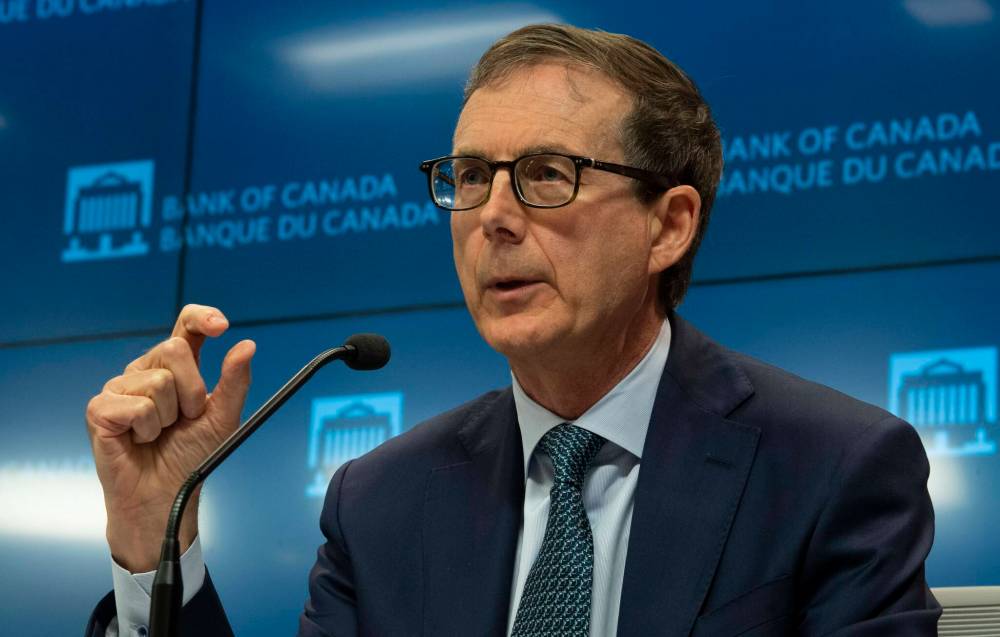
Adrian Wyld/THE CANADIAN PRESS
Bank of Canada Governor Tiff Macklem said in March that the federal carbon tax adds at least half a percentage point to inflation annually.
This helps explain why, over most of the past two years, the federal Liberals have been primarily in denial about inflation, characterizing it as merely a temporary annoyance. They have also introduced no new policies to directly address inflation impacts. At most, they have rehashed already-announced measures as somehow addressing inflation, too.
This leaves us in a conundrum. Other countries, notably the U.S., are at least trying to offset adverse impacts, while Canada has effectively been doing little to nothing.
Yes, food inflation is a complex problem, but complexity is not an excuse for inaction. Indeed, there are short-term measures that could at least help beleaguered Canadians to some degree. In this regard, there are important but less obvious linkages to federal environmental policy, in particular the federal carbon tax.
The marquee Liberal climate policy has been a national carbon price, which is really a form of tax. Yet, imposing such a tax also has unintended consequences. Even with fancy revenue recycling, increasing the price of fuels via a carbon tax inevitably pushes up the Consumer Price Index, an unavoidable economic reality.
Indeed, back in March, Bank of Canada governor Tiff Macklem admitted the carbon tax adds at least half a percentage point of inflation annually.
Canceling the carbon tax has already been suggested from several perspectives, but some would ask why should we alter such an important policy? The response is easy: firstly, the tax has never worked to accomplish its intended policy goal; and secondly, it is now largely irrelevant.
The carbon tax was supposed to produce large and rapid reductions of greenhouse-gas emissions, by 80 to 90 million tonnes by 2022 alone. These are obviously not happening. As my students have continued to evaluate, we see the tax to be entirely ineffective and expensive.
The tax also continues to be unfair. Suggestions that eight of 10 families somehow gain back more are utter fabrications, never proven. While well-off families do spend more in total on energy, low-income families spend proportionately almost double on energy. Thus, they are affected much more by the tax.
When considering liquid fossil fuels, everyone thinks immediately of gasoline. Everyone forgets about diesel. Gasoline is used overwhelmingly for passenger vehicles, while diesel, on the other hand, is used overwhelmingly in transport trucks, but also in transit and school buses. Still, emissions from diesel are almost as large as those for gasoline.
A few years ago, an opposition politician characterized the carbon tax as a “tax on everything.” All the food we eat, as well as all other goods we need and use, are moved around using diesel, frequently covering surprisingly large distances. Modern businesses operate their supply chains according to the paradigm of “just-in-time” or JIT, and JIT itself depends critically on one single fuel: diesel.
Because the carbon tax applies to diesel, and because transport companies get no breaks and need to just pass on the cost, the tax on diesel does end up effectively becoming a tax on everything we use, including (and especially) our food.

At the same time, owing primarily to the Ukraine situation, fuel prices have shot up dramatically higher, with price impacts far exceeding the amount of the carbon tax. When market conditions are already producing significant downward pressures on fossil-fuel consumption, is the tax really needed any longer?
Removing the carbon tax, at least on a temporary basis, is a practical measure to at least assist in addressing impacts of food inflation. It is doable, would show the government is listening, would provide some immediate relief, and would have negligible effects on the emissions performance of the country.
The clear priority in this regard is removing the carbon tax on diesel, given the critical dependence of food supply chains.
Other environmental measures can be also raised that could assist with food and nutrition security, but more on that later. In the meantime, dropping the carbon tax, whether fully or selectively, is a good first step.
Robert Parsons teaches on the topics of sustainability economics, mathematical methods and supply chains at the I.H. Asper School of Business, University of Manitoba.

Advertisement Advertise With Us
Advertisement Advertise With Us