
Life gradually returns a year after fire chars Sierra Nevada

Advertisement

Advertise with us

LONE PINE, Calif. (AP) — The flames fade away. Firefighters extinguish the last embers. A final curl of smoke uncoils in the wind.

Read this article for free:


or

Already have an account? Log in here »

To continue reading, please subscribe:

Subscribe and receive a limited-edition Free Press branded hat or tote.

Digital Subscription

One year of digital access for only $205*

  • Enjoy unlimited reading on winnipegfreepress.com
  • Read the E-Edition, our digital replica newspaper
  • Access News Break, our award-winning app
  • Play interactive puzzles

*First annual payment billed as $205.00 + GST for one year. This annual subscription will automatically renew at $233.00 + GST every 52 weeks (10% off the regular annual price of $259.35). Offer available to new and qualified returning subscribers only. Cancel any time.

To continue reading, please subscribe:

Add Free Press access to your Brandon Sun subscription for only an additional

$1 for the first 4 weeks*

  • Enjoy unlimited reading on winnipegfreepress.com
  • Read the E-Edition, our digital replica newspaper
  • Access News Break, our award-winning app
  • Play interactive puzzles
Start now

*Your next Brandon Sun subscription payment will increase by $1.00 and you will be charged $17.95 plus GST for four weeks. After four weeks, your payment will increase to $24.95 plus GST every four weeks.

Hey there, time traveller!
This article was published 10/08/2022 (1528 days ago), so information in it may no longer be current.

LONE PINE, Calif. (AP) — The flames fade away. Firefighters extinguish the last embers. A final curl of smoke uncoils in the wind.

A wildfire in the California wilderness has come to an end, and what’s left behind is a blackened landscape of skeletal pines and leafless oaks, scorched meadows and ashen stumps where saplings once stood.

Then, slowly, life returns.
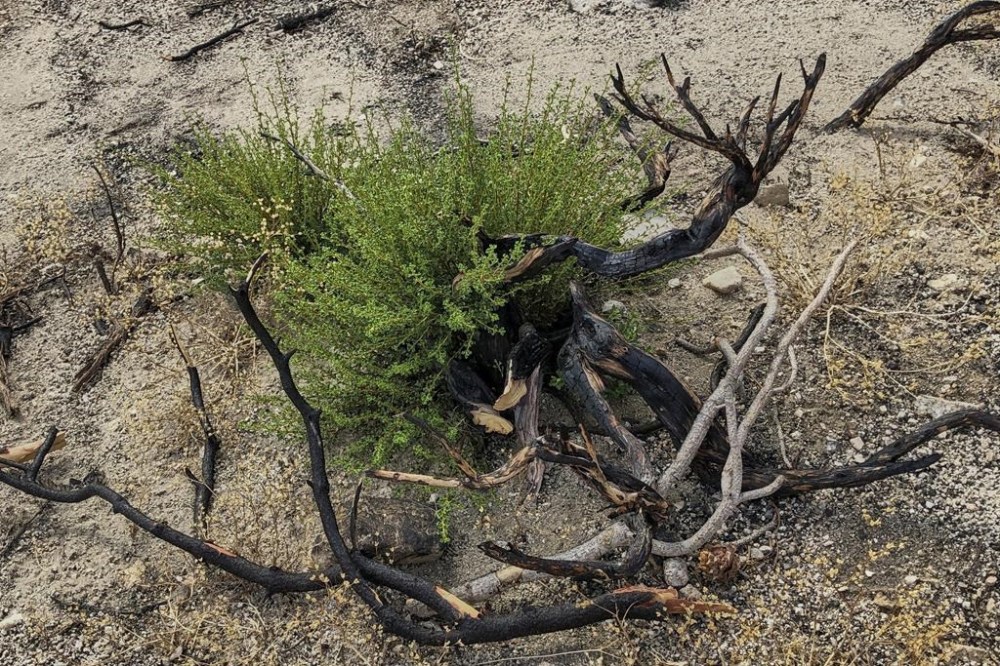
One year after a wind-fed wildfire charged across a craggy mountainside above Lone Pine, Calif., flashes of new vegetation growth can be seen emerging in this still-charred corner of the Inyo National Forest, on Wednesday, July 27, 2022, a hiking, climbing and fishing playground about 350 miles (563 km) southeast of San Francisco. (AP Photo/Michael Blood)

One year after a wind-whipped wildfire charged across a craggy mountainside above Lone Pine, California, flashes of new growth are emerging in this still-charred corner of the Inyo National Forest, a hiking, camping and fishing playground about 350 miles (563 km) southeast of San Francisco.

Tiny clusters of white and purple wildflowers stand out against denuded pines, many stripped of bark in the fire. Green shoots of horsetail as thin as yarn strands break from the ground below a tree’s barren branches. A fistful of new leaves emerges like a fresh bouquet from within an incinerated stump.

It’s the start of a long recovery, and a cycle that’s being repeated more often across the West as climate change brings drier, hotter seasons and more wildland fires.

As it roars across the landscape, a fire burns at different intensities. Some of the towering trees on the hillside are dead, others only singed and can recover. The first plants to reappear after a burn typically have grown more resistant over time to the flames.

“Some of the shrub species and other grass species are more fire-adapted, and they can come back quicker,” said Todd Ellsworth, a post-fire restoration program manager with the U.S. Forest Service.

But it can be five years before the ground cover returns to what it was before the blaze. One stand of pinyon pines was heavily damaged – needles burned off the branches, their trunks torched black – and will not come back.

“The conifer trees don’t come back very quickly,” Ellsworth said, referring to certain pines and other trees that bear cones. Sometimes, it’s up to foresters to go in and replant them.

The tiny, fragile flowers and patches of fresh growth against a stark mountainside and slabs of gray rock were a reminder that wildfire is part of the ecosystem in California, including the eastern Sierra Nevada where the fire took place.

Firefighters said they used minimum-impact techniques to fight the blaze because “natural fire plays an important role in maintaining the landscape within these areas.”

Some species only flower after a wildfire.

The area of the blaze — not far from the trailhead to Mt. Whitney, at 14,505 feet (4,421 meters) the highest mountain the contiguous United States — is home to Sierra Nevada bighorn sheep, an endangered species, and to the whitebark pine, an endangered species candidate.

News reports and press releases from June and July 2021 attributed the wildfire to a lightning strike and said the nearly 600-acre (243-hectare) blaze fanned by winds forced evacuations and cut off access to nearby roads, hiking trails and campgrounds. Firefighters used helicopters to dump water on the fire, which burned across rugged terrain.

The effects of climate change can be significant on forest regeneration.

One 2018 study in the journal Ecology Letters that looked at nearly 1,500 wildfire sites found that because of hotter and drier climates, fewer forests are returning to their pre-burn tree mix, and in some cases trees did not return at all.

Camille Stevens-Rumann, an assistant professor at Colorado State University and co-author of the study, said wildfires have become larger and more intense, killing more trees, while also happening more frequently.

“We have a lot of places that are probably climatically different than when those (conifer) species were established,” she said, which means they can struggle when trying to recover after a burn.

If a hotter, drier climate is unsuitable for those trees to come back, “they won’t recover,” she added.

Report Error Submit a Tip

More Stories

‘We know we’re not going to beat Mother Nature’: Ice prep begins at Princess Auto Stadium for Heritage Classic

Mike McIntyre 6 minute read Preview

‘We know we’re not going to beat Mother Nature’: Ice prep begins at Princess Auto Stadium for Heritage Classic

Mike McIntyre 6 minute read Tuesday, Oct. 13, 2026

Derek King typically has ice in his veins.

But the Manitoban admits there may be a few more butterflies than usual as he prepares for the ultimate home game — the 2026 Heritage Classic between the Winnipeg Jets and Montreal Canadiens.

“This is so exciting to be back,” King, the NHL’s vice-president of hockey operations and facilities operations, said Tuesday afternoon.

“It’s definitely going to be a fun event to be part of.”

Read
Tuesday, Oct. 13, 2026

Life gradually returns a year after fire chars Sierra Nevada

Michael R. Blood, The Associated Press 4 minute read Preview

Life gradually returns a year after fire chars Sierra Nevada

Michael R. Blood, The Associated Press 4 minute read Wednesday, Aug. 10, 2022

LONE PINE, Calif. (AP) — The flames fade away. Firefighters extinguish the last embers. A final curl of smoke uncoils in the wind.

A wildfire in the California wilderness has come to an end, and what’s left behind is a blackened landscape of skeletal pines and leafless oaks, scorched meadows and ashen stumps where saplings once stood.

Then, slowly, life returns.

One year after a wind-whipped wildfire charged across a craggy mountainside above Lone Pine, California, flashes of new growth are emerging in this still-charred corner of the Inyo National Forest, a hiking, camping and fishing playground about 350 miles (563 km) southeast of San Francisco.

Read
Wednesday, Aug. 10, 2022

Chief says minister offered money to remove highway checkstop

Kelly-Anne Riess 5 minute read Preview

Chief says minister offered money to remove highway checkstop

Kelly-Anne Riess 5 minute read Wednesday, Oct. 14, 2026

The chief of the Bloodvein River First Nation says a Manitoba cabinet minister offered up to $250,000 for economic development as he was trying to persuade her to remove a highway checkstop that has outraged hunters.

Read
Wednesday, Oct. 14, 2026

Possibility of Hellebuyck’s return grows each day as pay slips away

Mike McIntyre 7 minute read Preview

Possibility of Hellebuyck’s return grows each day as pay slips away

Mike McIntyre 7 minute read Wednesday, Oct. 14, 2026

CHICAGO — Buckle up, folks. The next plot twist in the ongoing soap opera between the Winnipeg Jets and Connor Hellebuyck could be a doozy.

Let’s start with a few cold, hard facts. Or, if you prefer: “Previously on As the Hellebuyck Turns…”

The franchise goaltender, with five years remaining on a contract extension he willingly signed with Winnipeg in 2023, refused to report to training camp last month as he awaits word on a trade request made at the end of last season. He’s the first NHL player in more than a quarter century to essentially go on strike.

The Jets are under no obligation to move Hellebuyck, but have indicated they would try to accommodate him if another team meets their needs. General manager Kevin Cheveldayoff has made it clear he needs to “get this right” and wants a haul for a three-time Vezina Trophy winner and one-time Hart Trophy recipient.

Read
Wednesday, Oct. 14, 2026

Get to know your Jet: Neal Pionk

Mike McIntyre 6 minute read Preview

Get to know your Jet: Neal Pionk

Mike McIntyre 6 minute read Yesterday at 5:41 PM CDT

“Give it 110 per cent.” “Get pucks in deep.” “One shift at a time.” “Play our game.” “Keep it simple.”

Hockey has a language all its own. Unfortunately, after hearing the same phrases repeated often enough, that language can start to sound a lot like white noise.

So we’re going to try something different.

The Free Press will occasionally sit down with a Winnipeg Jets player at his locker-room stall for a wide-ranging conversation about the stuff you don’t always hear in a media scrum.

Read
Yesterday at 5:41 PM CDT

Chronic kidney disease must be recognized

Carrie Thibodeau 5 minute read 2:00 AM CDT

Canada needs a strong plan of action to tackle chronic kidney disease.

Canada is facing a looming health crisis that remains largely unaddressed and invisible at the policy and health system level. More than four million Canadians live with chronic kidney disease (CKD) and 50,000 currently receive dialysis or are living with a transplant, both life-sustaining but burdensome treatments.

With no cure, CKD profoundly impacts quality of life, contributing to lost income, overall poor health, and uncertainty about the future. The implications of CKD extend far beyond patients and families. CKD is now the 11th leading cause of death in Canada and one of our most expensive chronic diseases. Health-care costs exceed $11.7 billion annually, with most expenses incurred in the later stages of the disease, particularly dialysis and transplantation.

By 2050, the total cost burden of CKD is projected to rise to $17.6 billion and an estimated 6.2 million Canadians will be affected, driven by an aging population and rising rates of diabetes and high blood pressure.


