

Zimbabwe moves 2,500 wild animals due to climate change
Advertisement
Read this article for free:
or
Already have an account? Log in here »
To continue reading, please subscribe:

Digital Subscription
One year of digital access for only $205*
- Enjoy unlimited reading on winnipegfreepress.com
- Read the E-Edition, our digital replica newspaper
- Access News Break, our award-winning app
- Play interactive puzzles
*First annual payment billed as $205.00 + GST for one year. This annual subscription will automatically renew at $233.00 + GST every 52 weeks (10% off the regular annual price of $259.35). Offer available to new and qualified returning subscribers only. Cancel any time.
To continue reading, please subscribe:
Add Free Press access to your Brandon Sun subscription for only an additional
$1 for the first 4 weeks*
- Enjoy unlimited reading on winnipegfreepress.com
- Read the E-Edition, our digital replica newspaper
- Access News Break, our award-winning app
- Play interactive puzzles
*Your next Brandon Sun subscription payment will increase by $1.00 and you will be charged $17.95 plus GST for four weeks. After four weeks, your payment will increase to $24.95 plus GST every four weeks.
Read unlimited articles for free today:
or
Already have an account? Log in here »
Hey there, time traveller!
This article was published 01/09/2022 (1475 days ago), so information in it may no longer be current.
HARARE, Zimbabwe (AP) — A helicopter herds thousands of impalas into an enclosure. A crane hoists sedated upside-down elephants into trailers. Hordes of rangers drive other animals into metal cages and a convoy of trucks starts a journey of about 700 kilometers (435 miles) to take the animals to their new home.
Zimbabwe has begun moving more than 2,500 wild animals from a southern reserve to one in the country’s north to rescue them from drought, as the ravages of climate change replace poaching as the biggest threat to wildlife.
About 400 elephants, 2,000 impalas, 70 giraffes, 50 buffaloes, 50 wildebeest, 50 zebras, 50 elands, 10 lions and a pack of 10 wild dogs are among the animals being moved from Zimbabwe’s Save Valley Conservancy to three conservancies in the north — Sapi, Matusadonha and Chizarira — in one of southern Africa’s biggest live animal capture and translocation exercises.
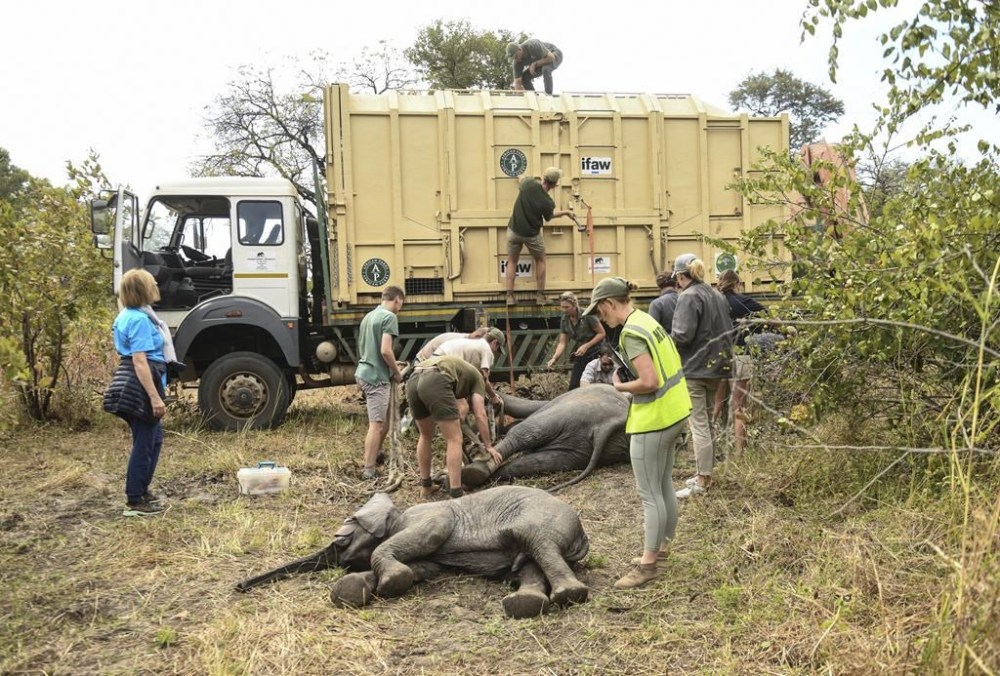
“Project Rewild Zambezi,” as the operation is called, is moving the animals to an area in the Zambezi River valley to rebuild the wildlife populations there.
It’s the first time in 60 years that Zimbabwe has embarked on such a mass internal movement of wildlife. Between 1958 and 1964, when the country was white-minority-ruled Rhodesia, more than 5,000 animals were moved in what was called “Operation Noah.” That operation rescued wildlife from the rising water caused by the construction of a massive hydro-electric dam on the Zambezi River that created one of the world’s largest man-made lakes, Lake Kariba.
This time it’s the lack of water that has made it necessary to move wildlife as their habitat has become parched by prolonged drought, said Tinashe Farawo, spokesman for the Zimbabwe National Parks and Wildlife Management Authority.
The parks agency issued permits to allow the animals to be moved to avert “a disaster from happening,” said Farawo.
“We are doing this to relieve pressure. For years we have fought poaching and just as we are winning that war, climate change has emerged as the biggest threat to our wildlife,” Farawo told The Associated Press.
“Many of our parks are becoming overpopulated and there is little water or food. The animals end up destroying their own habitat, they become a danger unto themselves and they encroach neighboring human settlements for food resulting in incessant conflict,” he said.
One option would be culling to reduce the numbers of wildlife, but conservation groups protest that such killings are cruel. Zimbabwe last did culling in 1987, said Farawo.
The effects of climate change on wildlife is not isolated to Zimbabwe. Across Africa, national parks that are home to myriad wildlife species such as lions, elephants and buffaloes are increasingly threatened by below-average rainfall and new infrastructure projects. Authorities and experts say drought has seriously threatened species like rhinos, giraffes and antelope as it reduces the amount of food available.
For example, a recent study conducted in South Africa’s Kruger National Park linked extreme weather events to the loss of plants and animals, unable to cope with the drastic conditions and lack of water due to longer dry spells and hotter temperatures.
The mass movement is supported by the Great Plains Foundation, a non-profit organization that works “to conserve and expand natural habitats in Africa through innovative conservation initiatives,” according to its website. The organization is working with the Zimbabwe National Parks and Wildlife Management Authority, local experts, the University of Washington-Seattle’s Center for Environmental Forensic Science and Oxford University’s Department of Zoology, according to the website.
One of the new homes for the animals moved in Zimbabwe is Sapi Reserve. the privately-run 280,000-acre private concession is east of Mana Pools National Park, a UNESCO World Heritage Site known for its splendid setting along the Zambezi River that forms the border between Zimbabwe with Zambia.
Sapi “is the perfect solution for many reasons,” Great Plains chief executive officer Dereck Joubert said on the foundation’s website.
“This reserve forms the middle-Zambezi biosphere, totaling 1.6 million acres,” wrote Joubert. “From the 1950s until we took it over in 2017, decades of hunting had decimated wildlife populations in Sapi Reserve. We are rewilding and restoring the wild back to what it once was.”