On Colombia’s San Andres, a historic church’s roots run deep

Advertisement

Advertise with us

SAN ANDRES, Colombia (AP) — First Baptist Church was born by a tamarind tree perched on a hill overlooking the turquoise waters of the Caribbean.

Read this article for free:


By clicking the button above, an account will be created and you will begin to receive some of our recommended newsletters. You may opt out of any newsletter by visiting your Email and Communication Preferences page or by clicking "unsubscribe" at the bottom of any email.

or

Already have an account? Log in here »

To continue reading, please subscribe:

Digital Subscription

One year of digital access for only $1.44 a week*

  • Enjoy unlimited reading on winnipegfreepress.com
  • Read the E-Edition, our digital replica newspaper
  • Access News Break, our award-winning app
  • Play interactive puzzles

*Billed as $5.77 plus GST every four weeks. After 52 weeks, price increases to the regular rate of $19.95 plus GST every four weeks. Offer available to new and qualified returning subscribers only. Cancel any time.

To continue reading, please subscribe:

Add Free Press access to your Brandon Sun subscription for only an additional

$1 for the first 4 weeks*

  • Enjoy unlimited reading on winnipegfreepress.com
  • Read the E-Edition, our digital replica newspaper
  • Access News Break, our award-winning app
  • Play interactive puzzles
Start now

*Your next Brandon Sun subscription payment will increase by $1.00 and you will be charged $17.95 plus GST for four weeks. After four weeks, your payment will increase to $24.95 plus GST every four weeks.

Hey there, time traveller!
This article was published 04/09/2022 (1507 days ago), so information in it may no longer be current.

SAN ANDRES, Colombia (AP) — First Baptist Church was born by a tamarind tree perched on a hill overlooking the turquoise waters of the Caribbean.

Under the tree’s shade, First Baptist’s founder taught English-speaking former slaves and their descendants how to read using the Bible. The tree still stands more than 175 years later — even if crooked after surviving devastating hurricanes.

The church is so crucial to the history of the Colombian island of San Andres that detailed record of births and deaths are kept here in crumbling books that date back nearly two centuries.
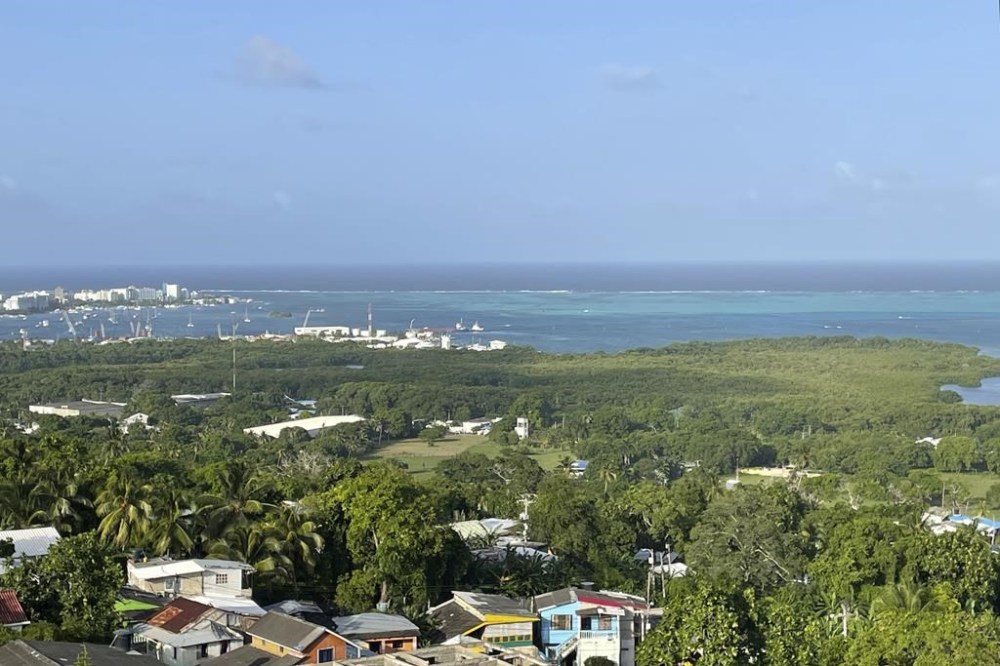
Colombia's San Andres Island is seen from a mirador on the steeple of First Baptist Church on Thursday, Aug. 18, 2022. Over a century after being claimed by Spain, San Andres was first settled in the 1630s by English Puritans. It later became an outpost for pirates and today is home to many descendants of Puritans and African slaves, and also large numbers of more recent arrivals from mainland Colombia. (AP Photo/Luis Andres Henao)

The “mother church,” as it is often called, is a source of pride for the Raizals, the English-speaking, mostly Protestant inhabitants of San Andres, Providencia and the smaller islands and keys that form an archipelago in the western Caribbean near Nicaragua, about 440 miles (710 kilometers) from the Colombian mainland.

“For a young person like me, it’s finding my roots — it’s good to know where we come from,” said the Rev. Shuanon Hudgson, 26, the church’s associate pastor.

“It’s like Marcus Garvey says,” quoting the Jamaica-born, early 20th-century Black nationalist: “‘A people without knowledge of their past history, origin and culture is like a tree without roots.’ And this church has been a pillar.”

Under the tree, a stone plaque commemorates the birth of the congregation: “Baptist work was established here by Rev. Phillip Beekman Livingston (Jr.) in 1844.”

Three years later the congregation began to meet nearby under a thatched hut.

It kept growing, and a building made in the style of the large Anglican churches of Jamaica was ordered. First built in the late 19th century in Mobile, Alabama, and then moved to New York City, the white-walled church was disassembled and shipped to the island piece by piece.

Parishioners carried the foundations on their backs from the port to one of the highest points on the island, a neighborhood known as the Hill, said Lastenia Herrera May, the wife of the current lead pastor, the Rev. Ronald Hooker, and the church was dedicated on Feb. 2, 1896.

A scenic overlook more than 100 feet up in the steeple offers some of the best views of San Andres.

Over a century after being claimed by Spain, the island was first settled in the 1630s by English Puritans. It later became an outpost for pirates and today is home to many descendants of Puritans and African slaves, and also large numbers of more recent arrivals from mainland Colombia.

Sharika Crawford, a professor of history at the United States Naval Academy in Annapolis, Maryland, whose research focuses on Colombia and its African-descended peoples, said First Baptist “was the bedrock of the Raizal community” and “the most important social institution” in the archipelago.

From its founding until 1913, she said, its pastors held great authority over the community in shaping islanders’ values and behavior.

“Before the church was formed, the island population lived without a church or religious establishment. Efforts to bring a Catholic priest never materialized,” Crawford said. “Thus, First Baptist Church and its satellite churches across San Andres and Providencia Islands had the advantage over other Christian communities such as the Catholics and Seventh-day Adventists.”
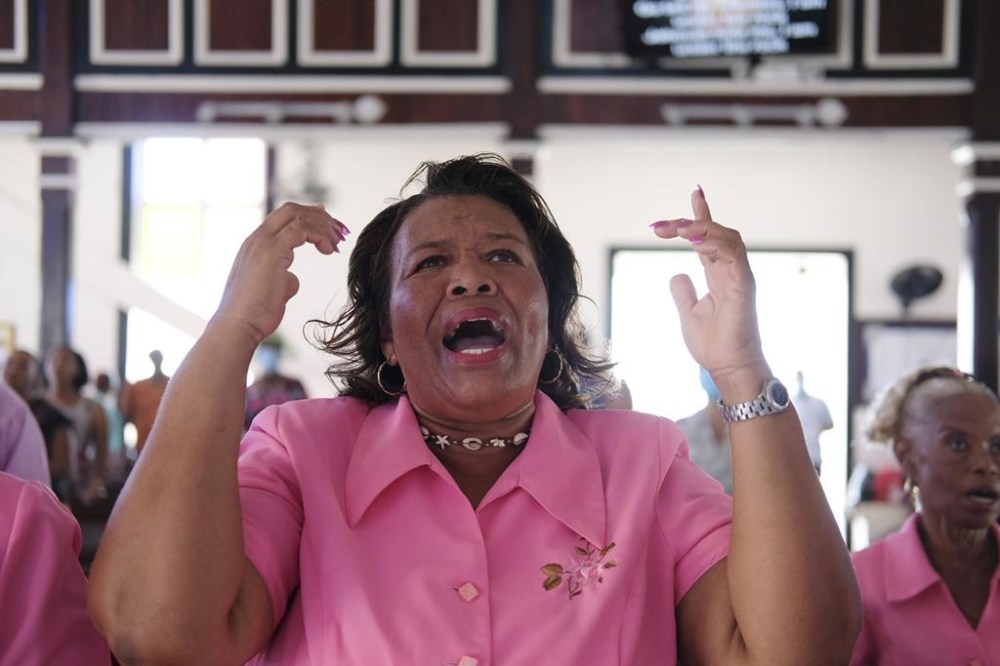
A choir member sings hymns at First Baptist Church on Colombia's San Andres island on Sunday, Aug. 21, 2022. The church is a source of pride for the Raizals, the English-speaking, mostly Protestant inhabitants of San Andres and smaller islands that form an archipelago in the western Caribbean. (AP Photo/Luis Andres Henao)

“The church had glorious moments,” Herrera May said. “By the 1900s, thousands had converted.”

Livingston, the founder, first evangelized among enslaved and freed people of San Andres, Crawford said, and the church remains a symbol of the anti-slavery struggle. Each year people from congregations across the islands gather here Aug. 1 to celebrate events commemorating emancipation.

During a recent Sunday service, Lucia Barker, 83, and other women in the choir, clothed in bright pink shirts, sang hymns. Parishioners in wooden pews, illuminated by sunlight from stained-glass windows, swayed, lifted their arms and sang along to songs infused with Calypso beats.

“This church is my life,” Barker said of the sanctuary where she was baptized, married and has worshipped for more than seven decades.

In his homily, Hudgson, the associate pastor, asked congregants to remember the sacrifice of their enslaved ancestors. He called on them to be resilient against adversity, just as the tree and the church, and listed by name and year the many hurricanes that both survived.

“Here we get the knowledge about our land, our history, how we started by this tamarind tree, how we have a church,” choir member Marjeen Martínez said. “It’s very important to maintain our roots alive.”

___

Associated Press religion coverage receives support through the AP’s collaboration with The Conversation US, with funding from Lilly Endowment Inc. The AP is solely responsible for this content.

Report Error Submit a Tip

The Free Press acknowledges the financial support it receives from members of the city’s faith community, which makes our coverage of religion possible.

More Stories

Empty desks: Advocates talk chronic school absenteeism

Maggie Macintosh 5 minute read Preview

Empty desks: Advocates talk chronic school absenteeism

Maggie Macintosh 5 minute read 6:00 AM CDT

Concerned school and government leaders are downplaying the state of student absenteeism, as community organizers are strategizing to create urgency around who’s regularly missing class — and why — in Winnipeg.

The inaugural Youth at Risk in Winnipeg Symposium, held over the weekend at the Canadian Mennonite University, drew roughly 100 people to discuss barriers to attendance and brainstorm ways to remove them.

Nearly 20 years after he began calling attention to the issue, first as a volunteer with the Point Douglas Residents Committee, Sel Burrows gave an impassioned speech about the lack of political will to take meaningful action to help students from “dysfunctional homes.”

“I’ve dealt with nine cabinet ministers, Conservative and NDP, and five deputy ministers, and the issue has not gotten any better,” Burrows told teachers, reseachers and community support workers gathered Saturday on CMU’s Shaftesbury campus.

Read
6:00 AM CDT

Today’s horoscope

Georgia Nicols 4 minute read Preview

Today’s horoscope

Georgia Nicols 4 minute read 2:00 AM CDT

MOON ALERT: There are no restrictions to shopping or important decisions today. The moon is in Aquarius.

ARIES (March 21-April 19)

This can be a lovely, friendly and romantic day if you can avoid intense discussions about shared property, inheritances and anything jointly held. Focus on what works. Avoid people who are intent on getting their way – not yours.

TAURUS (April 20-May 20)

Read
2:00 AM CDT

Buhler Versatile completes Atlas Group acquisition

Free Press staff 2 minute read 2:01 AM CDT

Winnipeg-based Buhler Versatile Inc. announced on Monday the completion of its acquisition of German construction machinery manufacturer Atlas Group.

The transaction was first announced in June and officially closed on Oct. 1, following the satisfaction of the required closing conditions. Financial terms of the deal will remain confidential, the company said in a news release. As part of the acquisition, more than 200 jobs at Atlas will be retained.

“The completion of this acquisition marks an important milestone for Buhler Versatile and our long-term growth strategy,” Zafer Ozbalaban, president of Buhler Versatile, said in the release. “Atlas brings an established European brand, valuable engineering expertise and a strong manufacturing heritage. Together, we have an opportunity to expand our capabilities, strengthen our international presence and build a more diversified equipment manufacturing business.”

The addition of Atlas broadens Buhler Versatile’s equipment portfolio beyond its agricultural equipment brand, expanding into construction and material handling equipment. It also strengthens the company’s European manufacturing presence, with Atlas continuing operations at its established locations, including Ganderkesee, Delmenhorst and Vechta in Germany, and Bradford, England.

Campaign blunder: Klein features wrong city in election video

Malak Abas 4 minute read Preview

Campaign blunder: Klein features wrong city in election video

Malak Abas 4 minute read Yesterday at 4:08 PM CDT

A paid ad from mayoral candidate Kevin Klein on his commitment to Winnipeg has been pulled after commenters noticed one small error: the footage used in the ad was actually of Edmonton.

Read
Yesterday at 4:08 PM CDT

Spinning yarns into comedy, chaos and hope

Denise Duguay 5 minute read Preview

Spinning yarns into comedy, chaos and hope

Denise Duguay 5 minute read 2:00 AM CDT

“I watch ALL the new TV,” I recently bragged at a family Thanksgiving, a fiction that I was rightly called out on.

But I do watch a lot and, more than that, I read about as close to all the upcoming TV as I can. It’s not (usually) for bragging rights but because stories are either distractions or inspiration and both are now more valuable than ever. Here are a handful of worthy-looking new series and docs.

●Phony (series premières today (Oct. 20) on Disney+/Hulu)

High schooler Sonny (Sam Nivola, The White Lotus) has every reason to be faltering in his perception of reality. He did, after all, just barely survive a terrible car accident. But his friends and the other responsible adults in his life are having a hard time with his insistence that his single mom and the school’s principal (Connie Britton) has been replaced by an imposter. Is he suffering from brain trauma or is a sinister plot afoot? This is billed as comedy/mystery, which is an intriguing combo.

Read
2:00 AM CDT

Would Canada actually spy on Cuba?

Peter McKenna 5 minute read Preview

Would Canada actually spy on Cuba?

Peter McKenna 5 minute read 2:00 AM CDT

The Globe and Mail recently ran a series of stories on how “Havana syndrome” negatively impacted a number of diplomats working at the Canadian embassy in Cuba. As of this writing, there has been unusual radio silence on the topic from Mark Carney’s governing Liberals.

The reportage also linked the so-called “sonic attacks” or what the Americans call “anomalous health incidents” (and the attendant concussion-like symptoms) to a Russian high-frequency microwave weapon. More importantly, the Globe maintained that Moscow’s retaliation against Canadian officials in Havana was because of their close co-operation with U.S. intelligence agencies in spying on the Cuban government.

Some of the articles claimed that high-tech satellite gear, which was brought into Cuba covertly by U.S. officials, was installed on the roofs of the residences of Canadian diplomats in Havana. Presumably, Canadian officials — or what are sometimes referred to as officers or agents working under the Global Security Reporting Program (GSRP) within the Department of Global Affairs — were using this satellite technology to collect intelligence on human sources in Cuba.

The secret information was eventually passed on to Canada’s partners in the so-called “Five Eyes” alliance (the U.S., Australia, Britain and New Zealand). It’s worth pointing out that this wouldn’t have been the first time Canadian officials in Cuba were funnelling sensitive intelligence to their U.S. counterparts.

Read
2:00 AM CDT