

Would Canada actually spy on Cuba?
Advertisement
Read this article for free:
or
Already have an account? Log in here »
To continue reading, please subscribe:
Digital Subscription
One year of digital access for only $1.44 a week*
- Enjoy unlimited reading on winnipegfreepress.com
- Read the E-Edition, our digital replica newspaper
- Access News Break, our award-winning app
- Play interactive puzzles
*Billed as $5.77 plus GST every four weeks. After 52 weeks, price increases to the regular rate of $19.95 plus GST every four weeks. Offer available to new and qualified returning subscribers only. Cancel any time.
To continue reading, please subscribe:
Add Free Press access to your Brandon Sun subscription for only an additional
$1 for the first 4 weeks*
- Enjoy unlimited reading on winnipegfreepress.com
- Read the E-Edition, our digital replica newspaper
- Access News Break, our award-winning app
- Play interactive puzzles
*Your next Brandon Sun subscription payment will increase by $1.00 and you will be charged $17.95 plus GST for four weeks. After four weeks, your payment will increase to $24.95 plus GST every four weeks.
Read unlimited articles for free today:
or
Already have an account? Log in here »
The Globe and Mail recently ran a series of stories on how “Havana syndrome” negatively impacted a number of diplomats working at the Canadian embassy in Cuba. As of this writing, there has been unusual radio silence on the topic from Mark Carney’s governing Liberals.
The reportage also linked the so-called “sonic attacks” or what the Americans call “anomalous health incidents” (and the attendant concussion-like symptoms) to a Russian high-frequency microwave weapon. More importantly, the Globe maintained that Moscow’s retaliation against Canadian officials in Havana was because of their close co-operation with U.S. intelligence agencies in spying on the Cuban government.
Some of the articles claimed that high-tech satellite gear, which was brought into Cuba covertly by U.S. officials, was installed on the roofs of the residences of Canadian diplomats in Havana. Presumably, Canadian officials — or what are sometimes referred to as officers or agents working under the Global Security Reporting Program (GSRP) within the Department of Global Affairs — were using this satellite technology to collect intelligence on human sources in Cuba.
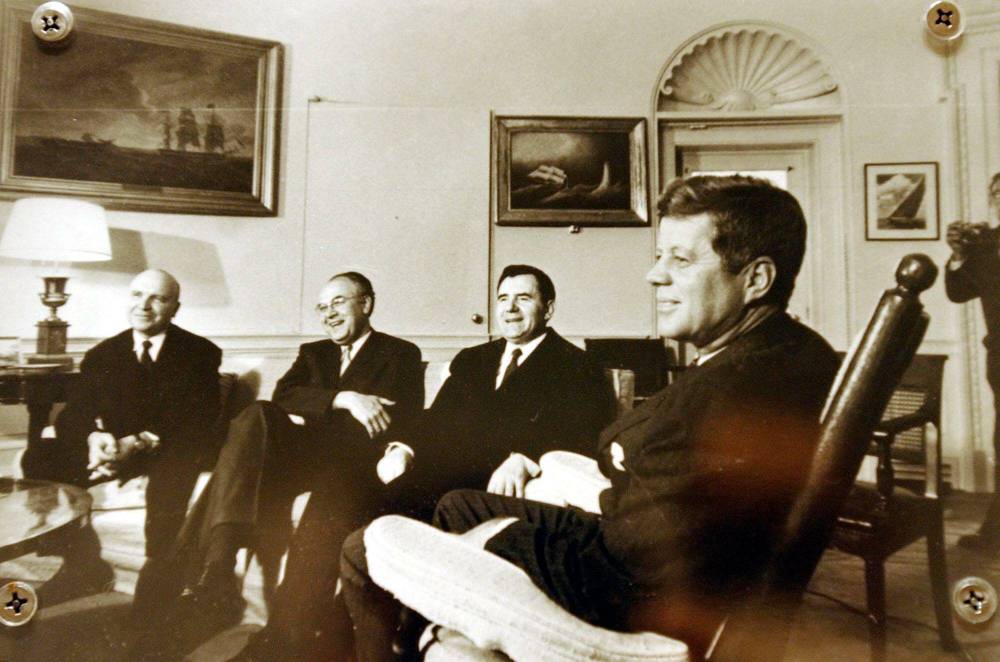
The Associated Press files
U.S. President John F. Kennedy (right) meets with Soviet officials in the Oval Office in October 1962, during the Cuban missile crisis. When the crisis was defused, a Canadian diplomat passed intelligence to the U.S.
The secret information was eventually passed on to Canada’s partners in the so-called “Five Eyes” alliance (the U.S., Australia, Britain and New Zealand). It’s worth pointing out that this wouldn’t have been the first time Canadian officials in Cuba were funnelling sensitive intelligence to their U.S. counterparts.
After the 1962 Cuban Missile Crisis had been defused, one Canadian diplomat was tasked with verifying whether Moscow had actually followed through on its pledge to dismantle the ballistic missile launchers and to decrease the number of Soviet military personnel on the island. The core objective — especially since virtually every CIA agent in the country had been rounded up by the country’s vaunted counter-intelligence service (G-2) — was to record what was happening on Soviet bases in Cuba, to monitor any troop movements and to identify weapons systems and sophisticated electronic/communications equipment. These secret reports of Soviet FKR-1 cruise missiles, surface-to-air missiles and Komar-class guided-missile patrol boats ultimately ended up at CIA headquarters in Langley, Va.
Canadian diplomats also sought to gather intelligence by cultivating informants from within the government, domestic opposition groups and the Cuban general public. Canadian tourists visiting the country for sun and sand often provided sensitive information to Canadian officials in Havana. Interestingly, there were even reports that Canadian Catholic priests and nuns living and working in Cuba also collected human intelligence.
The Kennedy administration asked Prime Minister Lester Pearson to spy on its behalf in Cuba. Moreover, Kennedy and other U.S. presidents were adamant that Canada should not contemplate severing diplomatic relations with the island. Even when Pierre Trudeau was in office, the U.S. government encouraged Canada to continue on with its various espionage activities.
The central arguments for assisting U.S. spying efforts in Cuba boiled down to three key elements.
First, it was hoped that Canada’s intel-sharing and co-operation would serve to undercut any criticism from Washington officialdom of Ottawa’s outwardly cordial relationship with revolutionary Cuba since 1959.
Second, Canadian officials believed that doing so would boost Canada’s street cred and demonstrate its bona fides as a valued member of the Five Eyes. Last, there were those who believed, mistakenly, that Canada’s intelligence-gathering collaboration would enable Ottawa to influence U.S. policy on Cuba.
It is important to remember that Canada was spying on Cuba while maintaining uninterrupted diplomatic, commercial and people-to-people ties to the country. In fact, the Canadian government has for decades boasted about the independence and autonomy of Canada’s policy toward Cuba even in the face of substantial pressure from Washington to mimic its overly aggressive position.

Indeed, Canada was critical of the U.S. Bay of Pigs invasion and its longstanding economic blockade of Cuba. In fact, ever since Cuba brought a resolution condemning the U.S. embargo before the United Nations in the early 1990s, Canadian governments have consistently endorsed it. Ottawa was also dead-set against the Cuban Democracy Act, the Helms-Burton Law and just about any other U.S. effort to strangle the Cuban economy.
One wonders whether the Cuban authorities, though, knew all along that Canadian diplomats were spying on them. My sense from studying Canadian-Cuban relations for more than 30 years is that they most assuredly did. But Havana wasn’t going to upset the Canada-Cuba apple cart, as long as the Cubans believed that Ottawa could be helpful to them from a trade, diplomatic, tourism and propaganda standpoint.
Still, all this espionage intrigue clearly shows just how complicated and integrated the whole Canada-U.S.-Cuba triangle actually is. Furthermore, it speaks to how useful Canada has been to the U.S. over the years when it comes to collecting human intelligence on Cuba.
Unfortunately, it also raises serious questions about just how independent Canada’s Cuba policy has been since the early 1960s.
Peter McKenna is professor of political science at the University of Prince Edward Island in Charlottetown.