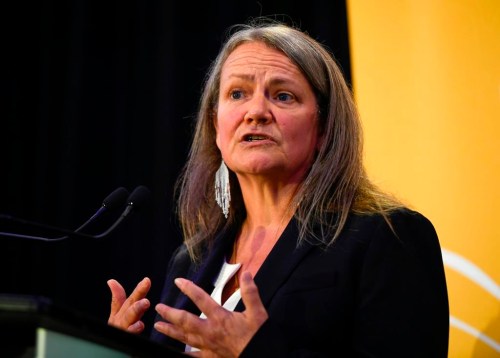
Presenters at National Gathering on Unmarked Burials want to break barriers

Advertisement

Advertise with us

EDMONTON - The smell of burning sage filled the banquet hall of an Edmonton hotel Wednesday as Indigenous elders, youth and women wearing colourful ribbon skirts listened to presenters at the first National Gathering on Unmarked Burials.

Read this article for free:


or

Already have an account? Log in here »

To continue reading, please subscribe:

Subscribe and receive a limited-edition Free Press branded hat or tote.

Digital Subscription

One year of digital access for only $205*

  • Enjoy unlimited reading on winnipegfreepress.com
  • Read the E-Edition, our digital replica newspaper
  • Access News Break, our award-winning app
  • Play interactive puzzles

*First annual payment billed as $205.00 + GST for one year. This annual subscription will automatically renew at $233.00 + GST every 52 weeks (10% off the regular annual price of $259.35). Offer available to new and qualified returning subscribers only. Cancel any time.

To continue reading, please subscribe:

Add Free Press access to your Brandon Sun subscription for only an additional

$1 for the first 4 weeks*

  • Enjoy unlimited reading on winnipegfreepress.com
  • Read the E-Edition, our digital replica newspaper
  • Access News Break, our award-winning app
  • Play interactive puzzles
Start now

*Your next Brandon Sun subscription payment will increase by $1.00 and you will be charged $17.95 plus GST for four weeks. After four weeks, your payment will increase to $24.95 plus GST every four weeks.

Hey there, time traveller!
This article was published 14/09/2022 (1490 days ago), so information in it may no longer be current.

EDMONTON – The smell of burning sage filled the banquet hall of an Edmonton hotel Wednesday as Indigenous elders, youth and women wearing colourful ribbon skirts listened to presenters at the first National Gathering on Unmarked Burials.

Reports from two days of sessions included information about archives, search technology and protecting burial sites.

Indigenous community members, federal ministers, and Catholic Church representatives responded to the reports with potential next steps.
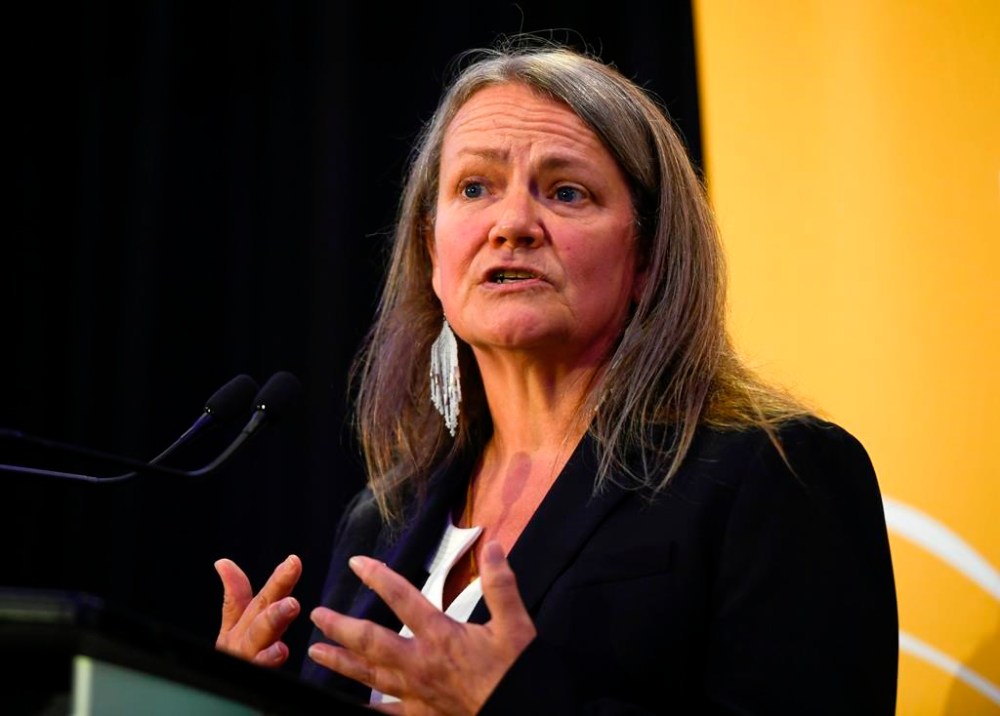
Kimberly Murray speaks after being appointed as Independent Special Interlocutor for Missing Children and Unmarked Graves and Burial Sites associated with Indian Residential Schools, at a news conference in Ottawa June 8, 2022. THE CANADIAN PRESS/Justin Tang

Kimberly Murray, special interlocutor for missing children and unmarked burials, called for an Indigenous-led investigation process that would follow Indigenous practices and protocols. This would act similarly to community, coroner and police investigations.

“The work of recovery can be done in ways that respect Indigenous protocols and respects and honours the family, children, survivors and communities,” said Murray.

One of the themes was pushing to get institutions like churches and universities to have records readily available for families of residential school victims.

“I encourage all those institutions to actually look in their archives and do the work, and not sit back,” she said.

Rev. Carmen Lansdowne, a representative of the United Church of Canada who is a member of Heiltsuk First Nation in British Columbia, teared up while addressing her conflicting relationship with residential schools and the church.

Lansdowne’s grandfather attended St. Michael’s residential school in Alert Bay for 12 years. When revisiting the trauma, he went into a coma for three months.

“It is a very mixed blessing to be the spiritual leader and the public representative of a church that operated residential schools,” said Lansdowne.

Murray was appointed earlier this year to work with Indigenous communities to help them search for unmarked burial sites.

She said her office will hold another gathering in Winnipeg in November and one in Vancouver in January.

Many investigations are being done at former residential schools across Canada following the discovery last year of what are believed to be 215 unmarked graves at a former school site in Kamloops, B.C.

An estimated 150,000 Indigenous children were forced to attend residential schools in Canada.

The Truth and Reconciliation Commission has documented stories from survivors and families detailing mistreatment at the schools, including emotional, physical and sexual abuse. It said there were at least 4,100 deaths at the institutions.

This report by The Canadian Press was first published Sept. 14, 2022

Report Error Submit a Tip

The Free Press acknowledges the financial support it receives from members of the city’s faith community, which makes our coverage of religion possible.

More Stories

Gang member who shot rival, bystander back in prison after release revoked

Erik Pindera 4 minute read Preview

Gang member who shot rival, bystander back in prison after release revoked

Erik Pindera 4 minute read Yesterday at 11:34 PM CDT

A Winnipeg man who shot a rival teenage gangster and an innocent 11-year-old bystander at the crowded Red River Exhibition more than four years ago has been sent back to prison.

Mocree Chuck Scatch-Dubour, now in his early 20s, left prison in April on statutory release on his 5 1/2-year federal sentence for the 2022 shooting. Scatch-Dubour was sentenced to the prison term as an adult in the spring of 2023 after pleading guilty to discharge of a firearm with intent to wound, aggravated assault and possession of a restricted firearm.

By law, most federal inmates automatically receive statutory release after two-thirds of their sentence, if they have not already been paroled.

Parole Board of Canada officials formally revoked Scatch-Dubour’s release this month after he unlawfully left his halfway house in June.

Read
Yesterday at 11:34 PM CDT

Woman accused of pulling handgun on taxi driver

1 minute read Yesterday at 10:39 AM CDT

A 45-year-old woman accused of pulling a handgun on a Winnipeg taxi driver is facing multiple firearms-related charges.

It happened Sunday afternoon, at about 2:30 p.m., near the intersection of Concordia Avenue and Louelda Street. Officers learned a woman got into a cab in the Munroe East neighbourhood and pulled out a handgun, asking the driver to take her to a specific location, the Winnipeg Police Service stated in a news release.

The taxi driver activated the taxi's emergency beacon, exited the vehicle, and contacted police.

The woman got into the driver's seat of the taxi, but the keys had been removed, and she fled on foot. A suspect was arrested shortly afterward in the 1000 block of Concordia Avenue. Police seized a .22-calibre handgun during the arrest.

A question of public utility

Tom Pearson 5 minute read 2:00 AM CDT

The editorial page of the Free Press often provides perspectives that are thought-provoking and sometimes contradictory. Keeping the lights on, (Oct. 5) by Hal Turner and Wasteful operations should be held accountable, (Oct. 6) by Barry Prentice are both thought-provoking. They are not contradictory because they cover two quite different topics. Where they differ is in their delivery and the quality of the underlying facts.

Mr. Turner provides what is, in my view, the most cogent rationale for gas-fuelled generation that I have read. He highlights the essential aspect of power supply to Manitobans. He supports the argument for natural gas generation with succinct, relatable facts and anecdotes relating to what other comparable utilities have done. He states that, “Manitoba Hydro’s experts are neither anti-wind nor pro-fossil fuel.” They are simply seeking the best possible solution for Manitobans — a fact many special-interest groups either ignore or sadly, impugn.

Although some would argue the contrary, I believe that Mr. Turner’s position and longevity in the Manitoba Hydro organization lend gravitas to his column. Mr. Turner understands that “keeping the lights on” is a non-negotiable requirement and a public trust.

Before I turn to Mr. Prentice’s column, I should disclose that before I retired (it’s been a while), I was responsible at different times for Winnipeg’s regional water system and subsequently water supply from source to tap. In that context I was also responsible for the operation of the Greater Winnipeg Water District (GWWD) railway. Like Mr. Turner’s perspective on the supply of electricity to Manitobans, I regard the supply of safe drinking water to Winnipeggers as a public trust.

Comparing the Iran and Vietnam Wars

Peter McKenna 5 minute read Preview

Comparing the Iran and Vietnam Wars

Peter McKenna 5 minute read 2:00 AM CDT

The other day I asked my students in U.S. foreign policy to think about the relevance of the Vietnam War in relation to the ongoing war in Iran. More specifically, I wanted them to identify the similarities and differences between the two wars.

Read
2:00 AM CDT

Gianmarco Soresi coming to Winnipeg

1 minute read Yesterday at 2:26 PM CDT

Stand-up comedian and actor Gianmarco Soresi is set to perform at Club Regent Event Centre in the spring.

Soresi's The Misery Loves Tour stops in Winnipeg May 28, 2027. The New York-based comedian released his debut comedy special Thief of Joy on YouTube last year.

Tickets go on sale Oct. 16 at ticketmaster.ca.

Presenters at National Gathering on Unmarked Burials want to break barriers

Angela Amato, The Canadian Press 3 minute read Preview

Presenters at National Gathering on Unmarked Burials want to break barriers

Angela Amato, The Canadian Press 3 minute read Wednesday, Sep. 14, 2022

EDMONTON - The smell of burning sage filled the banquet hall of an Edmonton hotel Wednesday as Indigenous elders, youth and women wearing colourful ribbon skirts listened to presenters at the first National Gathering on Unmarked Burials.

Reports from two days of sessions included information about archives, search technology and protecting burial sites.

Indigenous community members, federal ministers, and Catholic Church representatives responded to the reports with potential next steps.

Kimberly Murray, special interlocutor for missing children and unmarked burials, called for an Indigenous-led investigation process that would follow Indigenous practices and protocols. This would act similarly to community, coroner and police investigations.

Read
Wednesday, Sep. 14, 2022