If art is worth protecting, so is the future of Earth

Advertisement
Read this article for free:
or
Already have an account? Log in here »
To continue reading, please subscribe:

Digital Subscription
One year of digital access for only $205*
- Enjoy unlimited reading on winnipegfreepress.com
- Read the E-Edition, our digital replica newspaper
- Access News Break, our award-winning app
- Play interactive puzzles
*First annual payment billed as $205.00 + GST for one year. This annual subscription will automatically renew at $233.00 + GST every 52 weeks (10% off the regular annual price of $259.35). Offer available to new and qualified returning subscribers only. Cancel any time.
To continue reading, please subscribe:
Add Free Press access to your Brandon Sun subscription for only an additional
$1 for the first 4 weeks*
- Enjoy unlimited reading on winnipegfreepress.com
- Read the E-Edition, our digital replica newspaper
- Access News Break, our award-winning app
- Play interactive puzzles
*Your next Brandon Sun subscription payment will increase by $1.00 and you will be charged $17.95 plus GST for four weeks. After four weeks, your payment will increase to $24.95 plus GST every four weeks.
Read unlimited articles for free today:
or
Already have an account? Log in here »
Hey there, time traveller!
This article was published 18/10/2022 (1454 days ago), so information in it may no longer be current.
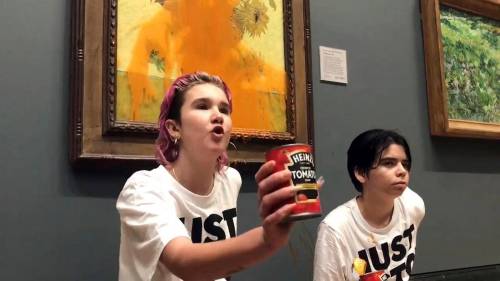
On Friday, two young English activists walked into the National Gallery in London and threw tins of Heinz tomato soup on Vincent van Gogh’s Sunflowers, one of the most well-known paintings of all time.
The women, Phoebe Plummer, 21, and Anna Holland, 20, are part of a U.K.-based climate campaign group called Just Stop Oil and their provocative stunt immediately made headlines all over the world.
Initially, I was confused by the act. What does van Gogh’s Sunflowers have to do with oil? Surely not the fact that it’s an oil painting? I was also baffled by the sheer logistics of it. I was recently admonished for breathing too close to Georges Seurat’s pointillist masterwork A Sunday on La Grande Jatte; how does one stroll up to a beloved 133-year-old painting with two full cans of soup?
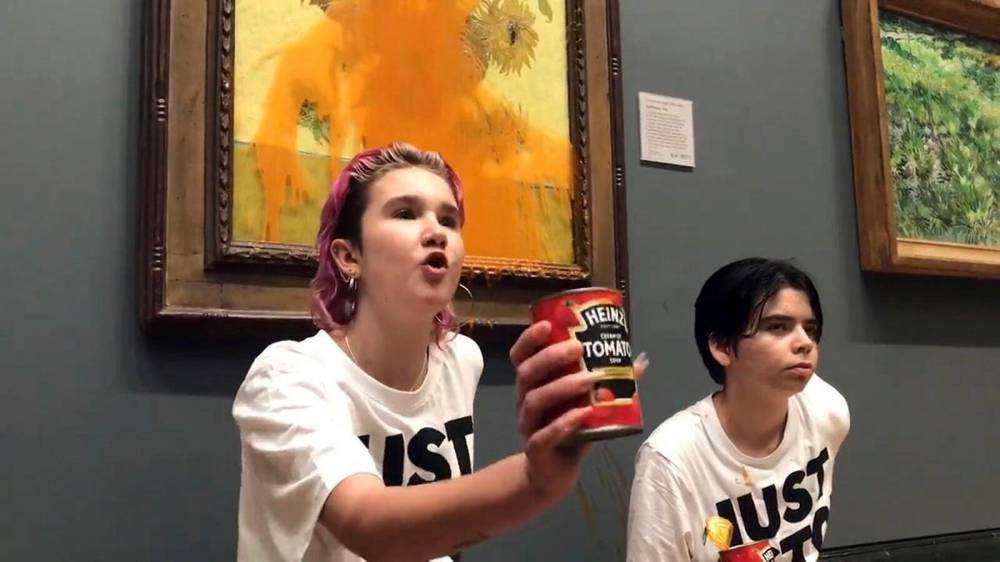
Just Stop Oil via The Associated Press
Two protesters from the group Just Stop Oil threw tinned soup at Vincent van Gogh’s famous 1888 work Sunflowers at the National Gallery in London.
Upon reflection, I would submit that this stunt could be viewed as a work of performance art and, as with most art, there’s a metaphor in there somewhere. And this one is pretty simple: the tomato soup represents oil. Van Gogh’s Sunflowers represents the climate.
The big reveal was in the reaction: people seem to be more outraged about the (potential) destruction of an iconic painting than they are about the ongoing destruction of the planet.
It’s also poetic that the painting in question is Sunflowers, an image heavily reproduced on petroleum-based objets d’landfill such as tote bags, coasters, mouse pads and fridge magnets that will likely outlive their source material.
I say “potential” destruction because the painting is behind glass. Sunflowers was unharmed, in the end, making the charge that these women were “desecrating art” seem wee bit over the top — especially since you don’t have to look hard, far or long for examples of artworks that were actually trashed by literal fascists because they were “created by degenerates.”
But I understand the visceral reaction to the soup-throwing. I had one, too. I gasped when I saw the video of soup hitting the painting, especially since I forgot it was behind glass. It’s a shocking image, garish orange slop flowing down a painting that has survived for more than a century because it is cared for — and, yes, protected — by humans.
You’d think that some of the more ubiquitous images, ones that have crossed from fine art to popular culture, would lose their ability to inspire awe, but there is something about seeing these masterworks in the flesh — which is, I expect, why we all take our little iPhone photos of the famous ones.
Yes, Google images exist, but I’ll tell you: when I saw Sunflowers in person at the National Gallery in 2012, I couldn’t believe I was in the same room. It’s just so old. It doesn’t even seem real.
It’s not lost on me, in the context of this conversation, that I had to fly across an ocean in an airplane to see this painting. But then, what conversation is that, exactly? From what I’ve seen from most of the chatter online, no one is talking about climate change or oil or the cost of living or anything else the activists were trying to raise awareness about. No, most of it is about the value of art.
“What is worth more, art or life?” one of the activists asked the crowd. Ah, but see, you can’t have one without the other. To value art is to value life. The sunflowers van Gogh painted are also imbued with life, his and the fleeting ones of his subjects; the Dutch artist wrote to his brother that painting them “takes the energy and concentration of a person’s whole being.”
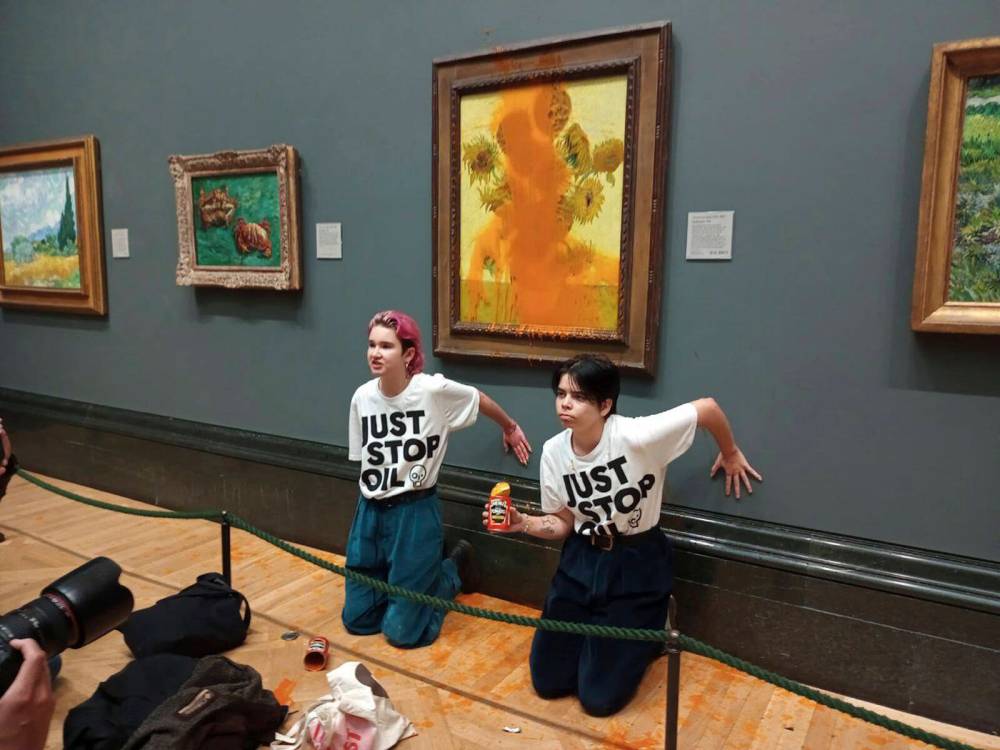
Just Stop Oil via The Associated Press
Activists from Just Stop Oil made a statement, but the resulting conversation was about art rather than the environment.

He did not dream up his palette of yellows and golds — nature did. All of it is worth something. All of it is worth protecting.
Humans have, no question, destroyed so much. Art is one the few things we actually did right amid the hash we’ve made of this planet. It’s an act of hope to create, to make something that can move and inspire people — possibly generations of people.
The soup, in the end, is just wiped away.
jen.zoratti@winnipegfreepress.com
Twitter: @JenZoratti
Jen Zoratti is a columnist and feature writer working in the Arts & Life department, as well as the author of the weekly newsletter NEXT. A National Newspaper Award finalist for arts and entertainment writing, Jen is a graduate of the Creative Communications program at RRC Polytech and was a music writer before joining the Free Press in 2013. Read more about Jen.
Every piece of reporting Jen produces is reviewed by an editing team before it is posted online or published in print – part of the Free Press‘s tradition, since 1872, of producing reliable independent journalism. Read more about Free Press’s history and mandate, and learn how our newsroom operates.
Our newsroom depends on a growing audience of readers to power our journalism. If you are not a paid reader, please consider becoming a subscriber.
Our newsroom depends on its audience of readers to power our journalism. Thank you for your support.
Jen Zoratti is a columnist and feature writer working in the Arts & Life department, as well as the author of the weekly newsletter NEXT. A National Newspaper Award finalist for arts and entertainment writing, Jen is a graduate of the Creative Communications program at RRC Polytech and was a music writer before joining the Free Press in 2013. Read more about Jen.
Every piece of reporting Jen produces is reviewed by an editing team before it is posted online or published in print – part of the Free Press‘s tradition, since 1872, of producing reliable independent journalism. Read more about Free Press’s history and mandate, and learn how our newsroom operates.
Our newsroom depends on a growing audience of readers to power our journalism. If you are not a paid reader, please consider becoming a subscriber.
Our newsroom depends on its audience of readers to power our journalism. Thank you for your support.
Related Articles
Activists in UK court after soup thrown at Van Gogh picture

Advertisement Advertise With Us
Advertisement Advertise With Us