EXPLAINER: How will UN climate deal on loss and damage work?

Advertisement

Advertise with us

SHARM el-SHEIKH, Egypt (AP) — The decision Sunday by nations around the world to establish a fund to help poor countries hit hard by a warming planet was one of the most significant since U.N. climate talks began 30 years ago.

Read this article for free:


By clicking the button above, an account will be created and you will begin to receive some of our recommended newsletters. You may opt out of any newsletter by visiting your Email and Communication Preferences page or by clicking "unsubscribe" at the bottom of any email.

or

Already have an account? Log in here »

To continue reading, please subscribe:

Digital Subscription

One year of digital access for only $1.44 a week*

  • Enjoy unlimited reading on winnipegfreepress.com
  • Read the E-Edition, our digital replica newspaper
  • Access News Break, our award-winning app
  • Play interactive puzzles

*Billed as $5.77 plus GST every four weeks. After 52 weeks, price increases to the regular rate of $19.95 plus GST every four weeks. Offer available to new and qualified returning subscribers only. Cancel any time.

To continue reading, please subscribe:

Add Free Press access to your Brandon Sun subscription for only an additional

$1 for the first 4 weeks*

  • Enjoy unlimited reading on winnipegfreepress.com
  • Read the E-Edition, our digital replica newspaper
  • Access News Break, our award-winning app
  • Play interactive puzzles
Start now

*Your next Brandon Sun subscription payment will increase by $1.00 and you will be charged $17.95 plus GST for four weeks. After four weeks, your payment will increase to $24.95 plus GST every four weeks.

Hey there, time traveller!
This article was published 20/11/2022 (1435 days ago), so information in it may no longer be current.

SHARM el-SHEIKH, Egypt (AP) — The decision Sunday by nations around the world to establish a fund to help poor countries hit hard by a warming planet was one of the most significant since U.N. climate talks began 30 years ago.

It was an unequivocal confirmation that poor countries, with limited resources, are being most impacted by extreme weather events like floods, heat waves and storms and, at least at some level, industrialized nations that have done the most to contribute to climate change have a responsibility to help.

While government leaders, environmentalists and activists celebrated plans for such a fund, there are many outstanding questions, ranging from how it will work to long-term repercussions. Here is a look at the development of the idea of “loss and damage,” the term it’s given in climate negotiations, and what we know about the fund.

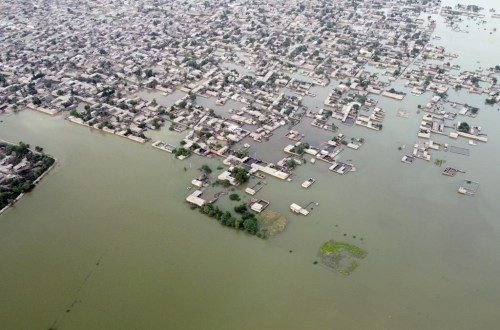
FILE -Homes are surrounded by floodwaters in Jaffarabad, a district of Pakistan's southwestern Baluchistan province, Sept. 1, 2022. (AP Photo/Zahid Hussain, File)

HISTORY

In the early 1990s, the Alliance of Small Island States, a group of low-lying coastal and small island countries, began calling for the establishment of a loss and damage fund as the United Nations was creating a framework to deal with climate change on an international level.

Since then, the idea has always been a part of annual U.N. climate summits. However, it was often talked about on the margins of negotiations, something developing nations and activists would push for while many rich nations used their weight to squash the idea. For the first time, at this year’s COP27 it was included in the agenda and became the centerpiece of discussions.

WHO WILL FUND IT?

The fund will initially draw on contributions from developed countries and other private and public sources, such as international financial institutions, with an option for other major economies to join down the line.

The final text points to “identifying and expanding sources of funding,” something the EU, the U.S. and others had pushed for during negotiations, suggesting that nations that are both high-polluting and considered developing under the criteria, should also pay into the fund.

During the talks, China said money for the new fund should come from developed countries, not them. But there’s precedence for China to voluntarily pay into climate funds, if the U.S. does too.

When the Obama administration pledged $3 billion to the Green Climate Fund in 2014, China also paid $3.1 billion for the fund.

More details of who pays will be decided by a committee that plans to get the fund going within a year.

WHO WILL GET MONEY?

The deal says the fund will assist “developing countries that are particularly vulnerable to the adverse effects of climate change,” though there will be room for middle-income countries that are severely affected by climate disasters to also get paid.

Pakistan, which was devastated by flooding that put a third of the country underwater, or Cuba, recently battered by Hurricane Ian, could be eligible.

How the loss and damage fund will fit in with “other institutions, agencies that are out there doing humanitarian work, helping people rebuild, dealing with migration and refugee crises, dealing with food security, water security” will need to be worked out, said David Waskow, the World Resources Institute international climate director.

Those details will also be hammered out by the committee in the coming year.

REBUILDING TRUST

Beyond just financial help, setting up the fund is seen as a huge step forward, but how it’s ultimately viewed will depend in part on how fast it can be set up.

In the closing session Sunday, Antigua’s Lia Nicholson said the transitional committee should be set up immediately and given clear mandates.

“This loss and damage fund must become the lifeboat that we need it to be,” she said.

There is a credibility gap because of past broken promises.

In 2009, rich nations agreed to provide $100 billion a year to help developing countries transition to green energy systems and adapt to climate change. However, to date, that initiative has never been fully funded.

REPERCUSSIONS

One of the main reasons that rich nations long opposed such a loss and damage fund was the fear that it would open then up to long-term liability. Despite passage, that concern is very much still at play, as evidence by how negotiators made sure the language of the fund didn’t say “liability” and that contributions were voluntary.

Despite those caveats, the establishment of such a fund could have repercussions, both legal and symbolic, in climate circles and beyond. For example, several Pacific Island nations have been pushing for the International Court of Justice to consider climate change. They argue that international laws must be strengthened to protect their rights in the case that their lands are engulfed by rising seas. The establishment of a loss and damage fund could bolster those arguments.

___

Associated Press writers Frank Jordans and Seth Borenstein contributed to this report.

____

Associated Press climate and environmental coverage receives support from several private foundations. See more about AP’s climate initiative here. The AP is solely responsible for all content.

Report Error Submit a Tip

More Stories

Opening of Portage and Main shows even seemingly insurmountable impasses can be overcome

Jason Syvixay 10 minute read Preview

Opening of Portage and Main shows even seemingly insurmountable impasses can be overcome

Jason Syvixay 10 minute read 2:00 AM CDT

There are places in a city that become more than places. Portage and Main is one of them. For generations of Winnipeggers, the intersection has represented downtown, traffic, development and civic identity. Its reopening to pedestrians in 2025, after 46 years of closure, was about more than crossing a street. It was a reminder that decisions made by one generation can shape the choices available to another — and that even seemingly permanent decisions can be reconsidered.

I have spent much of my professional life thinking about Winnipeg as a planner, working in public, private and non-profit settings. My PhD research gave me an opportunity to examine Portage and Main differently: not simply as a debate about cars and pedestrians, but as a window into how power operates in a city. I reviewed 569 archival documents spanning the 1960s to the present, interviewed 48 planners with experience in Winnipeg, and mapped the relationships between planners, politicians, developers, engineers, residents, businesses and advocacy groups.

What emerged was a story about how planning decisions become embedded in a city’s institutions, agreements, infrastructure, professional practices and political expectations — shaping not only what gets built, but who gets to influence what gets built.

The closure of Portage and Main in 1979 did not remain a decision confined to a particular political moment. Over time, it was reinforced by development agreements, physical infrastructure, property relationships, traffic-engineering practices, administrative routines, and public narratives about mobility and downtown revitalization. The people who made many of those original decisions eventually left office. The arrangements they created remained. Later planners inherited them.

Read
2:00 AM CDT

EXPLAINER: How will UN climate deal on loss and damage work?

Dana Beltaji And Peter Prengaman, The Associated Press 5 minute read Preview

EXPLAINER: How will UN climate deal on loss and damage work?

Dana Beltaji And Peter Prengaman, The Associated Press 5 minute read Sunday, Nov. 20, 2022

SHARM el-SHEIKH, Egypt (AP) — The decision Sunday by nations around the world to establish a fund to help poor countries hit hard by a warming planet was one of the most significant since U.N. climate talks began 30 years ago.

It was an unequivocal confirmation that poor countries, with limited resources, are being most impacted by extreme weather events like floods, heat waves and storms and, at least at some level, industrialized nations that have done the most to contribute to climate change have a responsibility to help.

While government leaders, environmentalists and activists celebrated plans for such a fund, there are many outstanding questions, ranging from how it will work to long-term repercussions. Here is a look at the development of the idea of “loss and damage,” the term it’s given in climate negotiations, and what we know about the fund.

HISTORY

Read
Sunday, Nov. 20, 2022

Woman receives 8½-month sentence for disposal of body

Dean Pritchard 4 minute read 5:04 PM CDT

A Winnipeg woman who helped dispose the body of a slain Mexican man under threat of death from his killers has been ordered to serve another 8½ months in jail.

Devlin Langlois, 25, had pleaded guilty to accessory after the fact to murder in the March 2025 killing of 28-year-old Diego Moscoza in a Selkirk Avenue house.

Court of King’s Bench Justice Candace Grammond, in a written ruling delivered Friday, rejected a recommendation by Langlois’s lawyer Joshua Rogala that she be sentenced to the equivalent of nearly 16 months of time served.

Grammond said she accepted that Langlois feared for her life. However, she made no effort to help Moscoza when he was gravely injured and his killers were not present in the home and had not yet threatened her.

Eadie faces crowded field — including former councillor — in bid for fifth term in Mynarski

Malak Abas 8 minute read Preview

Eadie faces crowded field — including former councillor — in bid for fifth term in Mynarski

Malak Abas 8 minute read Yesterday at 6:00 AM CDT

The city’s most crowded council race has a little bit of everything: a long-serving incumbent, a former ward councillor in the 1980s, an unsuccessful candidate in the last municipal election seeking a rematch and three political newcomers.

Mynarski has long been led by Coun. Ross Eadie, who was first elected in 2010 and is seeking his fifth term. Five challengers want the job: Natalie Smith, who ran in the ward in 2022 and came in second, Terry Wachniak, Harold Brazil, Laurie Kozak and Ayaz Noor Mohammed.

It’s the city ward with the largest number of candidates this year.

Eadie describes himself as “a dancer, a singer and a city councillor” who has made inroads on garbage pickup, back-lane cleaning and earning the respect of his fellow council members by being the first Mynarski councillor to be appointed to executive policy committee, the mayor’s inner circle, in decades.

Read
Yesterday at 6:00 AM CDT

Province orders ban on private teacher-student messaging

Maggie Macintosh 4 minute read Preview

Province orders ban on private teacher-student messaging

Maggie Macintosh 4 minute read Updated: Yesterday at 6:14 PM CDT

Manitoba teachers are no longer allowed to text or use social media to contact a student – regardless of whether they coach a school sports team or supervise other activities outside typical instruction times.

Read
Updated: Yesterday at 6:14 PM CDT

Puzzles Palace

1 minute read Friday, Oct. 16, 2026

To solve our puzzles, please subscribe with this special offer: |