

Inflation’s impact felt by Canadians
Advertisement
Read this article for free:
or
Already have an account? Log in here »
To continue reading, please subscribe:

Digital Subscription
One year of digital access for only $205*
- Enjoy unlimited reading on winnipegfreepress.com
- Read the E-Edition, our digital replica newspaper
- Access News Break, our award-winning app
- Play interactive puzzles
*First annual payment billed as $205.00 + GST for one year. This annual subscription will automatically renew at $233.00 + GST every 52 weeks (10% off the regular annual price of $259.35). Offer available to new and qualified returning subscribers only. Cancel any time.
To continue reading, please subscribe:
Add Free Press access to your Brandon Sun subscription for only an additional
$1 for the first 4 weeks*
- Enjoy unlimited reading on winnipegfreepress.com
- Read the E-Edition, our digital replica newspaper
- Access News Break, our award-winning app
- Play interactive puzzles
*Your next Brandon Sun subscription payment will increase by $1.00 and you will be charged $17.95 plus GST for four weeks. After four weeks, your payment will increase to $24.95 plus GST every four weeks.
Read unlimited articles for free today:
or
Already have an account? Log in here »
Hey there, time traveller!
This article was published 29/12/2022 (1332 days ago), so information in it may no longer be current.
A recent Leger poll, conducted in collaboration with the Association for Canadian Studies (ACS) and published by The Canadian Press, suggests a plurality (31 per cent) of Canadians were not feeling happy at the end of this year. And almost one-quarter (22 per cent) feel 2023 is going to be even worse than 2022.
Canadians are worried about inflation, interest rates, higher prices and an economic recession. Conservative Party of Canada Leader Pierre Pollievre told his caucus recently Canada needs “fiscal sanity” as decades-high inflation has driven up the cost of living in the country.
He has regularly criticized the ruling Liberals for not doing enough to target high food costs and interest rates. But is Canada really in bad shape compared to other countries when it comes to inflation? And are higher food prices something the Liberals should have been able to remedy?
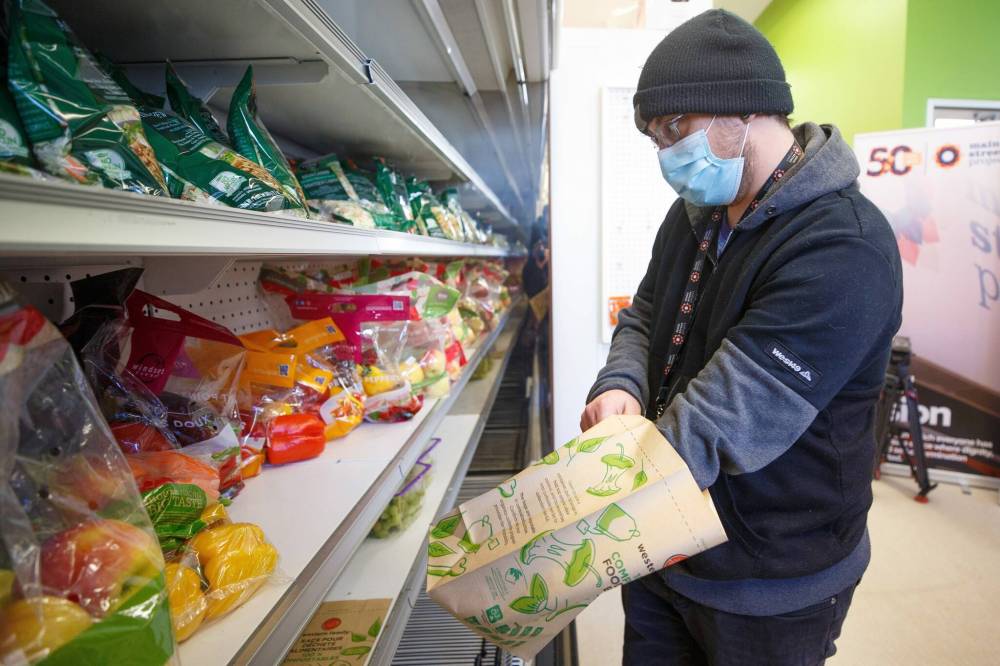
MIKE DEAL / WINNIPEG FREE PRESS
Food-bank co-ordinator Aaron Arbour puts together a care package at the Main Street Project on Dec. 7. Food-bank usage in Canada has increased 34 per cent since 2019.
It all depends on who you ask. Perhaps some of this end-of-the-year pessimism requires a bit of context to provide a better perspective. First, nearly all member nations in the G20 are dealing with inflation right now. Argentina and Turkey have been the hardest hit, with inflation rates well exceeding 80 per cent.
Canada, by comparison, is close to the bottom, with a rate at just below seven per cent. The U.S. and Australia have slightly higher rates, at more than seven per cent, and the U.K.’s inflation rate is above 11 per cent.
This is creating a rise in poverty, particularly in the poorer countries in the G20, and is leading to greater food insecurity. The World Bank has suggested domestic food price inflation is high in almost all low- and middle-income countries, and in high-income countries, and there are now estimates of more than 34 million people living in a food crisis.
Here in Canada, food-bank usage has gone up by an estimated 15 per cent compared to last year, and 35 per cent from November of 2019. The cost of food, which has risen by about 10 per cent, has been particularly difficult for those on fixed incomes: seniors, the disabled and those living on social assistance.
For many of us, it’s been easy to put at least some of the blame of the high price of food on the big grocery chains. As is suggested by Sylvain Charlebois, the director of Agri-Food Analytics Lab at Dalhousie University, blaming the food retailers is populist and easy to do. But it doesn’t tell the complete story.
Charlebois’s research indicates that while profits and margins are higher for Canada’s big three grocery chains, the increases are slight, and when compared to other major economic players in this country, such as banks, the difference is small.
As well, according to the World Economic Forum, in 1950 the average consumer spent 30 per cent of their total budget on food; currently in the United States, it’s only about seven per cent. The average worldwide is just 9.1 per cent.
In other words, while it may feel like we’re spending a lot of money on food now, compared to what our grandparents spent, we’re much further ahead.
Still, Canada’s federal government has convened a parliamentary committee questioning the record-level food price inflation. Earlier in December, senior executives for Loblaws, Sobeys and Metro appeared before MPs to talk about the pressures on the grocery giants.
Pierre St-Laurent from Sobey’s told MPs, “Commodity cost pressures due to geopolitical events and extreme weather, soaring energy costs, supply chain disruptions, the weakening Canadian dollar and labour shortages have all created a perfect storm for our suppliers. And unfortunately, we’ve had to increase the price of our products.”

The rest of the world is also experiencing high food prices. In the U.S., prices were up almost 11 per cent in October compared with last year. In Britain, prices were more than 16 per cent higher for the same period.
So while we can be pessimistic about the future and worried about inflation and rising food costs, we also need to temper that pessimism with context. We had double-digit inflation in the 1970s, along with double-digit interest rates, so by comparison, this is just a blip. Our poverty rates are actually declining, and have been since the 1950s.
Overall, we’ve had a rough couple of years, but this, too, will pass. Bring on 2023 and its challenges — we’re a resilient bunch, we Canadians; we can handle it.
Shannon Sampert is a communications consultant and former politics and perspectives editor at the Winnipeg Free Press.