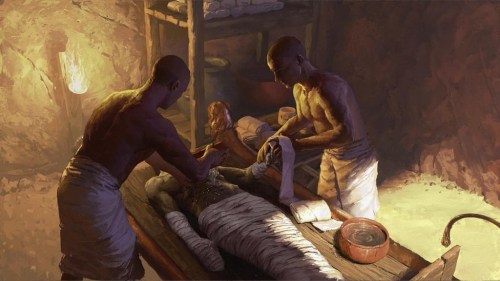
How to make a mummy: Ancient Egyptian workshop has new clues

Advertisement

Advertise with us

NEW YORK (AP) — For thousands of years, ancient Egyptians mummified their dead in the search for eternal life. Now, researchers have used chemistry and an unusual collection of jars to figure out how they did it.

Read this article for free:


or

Already have an account? Log in here »

To continue reading, please subscribe:

Subscribe and receive a limited-edition Free Press branded hat or tote.

Digital Subscription

One year of digital access for only $205*

  • Enjoy unlimited reading on winnipegfreepress.com
  • Read the E-Edition, our digital replica newspaper
  • Access News Break, our award-winning app
  • Play interactive puzzles

*First annual payment billed as $205.00 + GST for one year. This annual subscription will automatically renew at $233.00 + GST every 52 weeks (10% off the regular annual price of $259.35). Offer available to new and qualified returning subscribers only. Cancel any time.

To continue reading, please subscribe:

Add Free Press access to your Brandon Sun subscription for only an additional

$1 for the first 4 weeks*

  • Enjoy unlimited reading on winnipegfreepress.com
  • Read the E-Edition, our digital replica newspaper
  • Access News Break, our award-winning app
  • Play interactive puzzles
Start now

*Your next Brandon Sun subscription payment will increase by $1.00 and you will be charged $17.95 plus GST for four weeks. After four weeks, your payment will increase to $24.95 plus GST every four weeks.

Hey there, time traveller!
This article was published 01/02/2023 (1314 days ago), so information in it may no longer be current.

NEW YORK (AP) — For thousands of years, ancient Egyptians mummified their dead in the search for eternal life. Now, researchers have used chemistry and an unusual collection of jars to figure out how they did it.

Their study, published Wednesday in the journal Nature, is based on a rare archaeological find: An embalming workshop with a trove of pottery around 2,500 years old. Many jars from the site were still inscribed with instructions like “to wash” or “to put on his head.”

By matching the writing on the outside of the vessels with the chemical traces inside, researchers uncovered new details about the “recipes” that helped preserve bodies for thousands of years.
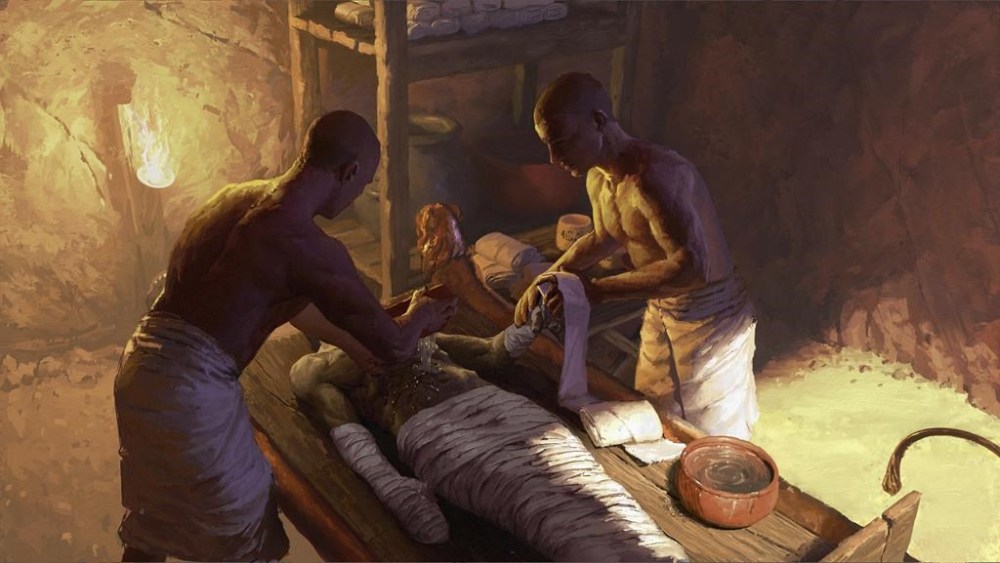
This illustration provided by Nikola Nevenov in January 2023 depicts an embalming process in an underground chamber in Saqqara, Egypt. For thousands of years, ancient Egyptians mummified their dead to help them reach eternal life. According to studypublished Wednesday, Feb. 1, 2023, in the journal Nature, researchers have used chemistry and an unusual collection of jars to figure out how they did it. (Nikola Nevenov via AP)

“It’s like a time machine, really,” said Joann Fletcher, an archaeologist at University of York who was not involved with the study. “It’s allowed us to not quite see over the shoulders of the ancient embalmers, but probably as close as we’ll ever get.”

Those recipes showed that embalmers had deep knowledge about what substances would help preserve their dead, said Fletcher, whose partner was a co-author on the study. And they included materials from far-flung parts of the world — meaning Egyptians went to great lengths to make their mummies “as perfect as they could possibly be.”

The workshop — uncovered in 2016 by study author Ramadan Hussein, who passed away last year — is located in the famous burial grounds of Saqqara. Parts of it sit above the surface, but a shaft stretches down to an embalming room and burial chamber underground, where the jars were discovered.

It was in rooms like these where the last phase of the process took place, said Salima Ikram, an Egyptologist at The American University in Cairo who was not involved with the study. After drying out the the body with salts, which probably took place above ground, embalmers would then take the bodies below.

“This was the last phase of your transformation where the secret rites, the religious rites, were being performed,” Ikram said. “People would be chanting spells and hymns while you were being wrapped and resin was being anointed all over your body.”

Experts already had some clues about what substances were used in those final steps, mainly from testing individual mummies and looking at written texts. But a lot of gaps remained, said senior author Philipp Stockhammer, an archaeologist at Ludwig Maximilian University in Germany.

The new finds helped crack the case.

Take the word “antiu,” which shows up in a lot of Egyptian texts but didn’t have a direct translation, Stockhammer said. In the new study, scientists found that several jars labeled as “antiu” contained a mixture of different substances — including animal fat, cedar oil and juniper resin.

These substances, along with others found in the jars, have key properties that would help preserve the mummies, said lead author Maxime Rageot, an archaeologist at Germany’s University of Tubingen.

Plant oils — which were used to protect the liver and treat the bandages — could ward off bacteria and fungi, while also improving the smell. Hard materials like beeswax, used on the stomach and skin, could help keep out water and seal the pores.

Some of the substances came from very far away — like dammar and elemi, types of resin that come from the tropical rainforests of Southeast Asia. These results show that ancient Egyptians would trade far and wide to get the most effective materials, the authors said.

“It’s interesting to see the complexity,” Stockhammer said. “Having this global network on the one hand, having all this chemical knowledge on the other side.”

Ikram said an important next step for the research will be to test different parts of actual mummies to see if the same substances show up. And these recipes probably weren’t universal — they changed over time and varied between workshops.

Still, the study gives a basis for understanding the past, and can bring us closer to people who lived long ago, she said.

“The ancient Egyptians have been separated from us through time and space, yet we still have this connection,” Ikram said. “Human beings all throughout history have been scared of death.”

———

The Associated Press Health and Science Department receives support from the Howard Hughes Medical Institute’s Science and Educational Media Group. The AP is solely responsible for all content.

Report Error Submit a Tip

The Free Press acknowledges the financial support it receives from members of the city’s faith community, which makes our coverage of religion possible.

More Stories

Manitoba doctor denies working to revive Carberry ER in response to recruitment lawsuit

Erik Pindera 4 minute read Preview

Manitoba doctor denies working to revive Carberry ER in response to recruitment lawsuit

Erik Pindera 4 minute read Yesterday at 9:40 AM CDT

A Manitoba doctor has denied he was working as a recruiter after an Ontario doctor accused him of misleading him about a position at the Carberry hospital.

Dr. Klevis Iliriani, who worked at the hospital in Carberry from May to August 2024, filed his statement of claim in Court of King’s Bench earlier this year.

Iliriani, who lives in an Ottawa suburb, has alleged recruiters negligently misrepresented the job at the Carberry hospital and breached the terms of his contract, which resulted in less pay than promised.

His court filing names defendants Dr. Dave Maharajh and Barry Banek as the recruiters.

Read
Yesterday at 9:40 AM CDT

At least 25 people dead in a bus crash in Cape Verde’s Fogo Island, officials and media say

The Associated Press 1 minute read Updated: Yesterday at 5:35 AM CDT

PRAIA, Cape Verde (AP) — At least 25 people — mostly teenagers — were killed in a traffic accident in the African island nation of Cape Verde, local media and officials said Sunday.

The accident, which occurred on the Campanas de Cima route, a mountainous area in Fogo Island, occurred on Saturday and involved a passenger bus. Several people were also injured.

The president of Cape Verde, José Maria Pereira Neves, called the accident “a great catastrophe” in a statement on his Facebook page.

Seven bodies were immediately buried due to their condition, local media report citing the island's health authorities. The cause of the accident is yet to be determined by the authorities.

Woman died while getting wisdom teeth out; case raises questions about transparency of dental association

Nicole Buffie 5 minute read Preview

Woman died while getting wisdom teeth out; case raises questions about transparency of dental association

Nicole Buffie 5 minute read Friday, Sep. 4, 2026

The parents of a 23-year-old southwestern Manitoba woman who died after receiving a local anesthetic during a wisdom tooth extraction say they are in the dark about the investigation into their daughter’s death.

Dulaney and Victoria Blatz say the Manitoba Dental Association has been unwilling to give them information about the probe into their daughter’s death, saying the self-governing regulatory body must be more transparent with the public.

“We have pushed through various channels trying to get information, but it’s nothing but stalling and sidelining,” Victoria said Friday. “This has crashed our world to pieces and we just want answers.”

Virginia Blatz went to Boundary Trails Dental Centre in Morden on Nov. 27, 2024, to have her wisdom teeth removed, but never returned home.

Read
Friday, Sep. 4, 2026

For newcomer pizza purveyors, it’s all about crafting solid foundations

David Sanderson 7 minute read Preview

For newcomer pizza purveyors, it’s all about crafting solid foundations

David Sanderson 7 minute read Saturday, Sep. 5, 2026

A recent poll conducted by an Internet-based market-research firm determined that close to 20 per cent of people eschew their leftover pizza crust.

Some argued that the residual crust lacks flavour. Others submitted that it’s too hard or crunchy to enjoy sans toppings. Given that information, what are we to make of Crusty Craft Pizza, a five-month-old takeout spot whose owners are so confident in their European-style pizza crust that they’ve chosen to highlight it in their business moniker?

Whenever somebody informs them they don’t like pizza crust, their response is, well, they haven’t tried theirs, says Oleksii Samokvhal, who together with his wife, Iryna Mehedyn, opened Crusty Craft Pizza in early April, at 1311 Day St. in Transcona.

“It’s thin in the middle, with raised edges we hand-form ourselves,” says Mehedyn, a native of Ukraine who, like her Kyiv-born husband, relocated to Winnipeg to escape the conflict in their home country.

Read
Saturday, Sep. 5, 2026

Politicians who harp on Klein’s history with Nygard do so at their own peril

Tom Brodbeck 5 minute read Preview

Politicians who harp on Klein’s history with Nygard do so at their own peril

Tom Brodbeck 5 minute read Friday, Sep. 4, 2026

It was probably the easiest prediction to make in Winnipeg politics this week: the moment Kevin Klein officially entered the mayoral race, someone would bring up Peter Nygard.

Sure enough, they did.

And it was led by Klein’s chief political opponent in this race, Mayor Scott Gillingham, who called Klein a “fixer” for the convicted sex offender.

None of this is particularly surprising.

Read
Friday, Sep. 4, 2026

How to make a mummy: Ancient Egyptian workshop has new clues

Maddie Burakoff, The Associated Press 4 minute read Preview

How to make a mummy: Ancient Egyptian workshop has new clues

Maddie Burakoff, The Associated Press 4 minute read Wednesday, Feb. 1, 2023

NEW YORK (AP) — For thousands of years, ancient Egyptians mummified their dead in the search for eternal life. Now, researchers have used chemistry and an unusual collection of jars to figure out how they did it.

Their study, published Wednesday in the journal Nature, is based on a rare archaeological find: An embalming workshop with a trove of pottery around 2,500 years old. Many jars from the site were still inscribed with instructions like “to wash” or “to put on his head.”

By matching the writing on the outside of the vessels with the chemical traces inside, researchers uncovered new details about the “recipes” that helped preserve bodies for thousands of years.

“It’s like a time machine, really,” said Joann Fletcher, an archaeologist at University of York who was not involved with the study. “It’s allowed us to not quite see over the shoulders of the ancient embalmers, but probably as close as we’ll ever get.”

Read
Wednesday, Feb. 1, 2023