How to make a mummy: Ancient Egyptian workshop has new clues

Advertisement

Advertise with us

NEW YORK (AP) — For thousands of years, ancient Egyptians mummified their dead in the search for eternal life. Now, researchers have used chemistry and an unusual collection of jars to figure out how they did it.

Read this article for free:


or

Already have an account? Log in here »

To continue reading, please subscribe:

Subscribe and receive a limited-edition Free Press branded hat or tote.

Digital Subscription

One year of digital access for only $205*

  • Enjoy unlimited reading on winnipegfreepress.com
  • Read the E-Edition, our digital replica newspaper
  • Access News Break, our award-winning app
  • Play interactive puzzles

*First annual payment billed as $205.00 + GST for one year. This annual subscription will automatically renew at $233.00 + GST every 52 weeks (10% off the regular annual price of $259.35). Offer available to new and qualified returning subscribers only. Cancel any time.

To continue reading, please subscribe:

Add Free Press access to your Brandon Sun subscription for only an additional

$1 for the first 4 weeks*

  • Enjoy unlimited reading on winnipegfreepress.com
  • Read the E-Edition, our digital replica newspaper
  • Access News Break, our award-winning app
  • Play interactive puzzles
Start now

*Your next Brandon Sun subscription payment will increase by $1.00 and you will be charged $17.95 plus GST for four weeks. After four weeks, your payment will increase to $24.95 plus GST every four weeks.

Hey there, time traveller!
This article was published 01/02/2023 (1313 days ago), so information in it may no longer be current.

NEW YORK (AP) — For thousands of years, ancient Egyptians mummified their dead in the search for eternal life. Now, researchers have used chemistry and an unusual collection of jars to figure out how they did it.

Their study, published Wednesday in the journal Nature, is based on a rare archaeological find: An embalming workshop with a trove of pottery around 2,500 years old. Many jars from the site were still inscribed with instructions like “to wash” or “to put on his head.”

By matching the writing on the outside of the vessels with the chemical traces inside, researchers uncovered new details about the “recipes” that helped preserve bodies for thousands of years.
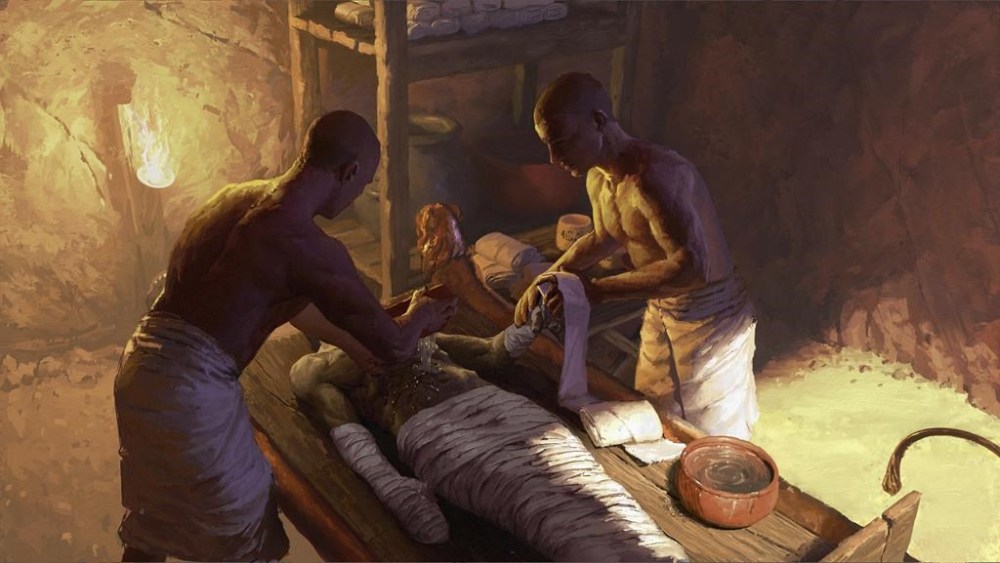
This illustration provided by Nikola Nevenov in January 2023 depicts an embalming process in an underground chamber in Saqqara, Egypt. For thousands of years, ancient Egyptians mummified their dead to help them reach eternal life. According to studypublished Wednesday, Feb. 1, 2023, in the journal Nature, researchers have used chemistry and an unusual collection of jars to figure out how they did it. (Nikola Nevenov via AP)

“It’s like a time machine, really,” said Joann Fletcher, an archaeologist at University of York who was not involved with the study. “It’s allowed us to not quite see over the shoulders of the ancient embalmers, but probably as close as we’ll ever get.”

Those recipes showed that embalmers had deep knowledge about what substances would help preserve their dead, said Fletcher, whose partner was a co-author on the study. And they included materials from far-flung parts of the world — meaning Egyptians went to great lengths to make their mummies “as perfect as they could possibly be.”

The workshop — uncovered in 2016 by study author Ramadan Hussein, who passed away last year — is located in the famous burial grounds of Saqqara. Parts of it sit above the surface, but a shaft stretches down to an embalming room and burial chamber underground, where the jars were discovered.

It was in rooms like these where the last phase of the process took place, said Salima Ikram, an Egyptologist at The American University in Cairo who was not involved with the study. After drying out the the body with salts, which probably took place above ground, embalmers would then take the bodies below.

“This was the last phase of your transformation where the secret rites, the religious rites, were being performed,” Ikram said. “People would be chanting spells and hymns while you were being wrapped and resin was being anointed all over your body.”

Experts already had some clues about what substances were used in those final steps, mainly from testing individual mummies and looking at written texts. But a lot of gaps remained, said senior author Philipp Stockhammer, an archaeologist at Ludwig Maximilian University in Germany.

The new finds helped crack the case.

Take the word “antiu,” which shows up in a lot of Egyptian texts but didn’t have a direct translation, Stockhammer said. In the new study, scientists found that several jars labeled as “antiu” contained a mixture of different substances — including animal fat, cedar oil and juniper resin.

These substances, along with others found in the jars, have key properties that would help preserve the mummies, said lead author Maxime Rageot, an archaeologist at Germany’s University of Tubingen.

Plant oils — which were used to protect the liver and treat the bandages — could ward off bacteria and fungi, while also improving the smell. Hard materials like beeswax, used on the stomach and skin, could help keep out water and seal the pores.

Some of the substances came from very far away — like dammar and elemi, types of resin that come from the tropical rainforests of Southeast Asia. These results show that ancient Egyptians would trade far and wide to get the most effective materials, the authors said.

“It’s interesting to see the complexity,” Stockhammer said. “Having this global network on the one hand, having all this chemical knowledge on the other side.”

Ikram said an important next step for the research will be to test different parts of actual mummies to see if the same substances show up. And these recipes probably weren’t universal — they changed over time and varied between workshops.

Still, the study gives a basis for understanding the past, and can bring us closer to people who lived long ago, she said.

“The ancient Egyptians have been separated from us through time and space, yet we still have this connection,” Ikram said. “Human beings all throughout history have been scared of death.”

———

The Associated Press Health and Science Department receives support from the Howard Hughes Medical Institute’s Science and Educational Media Group. The AP is solely responsible for all content.

Report Error Submit a Tip

The Free Press acknowledges the financial support it receives from members of the city’s faith community, which makes our coverage of religion possible.
More Stories

Police issue silver alert for missing man

1 minute read Updated: Yesterday at 6:13 PM CDT

Winnipeg police are calling on the public to help locate a missing senior.

Thomas Lakie, 78, was last seen near Wilkes Avenue and Waverley Street around 4 a.m. Saturday, a weekend news release states. Police believe he may be in the Crestview neighbourhood.

Lakie is described as 5-8 with a medium build, has grey hair, blue eyes and walks with a limp. Police say he was last seen wearing a black baseball hat, a black t-shirt, green sweatpants with cargo pockets and brown runners with beige soles.

Anyone who may have information on Lakie's whereabouts is asked to call the missing persons unit at 204-986-6250.

Woman who saved child, father from Red River uncomfortable with hero label

Scott Billeck 6 minute read Preview

Woman who saved child, father from Red River uncomfortable with hero label

Scott Billeck 6 minute read Wednesday, Sep. 2, 2026

A Winnipeg woman who’s been hailed as a hero by police for saving a father and his young child from the Red River says she doesn’t feel like one.

“I’m a mom… and I would do it again,” said Jayclyn Morrissette, who was walking with her neighbour through St. John’s Park on Aug. 24 when they spotted a young girl flailing in the nearby river. “I was meant to be there and that was supposed to happen.”

Morrissette, who spoke to the Free Press Wednesday after police released details about the rescue, said she and her neighbour began looking for the child’s parents and found them at the nearby playground searching for her.

Morrissette waved them over. The father, who she said could not swim, jumped into the river first and immediately began to sink.

Read
Wednesday, Sep. 2, 2026

‘Soapy disco’ for your ride

Aaron Epp 4 minute read Preview

‘Soapy disco’ for your ride

Aaron Epp 4 minute read Friday, Sep. 4, 2026

For Kyle Thompson, foam is where the heart is.

As a high school student at Winnipeg’s Transcona Collegiate, one of his classes required him to create a business plan. He was cleaning vehicles part-time at the Chamois Car Wash and Detail Centre, so he used the assignment to envision a car wash of his own — one with a Regent Avenue address.

Fast forward some 25 years later and that dream is a reality. Thompson is the co-owner and general manager at Flamingo Express Car Wash.

Located at 868 Regent Ave. West — east of the row of car dealerships that call the thoroughfare home and across the street from an Amazon distribution hub — Flamingo opened last month.

Read
Friday, Sep. 4, 2026

Mayoral candidate Gillingham vows building boom; Vogiatzakis, Woodstock promise improved safety

Joyanne Pursaga 5 minute read Preview

Mayoral candidate Gillingham vows building boom; Vogiatzakis, Woodstock promise improved safety

Joyanne Pursaga 5 minute read Friday, Sep. 4, 2026

Scott Gillingham promised several new steps to help get more homes and businesses built in Winnipeg Friday, if re-elected as mayor, amid other pledges from his competition.

Read
Friday, Sep. 4, 2026

How to make a mummy: Ancient Egyptian workshop has new clues

Maddie Burakoff, The Associated Press 5 minute read Preview

How to make a mummy: Ancient Egyptian workshop has new clues

Maddie Burakoff, The Associated Press 5 minute read Wednesday, Feb. 1, 2023

NEW YORK (AP) — For thousands of years, ancient Egyptians mummified their dead in the search for eternal life. Now, researchers have used chemistry and an unusual collection of jars to figure out how they did it.

Their study, published Wednesday in the journal Nature, is based on a rare archaeological find: An embalming workshop with a trove of pottery around 2,500 years old. Many jars from the site were still inscribed with instructions like “to wash” or “to put on his head.”

By matching the writing on the outside of the vessels with the chemical traces inside, researchers uncovered new details about the “recipes” that helped preserve bodies for thousands of years.

“It’s like a time machine, really,” said Joann Fletcher, an archaeologist at University of York who was not involved with the study. “It’s allowed us to not quite see over the shoulders of the ancient embalmers, but probably as close as we’ll ever get.”

Read
Wednesday, Feb. 1, 2023

‘Quite a journey’: dozens move into transitional housing downtown

Carol Sanders 4 minute read Preview

‘Quite a journey’: dozens move into transitional housing downtown

Carol Sanders 4 minute read Friday, Sep. 4, 2026

Dozens of residents have moved into transitional housing units in a former university building in downtown Winnipeg.

Housing, Addictions and Homelessness Minister Bernadette Smith said 42 residents have moved into suites on the third and fourth floors of a seven-storey building previously owned by Providence University College and Theological Seminary. There will be space for as many as 118 people who were in encampments or otherwise homeless.

The remaining units under renovation are expected to be ready and occupied in the coming weeks, Smith said.

“This has been two years in the making,” the minister said at a media event with residents, staff, neighbours and supporters. The building cost the province $24.4 million to purchase and renovate.

Read
Friday, Sep. 4, 2026