Worries abound that Mexico’s Maya Train will destroy jungle
Advertisement
Read this article for free:
or
Already have an account? Log in here »
To continue reading, please subscribe:

Digital Subscription
One year of digital access for only $205*
- Enjoy unlimited reading on winnipegfreepress.com
- Read the E-Edition, our digital replica newspaper
- Access News Break, our award-winning app
- Play interactive puzzles
*First annual payment billed as $205.00 + GST for one year. This annual subscription will automatically renew at $233.00 + GST every 52 weeks (10% off the regular annual price of $259.35). Offer available to new and qualified returning subscribers only. Cancel any time.
To continue reading, please subscribe:
Add Free Press access to your Brandon Sun subscription for only an additional
$1 for the first 4 weeks*
- Enjoy unlimited reading on winnipegfreepress.com
- Read the E-Edition, our digital replica newspaper
- Access News Break, our award-winning app
- Play interactive puzzles
*Your next Brandon Sun subscription payment will increase by $1.00 and you will be charged $17.95 plus GST for four weeks. After four weeks, your payment will increase to $24.95 plus GST every four weeks.
Read unlimited articles for free today:
or
Already have an account? Log in here »
Hey there, time traveller!
This article was published 03/02/2023 (1305 days ago), so information in it may no longer be current.
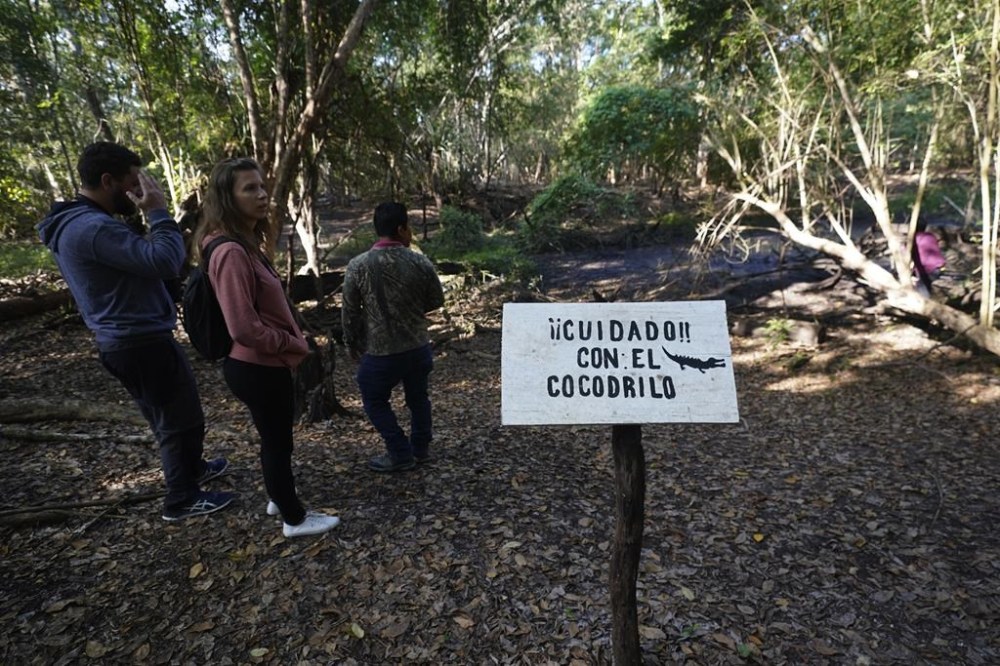
CALAKMUL BIOSPHERE RESERVE, Mexico (AP) — Miguel Ángel Díaz walks slowly so his footfall on dry leaves doesn’t drive away what he’s trying to find in this dense forest of seeded breadnut and sapodilla trees. Coming to a small wetland, a sign warns: Beware of the crocodile.
Díaz, a tourist guide, shines a laser pointer at a woodpecker and a toucan, and then moves it over to the blue tail of a Yucatecan jay. He learned years ago to decipher the sounds of the Calakmul jungle in Mexico’s southern Yucatan.
Although it’s high season, this recent morning Díaz had a hard time finding tourists to guide. Last year, just over 50,000 visitors came to Calakmul, home to an ancient Mayan city that today is a UNESCO world heritage site.
Díaz knows many more people will soon come.
“There will be more jobs for us guides,” said Díaz, from the shade of a tree full of lianas. “But it’s going to be a heavy blow to nature.”
Some 20 kilometers (12.4 miles) from the crocodile wetland, bulldozers are felling the jungle for the Maya Train, a $20 billion dollar project envisioned by Mexican President Andrés Manuel López Obrador. A path 40 meters (130 feet) wide is making way for the train, and logs are stacked along the narrow road to the hidden archaeological site. Currently, from the top of nearly-deserted pyramids, the roar of howler monkeys sounds across a sea of green.
The Maya Train is intended to drive economic development to some of the country’s poorest areas, in part by bringing up to three million tourists each year.
Fonatur, the national tourism agency, says the train will address a lack of transport infrastructure in the country’s southeast that has meant “not all our tourist destinations have been fully developed.” There will be 20 stations along the ride, where hotels and commercial markets are planned. It will also be a cargo route for fuel and farm products.
The 1,500 kilometers (930 miles) of rail will pass through unique ecosystems, including the limestone formations filled with freshwater known as cenotes along the Mayan Riviera. This raised a wave of criticism and lawsuits last year that got international attention and temporarily halted the work.
Now the focus has shifted to this section that crosses the intact Calakmul jungle, which is part of the larger Mayan jungle, the largest tropical forest in the Americas after the Amazon.
“I’m not against the train, but for a megaproject of this type, planning normally takes more than 10 years,” said British primatologist Kathy Slater, who has been working in Calakmul for a decade with the organization Operation Wallacea. “But this is without planning, it’s crazy, they’re not thinking about the impacts.”
The president wants the train rolling by the end of this year, when his term ends, designating it a matter of “national security” so as to speed up the environmental and public hearing requirements. The army was put in charge of certain sections, including the one that crosses Calakmul.
A regional Indigenous council filed a complaint over lack of proper consultation and a judge agreed, issuing a stop work order that applied to the nearest city, Xpujil.
“They only talked about the benefits of the megaproject, not about the impacts or the damages,” said Jesús León Zapata, a member of the Xpujil Indigenous Council. The United Nations human rights office warned in December that the national security decree threatened the rights of Indigenous peoples.
The Associated Press observed work in progress in Xpujil during a trip in January. The president has said several times the national security designation legally allows the work to continue.
“They haven’t complied with court orders,” said Gustavo Alanís, executive director of the Mexico Environmental Law Center. “It’s a serious thing.”
The train’s path crosses the property of Norma Rosado. From her house with wooden planks and a tin roof, she said the government paid her the equivalent of $5,800. Officials also have promised to improve the roads and, most important to her, to repair the water main, which only delivers water a few hours two days a week, leaving Rosado and her husband to collect as much as they can in an array of tanks on the patio.
The area has always been forgotten, said Omar Hernández, Norma’s husband, “and from that point of view whatever they give us is significant. But these benefits are small scale because we’re just farmers, we can’t build hotels. Those will be built by investors.”
Hernández hopes to sell organic honey he produces to tourists. He had to relocate his hives though, worried the heavy machinery would scare them away. Hernández, a big man, looks small as he walks through the new clearcut that runs through their land.
Slater, the primatologist at the University of Liverpool, said that for years environmental officials and non-profits have been trying to convince people to stop raising livestock and instead switch to beekeeping to preserve the forest.
“It’s sad” that those efforts could be hindered, said Slater.
For the biologist Rodrigo Medellín, at Mexico’s largest university, UNAM, the railway simply should not pass through there. “It is going to irreversibly fragment one of the country’s most important strongholds for biodiversity,” he said.
The Calakmul region is home to one of the most important jaguar populations in Mesoamerica, more than 350 species of birds and one hundred mammals, plus other endangered species — the tapir, puma and ocellated turkey.
“I have seen with my own eyes troops of spider monkeys coming through the canopy and suddenly reach the clearcut and there is no way for them to cross,” he said.
Fonatur proposes 126 wildlife crossings along this section, but only six would be elevated, which large mammals need, said Medellín, known by many as Mexican Batman because of his expertise in bats.
As one approaches Volcan de los Murcielagos, a cave that is home to three million bats, the smell of guano gets more intense.
The first buzz is soft, like that of a hornet’s nest. From the mouth of the cave, 50 meters (165 feet) deep, thousands of bats emerge in a tornado that reaches the sky and covers it with a blanket of black.
All agriculture in the southern Yucatan benefits from them because the bats eat 30 tons of insects nightly, controlling pests on corn, chile and bean fields. Yet one version of the rail plan had the tracks passing 700 meters (less than a half mile) from the bat cave. No one is certain of the current plan; there have been many versions. Fonatur communications manager Fernando Vázquez said the agency is not commenting on this section of the Maya Train right now.
In the more than 2,100 pages of environmental impact report for this one section of the railway, the cave is not mentioned. It does say the construction will have “severe adverse” impacts on protected species and will cause “habitat fragmentation,” but concludes the project is environmentally “viable” because these effects can be mitigated. The plan is to reforest 74 hectares (183 acres), about ten percent of the 730 hectares (1800 acres) that will be cut down.
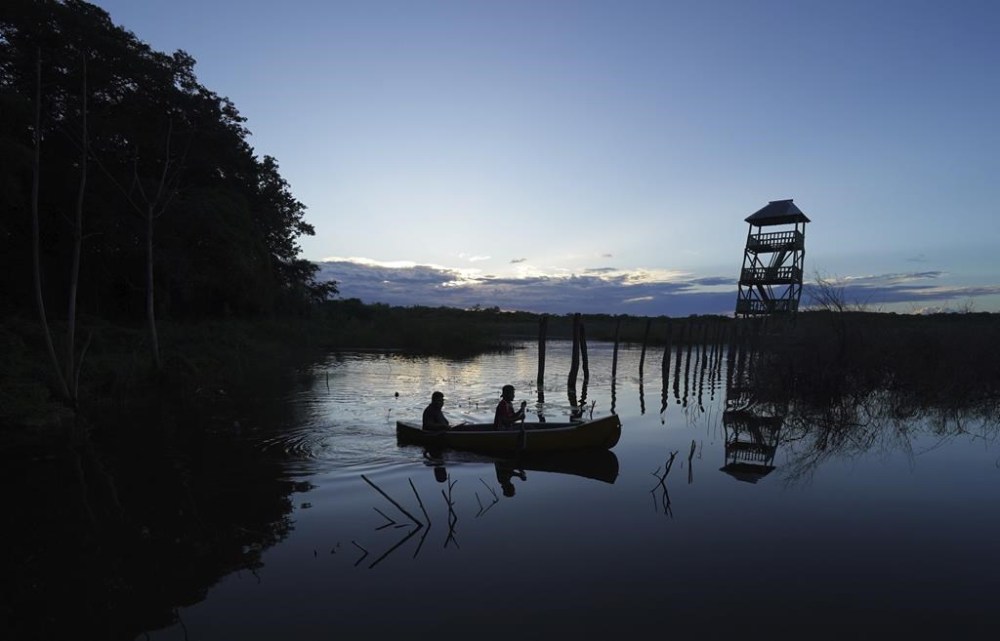
Some of that will be in the Valentin Gomez Farias communal farmlands. Residents there created an ecotourism project nine years ago that has visitors staying in tents under roofs of woven palm. Guests kayak in a lagoon, hike and observe wildlife as part of a project set up with camera traps.
With the Maya Train coming through, complete with hotel and tourism complexes, José Antonio Guzmán Hernández, who leads the project, fears Calakmul will turn into something more like Cancun or Tulum.
“We were always trying to keep that from happening,” he said. “But with all this now it feels like it will be like a bomb, it’s going to explode.”
___
Associated Press climate and environmental coverage receives support from several private foundations. See more about AP’s climate initiative here. The AP is solely responsible for all content.