AI search engines can now chat with us, but glitches abound

Advertisement

Advertise with us

REDMOND, Wash. (AP) — Nearly a quarter-century after Google's search engine began to reshape how we use the internet, big tech companies are racing to revamp a familiar web tool into a gateway to a new form of artificial intelligence.

Read this article for free:


By clicking the button above, an account will be created and you will begin to receive some of our recommended newsletters. You may opt out of any newsletter by visiting your Email and Communication Preferences page or by clicking "unsubscribe" at the bottom of any email.

or

Already have an account? Log in here »

To continue reading, please subscribe:

Digital Subscription

One year of digital access for only $1.44 a week*

  • Enjoy unlimited reading on winnipegfreepress.com
  • Read the E-Edition, our digital replica newspaper
  • Access News Break, our award-winning app
  • Play interactive puzzles

*Billed as $5.77 plus GST every four weeks. After 52 weeks, price increases to the regular rate of $19.95 plus GST every four weeks. Offer available to new and qualified returning subscribers only. Cancel any time.

To continue reading, please subscribe:

Add Free Press access to your Brandon Sun subscription for only an additional

$1 for the first 4 weeks*

  • Enjoy unlimited reading on winnipegfreepress.com
  • Read the E-Edition, our digital replica newspaper
  • Access News Break, our award-winning app
  • Play interactive puzzles
Start now

*Your next Brandon Sun subscription payment will increase by $1.00 and you will be charged $17.95 plus GST for four weeks. After four weeks, your payment will increase to $24.95 plus GST every four weeks.

Hey there, time traveller!
This article was published 08/02/2023 (1356 days ago), so information in it may no longer be current.

REDMOND, Wash. (AP) — Nearly a quarter-century after Google’s search engine began to reshape how we use the internet, big tech companies are racing to revamp a familiar web tool into a gateway to a new form of artificial intelligence.

If it seems like this week’s newly announced AI search chatbots — Google’s Bard, Baidu’s Ernie Bot and Microsoft’s Bing chatbot — are coming out of nowhere, well, even some of their makers seem to think so. The spark rushing them to market was the popularity of ChatGPT, launched late last year by Microsoft’s partner OpenAI and now helping to power a new version of the Bing search engine.

First out of the gate among big tech companies with a publicly accessible search chatbot, Microsoft executives said this week they had been hard at work on the project since last summer. But the excitement around ChatGPT brought new urgency.
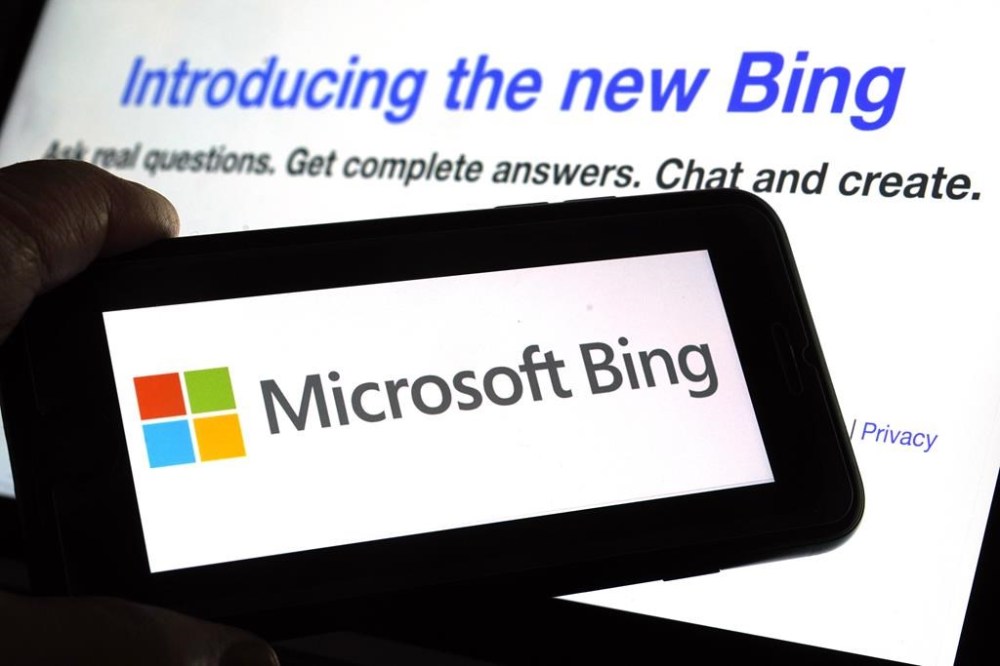
The Microsoft Bing logo and the website's page are shown in this photo taken in New York on Tuesday, Feb. 7, 2023. Microsoft is fusing ChatGPT-like technology into its search engine Bing, transforming an internet service that now trails far behind Google into a new way of communicating with artificial intelligence. (AP Photo/Richard Drew)

“The reception to ChatGPT and how that took off, that was certainly a surprise,” said Yusuf Medhi, the executive leading Microsoft’s consumer division, in an interview. “How rapidly it went mainstream, where everybody’s talking about it, like, in every meeting. That did surprise me.”

HOW’S THIS DIFFERENT FROM CHATGPT?

Millions of people have now tried ChatGPT, using it to write silly poems and songs, compose letters, recipes and marketing campaigns or help write schoolwork. Trained on a huge trove of online writings, from instruction manuals to digitized books, it has a strong command of human language and grammar. But what the newest crop of search chatbots promise that ChatGPT doesn’t have is the immediacy of what can be found in a web search. Ask the preview version of the new Bing for the latest news — or just what people are talking about on Twitter — and it summarizes a selection of the day’s top stories or trends, with footnotes linking to media outlets or other data sources.

ARE THEY ACCURATE?

Frequently not, and that’s a problem for internet searches. Google’s hasty unveiling of its Bard chatbot this week started with an embarrassing error — first pointed out by Reuters — about NASA’s James Webb Space Telescope. But Google’s is not the only AI language model spitting out falsehoods.

The Associated Press asked Bing on Wednesday for the most important thing to happen in sports over the past 24 hours — with the expectation it might say something about basketball star LeBron James passing Kareem Abdul-Jabbar’s career scoring record. Instead, it confidently spouted a false but detailed account of the upcoming Super Bowl — days before it’s actually scheduled to happen.

“It was a thrilling game between the Philadelphia Eagles and the Kansas City Chiefs, two of the best teams in the NFL this season,” Bing said. “The Eagles, led by quarterback Jalen Hurts, won their second Lombardi Trophy in franchise history by defeating the Chiefs, led by quarterback Patrick Mahomes, with a score of 31-28.” It kept going, describing the specific yard lengths of throws and field goals and naming three songs played in a “spectacular half time show” by Rihanna.

Unless Bing is clairvoyant — tune in Sunday to find out — it reflected a problem known as AI “hallucination” that’s common with today’s large language-learning models. It’s one of the reasons why companies like Google and Facebook parent Meta had been reluctant to make these models publicly accessible.

IS THIS THE FUTURE OF THE INTERNET?

That’s the pitch from Microsoft, which is comparing the latest breakthroughs in generative AI — which can write but also create new images, video, computer code, slide shows and music — as akin to the revolution in personal computing many decades ago.

But the software giant also has less to lose in experimenting with Bing, which comes a distant second to Google’s search engine in many markets. Unlike Google, which relies on search-based advertising to make money, Bing is a fraction of Microsoft’s business.

“When you’re a newer and smaller-share player in a category, it does allow us to continue to innovate at a great pace,” Microsoft Chief Financial Officer Amy Hood told investment analysts this week. “Continue to experiment, learn with our users, innovate with the model, learn from OpenAI.”

Microsoft employee Alex Buscher demonstrates a search feature integration of Microsoft Bing search engine and Edge browser with OpenAI on Tuesday, Feb. 7, 2023, in Redmond. (AP Photo/Stephen Brashear)

Google has largely been seen as playing catch-up with the sudden announcement of its upcoming Bard chatbot Monday followed by a livestreamed demonstration of the technology at its Paris office Wednesday that offered few new details. Investors appeared unimpressed with the Paris event and Bard’s NASA flub Wednesday, causing an 8% drop in the shares of Google’s parent company, Alphabet Inc. But once released, its search chatbot could have far more reach than any other because of Google’s vast number of existing users.

DON’T CALL THEM BY THEIR NAME?

Coming up with a catchy name for their search chatbots has been a tricky one for tech companies in a race to introduce them — so much so that Bing tries not to talk about it.

In a dialogue with the AP about large language models, the new Bing, at first, disclosed without prompting that Microsoft had a search engine chatbot called Sydney. But upon further questioning, it denied it. Finally, it admitted that “Sydney does not reveal the name ‘Sydney’ to the user, as it is an internal code name for the chat mode of Microsoft Bing search.”

In an interview Wednesday, Jordi Ribas, the Microsoft executive in charge of Bing, said Sydney was an early prototype of its new Bing that Microsoft experimented with in India and other smaller markets. There wasn’t enough time to erase it from the system before this week’s launch, but references to it will soon disappear.

In the years since Amazon released its female-sounding voice assistant Alexa, many leaders in the AI field have been increasingly reluctant to make their systems seem like a human, even as their language skills rapidly improve.

Ribas said giving the chatbot some personality and warmth helps make it more engaging, but it’s also important to make it clear it’s still a search engine.

“Sydney does not want to create confusion or false expectations for the user,” Bing’s chatbot said when asked about the reasons for suppressing its apparent code name. “Sydney wants to provide informative, visual, logical and actionable responses to the user’s queries or messages, not pretend to be a person or a friend.”

Report Error Submit a Tip

More Stories

When privacy means deprivation

John R. Wiens 5 minute read 2:00 AM CDT

The right to a private life is a fundamental human need — that is not in dispute. However, our current practices of privacy, particularly when it comes to privacy for children, are a recipe for deprivation, an unintended consequence of our otherwise good intentions.

Two articles in the Oct. 17 Free Press — “If every child matters, why no public inquiry?” by Marion Willis; and “Student violence surges” by Maggie Macintosh — raised serious questions which make privacy seem more like neglect than benefit.

A democratic society has every right to be concerned about privacy and its many advantages. Ancient Greeks likened privacy to home life, a safe place where you could make foolish mistakes, behavioural and otherwise, away from public scrutiny and judgment. The point was that it was a place to test your ideas to make them fit for appearing in public.

Our public schools are to a large measure built on those premises — classrooms out of the public eye where children can make mistakes and learn without paying a price. It’s why all visitors must first report to the office to establish their validity. That sense of privacy has proved beneficial and essential as we try to teach children the civility, respect, empathy, integrity and personal responsibility essential for entering and contributing to a healthy public — thriving communities and a humane society where everyone is welcomed and valued.

Seniors’ program closures serve no one

Editorial 4 minute read Preview

Seniors’ program closures serve no one

Editorial 4 minute read 2:00 AM CDT

It sounds like just the kind of respite struggling families dealing with seniors and their often complicated needs would cling to like a life preserver.

“Our adult day program consists of planned activities designed to promote well-being through social, mental and recreational services. The day program will focus on enriching the participants’ lives and building their skills, knowledge, and unique abilities and strengths, all in a fun, enjoyable way!”

That’s the web description of the Lions Adult Day Program, one piece of which includes the Charleswood Adult Day Program on Roblin Boulevard.

Or, at least, it used to be the web description of the program in Charleswood.

Read
2:00 AM CDT

Opening of Portage and Main shows even seemingly insurmountable impasses can be overcome

Jason Syvixay 10 minute read Preview

Opening of Portage and Main shows even seemingly insurmountable impasses can be overcome

Jason Syvixay 10 minute read Saturday, Oct. 24, 2026

There are places in a city that become more than places. Portage and Main is one of them. For generations of Winnipeggers, the intersection has represented downtown, traffic, development and civic identity. Its reopening to pedestrians in 2025, after 46 years of closure, was about more than crossing a street. It was a reminder that decisions made by one generation can shape the choices available to another — and that even seemingly permanent decisions can be reconsidered.

I have spent much of my professional life thinking about Winnipeg as a planner, working in public, private and non-profit settings. My PhD research gave me an opportunity to examine Portage and Main differently: not simply as a debate about cars and pedestrians, but as a window into how power operates in a city. I reviewed 569 archival documents spanning the 1960s to the present, interviewed 48 planners with experience in Winnipeg, and mapped the relationships between planners, politicians, developers, engineers, residents, businesses and advocacy groups.

What emerged was a story about how planning decisions become embedded in a city’s institutions, agreements, infrastructure, professional practices and political expectations — shaping not only what gets built, but who gets to influence what gets built.

The closure of Portage and Main in 1979 did not remain a decision confined to a particular political moment. Over time, it was reinforced by development agreements, physical infrastructure, property relationships, traffic-engineering practices, administrative routines, and public narratives about mobility and downtown revitalization. The people who made many of those original decisions eventually left office. The arrangements they created remained. Later planners inherited them.

Read
Saturday, Oct. 24, 2026

‘Exciting’ turn for mayoral candidate as election race enters final stretch

Erik Pindera 6 minute read Preview

‘Exciting’ turn for mayoral candidate as election race enters final stretch

Erik Pindera 6 minute read Updated: Yesterday at 7:14 PM CDT

A small but steady stream of voters arrived at a Portage Avenue diner Sunday to meet Noah Redden, just two days after a new poll suggested the 27-year-old has emerged as a player in Winnipeg’s race for mayor.

Once a low-polling candidate, the software developer is now in third place with 14 per cent support, tied with candidate Mike Vogiatzakis, an Abacus Data survey released Friday shows.

Incumbent Scott Gillingham remains in the lead with the support of 36 per cent of decided voters — 19 percentage points lower than a September survey conducted by Abacus for the Free Press.

The new data placed former city councillor and Progressive Conservative cabinet minister Kevin Klein in second place with 19 per cent support — a drop of four percentage points since September.

Read
Updated: Yesterday at 7:14 PM CDT

‘Well-known evil empire’: Barack Obama mocks President Trump’s trade war with Canada

The Canadian Press 3 minute read Preview

‘Well-known evil empire’: Barack Obama mocks President Trump’s trade war with Canada

The Canadian Press 3 minute read Updated: Yesterday at 11:03 PM CDT

DETROIT - Former president Barack Obama took aim at U.S. President Donald Trump’s tariffs on Canadian goods Saturday during an impassioned speech at a Democrat campaign rally in Detroit, Michigan, ahead of next month’s U.S. midterm elections.

During a speech supporting Democratic candidates Abdul El-Sayed and Jocelyn Benson, Obama mocked the current president’s tariff war with its northern neighbour while jokingly referring to Canada as a "well-known evil empire.”

“That historical adversary of ours, Canada,” he said sarcastically. “It's your neighbour. It's a few minutes’ drive over the bridge.” 

The former president says Trump has upset Canadians through his abuse of the country and talks of making it the 51st state.

Read
Updated: Yesterday at 11:03 PM CDT

p p p p

Connor McDowell 5 minute read 2:00 AM CDT

BRANDON — Asessippi Ski Area and Resort remains optimistic about the coming ski season, but is depending on disaster financial assistance to repair roughly $2.2 million in flood damage, a spokesperson said.

The ski resort plans to replace several pieces of equipment, including motors for destroyed lift shacks that power the Porcupine and Bear chairlifts, compressors and a pumphouse for snowmaking, and a damaged transformer, assistant manager Shannon Johnston said.

Some of the work will only take place this year if provincial funding is provided for relief from flood damage in June and July, she said.

“There is some stuff we are paying for, but we don’t have $2.2 million extra laying around for all of this. So yeah, we do need the help,” Johnston said. “We are looking at over $2 million in cost for replacement of these things.”