Stone Age discovery fuels mystery of who made early tools

Advertisement

Advertise with us

NEW YORK (AP) — Archaeologists in Kenya have dug up some of the oldest stone tools ever found, but who used them is a mystery.

Read this article for free:


or

Already have an account? Log in here »

To continue reading, please subscribe:

Subscribe and receive a limited-edition Free Press branded hat or tote.

Digital Subscription

One year of digital access for only $205*

  • Enjoy unlimited reading on winnipegfreepress.com
  • Read the E-Edition, our digital replica newspaper
  • Access News Break, our award-winning app
  • Play interactive puzzles

*First annual payment billed as $205.00 + GST for one year. This annual subscription will automatically renew at $233.00 + GST every 52 weeks (10% off the regular annual price of $259.35). Offer available to new and qualified returning subscribers only. Cancel any time.

To continue reading, please subscribe:

Add Free Press access to your Brandon Sun subscription for only an additional

$1 for the first 4 weeks*

  • Enjoy unlimited reading on winnipegfreepress.com
  • Read the E-Edition, our digital replica newspaper
  • Access News Break, our award-winning app
  • Play interactive puzzles
Start now

*Your next Brandon Sun subscription payment will increase by $1.00 and you will be charged $17.95 plus GST for four weeks. After four weeks, your payment will increase to $24.95 plus GST every four weeks.

Hey there, time traveller!
This article was published 09/02/2023 (1309 days ago), so information in it may no longer be current.

NEW YORK (AP) — Archaeologists in Kenya have dug up some of the oldest stone tools ever found, but who used them is a mystery.

In the past, scientists assumed that our direct ancestors were the only toolmakers. But two big fossil teeth found along with the tools at the Kenyan site belong to an extinct human cousin known as Paranthropus, according to a study published Thursday in the journal Science.

This adds to the evidence that our direct relatives in the Homo lineage may not have been the only tech-savvy creatures during the Stone Age, said study author Rick Potts, director of the Smithsonian’s Human Origins Program.
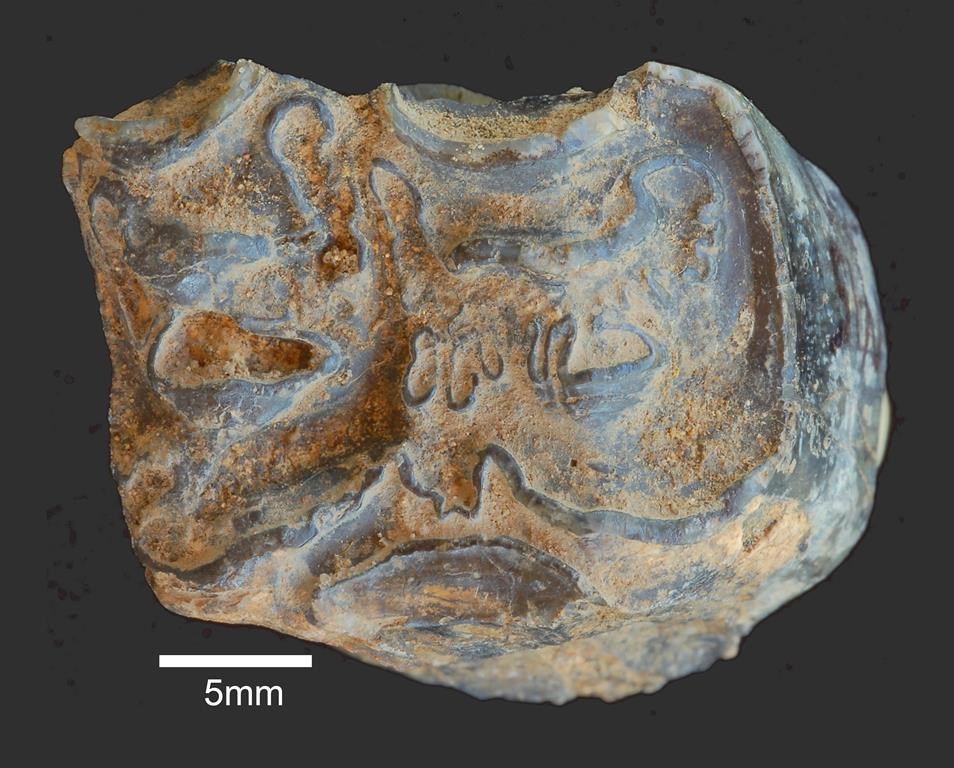
This photo provided by the Homa Peninsula Paleoanthropology Project shows the fossilized upper molar of a horse (Eurygnathohippus) found eroding from the Nyayanga site in southwestern Kenya. Archaeologists in Kenya have dug up some of the oldest stone tools ever found, dating back to around 2.9 million years ago, but who used them is a mystery, according to a study published Thursday, Feb. 9, 2023, in the journal Science. (J.S. Oliver/Homa Peninsula Paleoanthropology Project via AP)

“Those teeth open up an amazing whodunit — a real question of, well, who were these earliest toolmakers?” Potts said.

The tools date back to around 2.9 million years ago, when early humans used them to butcher hippos for their meat, the researchers report.

Older stone tools have been found in Kenya, dating back to around 3.3 million years ago, long before our own Homo ancestors appeared. Those tools were a bit simpler and so far have only been found in one spot, said Shannon McPherron, an archaeologist at Germany’s Max Planck Institute for Evolutionary Anthropology who was not involved with the study.

The latest discovery matches up with a much bigger tradition known as the Oldowan toolkit. These same kinds of tools show up across Africa and beyond during more than a million years of prehistory, Potts said, showing they really caught on among early humans.

They held a rock in one hand and hit it with another stone, chipping off thin, razor-sharp flakes, explained anthropologist Kathy Schick of the Stone Age Institute in Indiana, who wasn’t involved in the research.

With the rocks and flakes, early humans could slice and crush a wide range of materials, said lead author Thomas Plummer, an anthropologist at Queens College of the City University of New York. And the tools from the Kenya site — likely the most ancient Oldowan tools found to date — suggest this gave them an advantage in a key area: eating.

The site, known as Nyayanga, is a lush, hilly landscape on the shores of Lake Victoria. Since starting excavations there in 2015, researchers have found a trove of artifacts and animal bones, along with the two Paranthropus teeth.

Slice marks on several hippo bones show they were cut up for their meat, which would have been eaten raw as a hippo steak tartare, Plummer said. The early humans also likely used their tools to break open antelope bones for their fatty marrow inside, and to peel the outer rinds of tough plant roots, the authors concluded.

“Stone tools are allowing them, even at this really early date, to extract a lot of resources from the environment,” Plummer said. “If you can butcher a hippo, you can butcher pretty much anything.”

In the past, it was easy to assume that our direct ancestors were the ones using these tools, Plummer said. But the teeth make it hard to rule out that other early humans were picking up tools of their own, researchers said — even extinct cousins like Paranthropus, with their big teeth and small brains.

The mystery will be a tough one to solve.

After all, we can’t say for sure whether Paranthropus was using these tools, or just happened to die in the same place, Schick said: “When we find hominin fossils with stone tools, you always have to ask, is this the dinner or the diner?”

___

The Associated Press Health and Science Department receives support from the Howard Hughes Medical Institute’s Science and Educational Media Group. The AP is solely responsible for all content.

Report Error Submit a Tip

More Stories

Stone Age discovery fuels mystery of who made early tools

Maddie Burakoff, The Associated Press 4 minute read Preview

Stone Age discovery fuels mystery of who made early tools

Maddie Burakoff, The Associated Press 4 minute read Thursday, Feb. 9, 2023

NEW YORK (AP) — Archaeologists in Kenya have dug up some of the oldest stone tools ever found, but who used them is a mystery.

In the past, scientists assumed that our direct ancestors were the only toolmakers. But two big fossil teeth found along with the tools at the Kenyan site belong to an extinct human cousin known as Paranthropus, according to a study published Thursday in the journal Science.

This adds to the evidence that our direct relatives in the Homo lineage may not have been the only tech-savvy creatures during the Stone Age, said study author Rick Potts, director of the Smithsonian’s Human Origins Program.

“Those teeth open up an amazing whodunit — a real question of, well, who were these earliest toolmakers?” Potts said.

Read
Thursday, Feb. 9, 2023

Manitoba artists in TIFF spotlight as fest begins

Randall King 6 minute read Preview

Manitoba artists in TIFF spotlight as fest begins

Randall King 6 minute read 6:15 PM CDT

Expect Winnipeg film production — and Manitoba talent — to grab its share of the klieg lights at the 2026 edition of the Toronto International Film Festival, which starts today and runs to Sept. 20.

Read
6:15 PM CDT

Council to consider moving ahead with final phase of sewage plant upgrade before securing expected federal cash

Joyanne Pursaga 5 minute read Preview

Council to consider moving ahead with final phase of sewage plant upgrade before securing expected federal cash

Joyanne Pursaga 5 minute read 6:00 PM CDT

City council will consider approving $115 million toward the final phase of the North End sewage treatment plant upgrade, while civic staff warn sewer rates would soar $200 higher per year if more federal funding isn’t provided.

However, several politicians say a response from Ottawa to the city’s request for more money is expected soon.

A water and waste report asks council to waive a condition that the city finalize funding agreements with the provincial and federal governments for the mega-project before awarding the money for a contractor to complete the $115-million development phase agreement for the final project.

The third and final nutrient removal facilities phase is expected to cost $1.57 billion, bringing the total cost of the entire upgrade to $3.1 billion.

Read
6:00 PM CDT

Premier tells grieving parents site of fatal collision under review

Chris Kitching 4 minute read Preview

Premier tells grieving parents site of fatal collision under review

Chris Kitching 4 minute read 5:48 PM CDT

Premier Wab Kinew promised to pursue safety improvements at an Interlake intersection when he spoke to parents of some of the four teens who died in a crash at the site on the Labour Day weekend.

The collision at Highway 8 and Provincial Road 229, just west of Winnipeg Beach, prompted a review by Manitoba Transportation and Infrastructure, which is standard after a fatal crash, while some of the victims’ families and community leaders publicly called for changes.

“When you see the loss of these beautiful young lives, any parent, any Manitoban feels a sense of loss. On behalf of the whole province, I send my condolences to these families,” Kinew said in Winnipeg Wednesday.

“I did so directly earlier today, and I heard some of the parents’ suggestions for how we could make this safer for everybody. I committed to them that we’re going to take those actions — both stuff we can do relatively quickly and some longer-term fixes, as well.”

Read
5:48 PM CDT

Pointing fingers at Tories three years after election tiresome, accomplishes nothing

Tom Brodbeck 5 minute read Preview

Pointing fingers at Tories three years after election tiresome, accomplishes nothing

Tom Brodbeck 5 minute read Yesterday at 1:08 PM CDT

There is a point in every government’s life when blaming the previous government stops being an explanation and starts becoming an excuse.

For Manitoba’s NDP government, that point has arrived.

Justice Minister Matt Wiebe was asked last week about a grievance filed by Crown attorneys over excessive workloads and a government attempt to keep a report documenting those workloads out of an upcoming arbitration hearing.

Wiebe said he couldn’t discuss the arbitration case.

Read
Yesterday at 1:08 PM CDT

Grieving families, local leaders want review of Interlake intersection after teens die in crash

Chris Kitching 8 minute read Preview

Grieving families, local leaders want review of Interlake intersection after teens die in crash

Chris Kitching 8 minute read Updated: Yesterday at 6:34 PM CDT

A two-vehicle crash that killed four teenage friends in the Interlake Sunday night prompted outpourings of grief in several communities and calls for safety improvements at the intersection, which was also the site of a death in July.

Recent high school graduates Maya Borsa and Chloe Vermette, both 18, were identified by their families as victims of the collision at Highway 8 and Provincial Road 229, just west of Winnipeg Beach.

“(Chloe) was a very bubbly, loving personality. Always giving, always caring. Her friends meant the world to her,” said her mother, Veronique Vermette, who struggled to comprehend the tragedy when she went to the scene Monday. “We sat in the rain for hours, and it blew my mind that four lives were taken.”

The teens’ parents are waiting for RCMP to provide more information about the cause of the crash. Chloe, who graduated from Windsor Park Collegiate in Winnipeg in July, was driving one of the vehicles, her mother said.

Read
Updated: Yesterday at 6:34 PM CDT