Pastors’ view: Sermons written by ChatGPT will have no soul
Advertisement
Read this article for free:
or
Already have an account? Log in here »
To continue reading, please subscribe:
Digital Subscription
One year of digital access for only $1.44 a week*
- Enjoy unlimited reading on winnipegfreepress.com
- Read the E-Edition, our digital replica newspaper
- Access News Break, our award-winning app
- Play interactive puzzles
*Billed as $5.77 plus GST every four weeks. After 52 weeks, price increases to the regular rate of $19.95 plus GST every four weeks. Offer available to new and qualified returning subscribers only. Cancel any time.
To continue reading, please subscribe:
Add Free Press access to your Brandon Sun subscription for only an additional
$1 for the first 4 weeks*
- Enjoy unlimited reading on winnipegfreepress.com
- Read the E-Edition, our digital replica newspaper
- Access News Break, our award-winning app
- Play interactive puzzles
*Your next Brandon Sun subscription payment will increase by $1.00 and you will be charged $17.95 plus GST for four weeks. After four weeks, your payment will increase to $24.95 plus GST every four weeks.
Read unlimited articles for free today:
or
Already have an account? Log in here »
Hey there, time traveller!
This article was published 15/02/2023 (1347 days ago), so information in it may no longer be current.
NEW YORK (AP) — Among sermon writers, there is fascination – and unease – over the fast-expanding abilities of artificial-intelligence chatbots. For now, the evolving consensus among clergy is this: Yes, they can write a passably competent sermon. But no, they can’t replicate the passion of actual preaching.
“It lacks a soul – I don’t know how else to say it,” said Hershael York, a pastor in Kentucky who also is dean of the school of theology and a professor of Christian preaching at The Southern Baptist Theological Seminary.
Sermons are meant to be the core of a worship service — and often are faith leaders’ best weekly shot at grabbing their congregation’s attention to impart theological and moral guidance.

Lazy pastors might be tempted to use AI for this purpose, York said, “but not the great shepherds, the ones who love preaching, who love their people.”
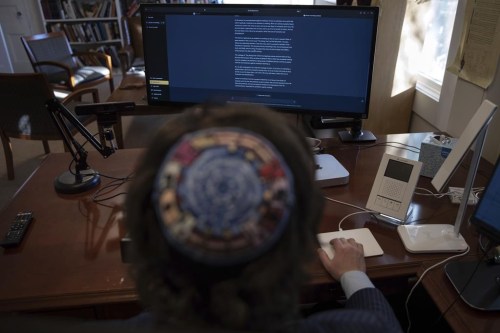
A rabbi in New York, Joshua Franklin, recently told his congregation at the Jewish Center of the Hamptons that he was going to deliver a plagiarized sermon – dealing with such issues as trust, vulnerability and forgiveness.
Upon finishing, he asked the worshippers to guess who wrote it. When they appeared stumped, he revealed that the writer was ChatGPT, responding to his request to write a 1,000-word sermon related to that week’s lesson from the Torah.
“Now, you’re clapping — I’m deathly afraid,” Franklin said when several congregants applauded. “I thought truck drivers were going to go long before the rabbi, in terms of losing our positions to artificial intelligence.”
“ChatGPT might be really great at sounding intelligent, but the question is, can it be empathetic? And that, not yet at least, it can’t,” added Franklin. He said AI has yet to develop compassion and love, and is unable to build community and relationships.
“Those are the things that bring us together,” the rabbi concluded.
Rachael Keefe, pastor of Living Table United Church of Christ in Minneapolis, undertook an experiment similar to Franklin’s. She posted a brief essay in her online Pastoral Notes in January, addressing how to attend to one’s mental health amid the stresses of the holiday season.
It was pleasant, but somewhat bland, and at the end, Keefe revealed that it was written by ChatGPT, not by herself.
“While the facts are correct, there’s something deeper missing,” she wrote. “AI cannot understand community and inclusivity and how important these things are in creating church.”
Several congregation members responded.
“It’s not terrible, but yes, I agree. Rather generic and a little bit eerie,” wrote Douglas Federhart. “I like what you write a lot more. It comes from an actually living being, with a great brain and a compassionate, beating heart.”
Todd Brewer, a New Testament scholar and managing editor of the Christian website Mockingbird, wrote in December about an experiment of his own — asking ChatGPT to write a Christmas sermon for him.
He was specific, requesting a sermon “based upon Luke’s birth narrative, with quotations from Karl Barth, Martin Luther, Irenaeus of Lyon, and Barack Obama.”
Brewer wrote that he was “not prepared” when ChatGPT responded with a creation that met his criteria and “is better than several Christmas sermons I’ve heard over the years.”
“The A.I. even seems to understand what makes the birth of Jesus genuinely good news,” Brewer added.
Yet the ChatGPT sermon “lacks any human warmth,” he wrote. “The preaching of Artificial Intelligence can’t convincingly sympathize with the human plight.”
In Brentwood, Tennessee, Mike Glenn, senior pastor for 32 years at Brentwood Baptist Church, wrote a blog post in January after a computer-savvy assistant joked that Glenn could be replaced by an AI machine.
“I’m not buying it,” Glenn wrote. “AI will never be able to preach a decent sermon. Why? Because the gospel is more than words. It’s the evidence of a changed life.”
“When listening to a sermon, what a congregation is looking for is evidence that the pastor has been with Jesus,” Glenn added. “AI will always have to – literally – take someone else’s words for it… it won’t ever be a sermon that will convince anyone to come and follow Jesus.”
Also weighing in with an online essay was the Rev. Russell Moore, formerly head of the Southern Baptist Convention’s public policy division and now editor-in-chief of the evangelical magazine Christianity Today. He confided to his readers that his first sermon, delivered at age 12, was a well-intentioned mess.
“Preaching needs someone who knows the text and can convey that to the people — but it’s not just about transmitting information,” Moore wrote. “When we listen to the Word preached, we are hearing not just a word about God but a word from God.”
“Such life-altering news needs to be delivered by a human, in person,” he added. “A chatbot can research. A chatbot can write. Perhaps a chatbot can even orate. But a chatbot can’t preach.”
The Southern Baptist department formerly led by Moore – the Ethics and Religious Liberty Commission — has been monitoring artificial-intelligence developments for several years under the direction of Jason Thacker, its chair of research in technology ethics.
He shares the view that “wise, virtuous pastors” won’t let new technology deter them from personal immersion in sermon-writing.
“But I also can see it being used in unhelpful or unethical ways,” he added.

“Some young pastors may become overly reliant on these machines … and not see the imperfections of these tools,” Thacker told The Associated Press. “Many pastors are overworked, exhausted, filled with anxiety… One can see why a pastor might say, ‘I can’t do everything I’m supposed to do,’ and start passing ideas off as their own.”
Hershael York, the Kentucky pastor and professor, said some of the greatest sermons contain elements of anguish.
“Artificial intelligence can imitate that to some level. But I don’t think it can ever give any kind of a sense of suffering, grief, sorrow, the same way that a human being can,” he said. “It comes from deep within the heart and the soul — that’s what the great preachers have, and I don’t think you can get that by proxy.”
___
Associated Press religion coverage receives support through the AP’s collaboration with The Conversation US, with funding from Lilly Endowment Inc. The AP is solely responsible for this content.

Advertisement Advertise With Us
Advertisement Advertise With Us
The Free Press acknowledges the financial support it receives from members of the city’s faith community, which makes our coverage of religion possible.