

Pundit predictions don’t square with riding realities
Advertisement
Read this article for free:
or
Already have an account? Log in here »
To continue reading, please subscribe:

Digital Subscription
One year of digital access for only $205*
- Enjoy unlimited reading on winnipegfreepress.com
- Read the E-Edition, our digital replica newspaper
- Access News Break, our award-winning app
- Play interactive puzzles
*First annual payment billed as $205.00 + GST for one year. This annual subscription will automatically renew at $233.00 + GST every 52 weeks (10% off the regular annual price of $259.35). Offer available to new and qualified returning subscribers only. Cancel any time.
To continue reading, please subscribe:
Add Free Press access to your Brandon Sun subscription for only an additional
$1 for the first 4 weeks*
- Enjoy unlimited reading on winnipegfreepress.com
- Read the E-Edition, our digital replica newspaper
- Access News Break, our award-winning app
- Play interactive puzzles
*Your next Brandon Sun subscription payment will increase by $1.00 and you will be charged $17.95 plus GST for four weeks. After four weeks, your payment will increase to $24.95 plus GST every four weeks.
Read unlimited articles for free today:
or
Already have an account? Log in here »
Hey there, time traveller!
This article was published 18/04/2023 (1215 days ago), so information in it may no longer be current.
Over the past year, there have been countless news reports and opinion pieces suggesting the New Democratic Party is headed for a landslide victory in the upcoming provincial election. All those reports, editorials and columns have created a widespread perception that the outcome is a foregone conclusion, but none has detailed exactly how that might occur.
If they had engaged in that exercise, they might have concluded the NDP’s path to victory is far narrower, and far less certain, than many believe.
Manitoba’s legislative assembly has 57 seats, which means a political party must win at least 29 seats in order to form a majority government. The government would also want one of its caucus members to serve as speaker, so the minimum number is really 30 seats.
David Lipnowski / Canadian Press Files
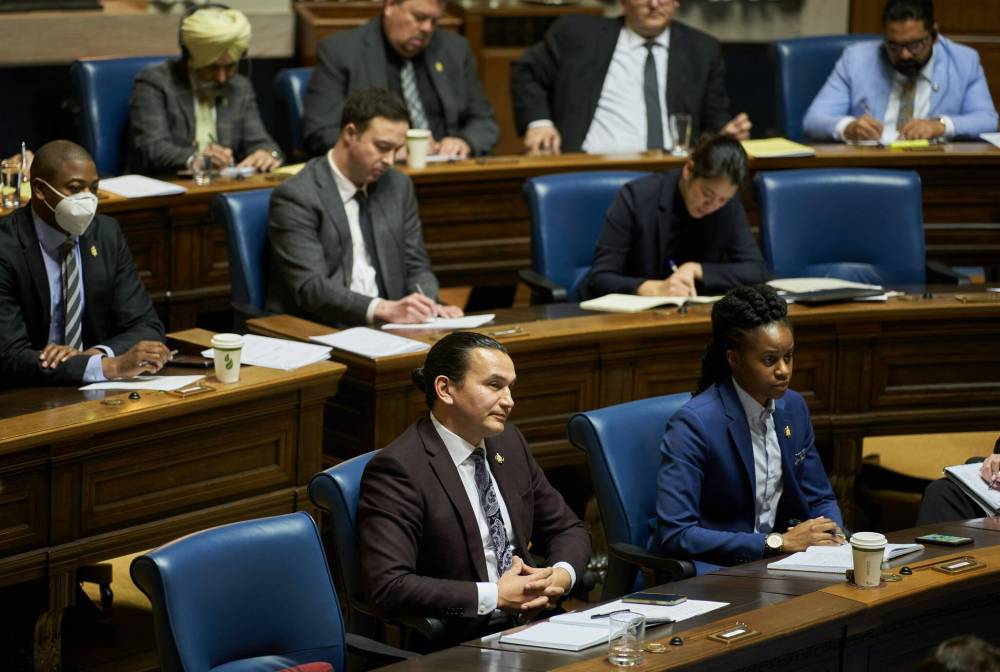
Manitoba Opposition NDP Leader Wab Kinew’s path to victory in October may prove to be thornier than many political commentators believe.
There are currently 36 Progressive Conservative MLAs, 18 New Democrats and three Liberals. That means the NDP must retain all the seats it currently holds in the upcoming election, and win an additional 11 seats in order to achieve just a bare majority. With the party holding a sizable lead in opinion polls, that might sound easy. It shouldn’t, because it won’t be.
In the 2019 Manitoba election, 35 of the 36 Progressive Conservative MLAs were elected with more than 42 per cent of votes cast in their respective ridings. A whopping 27 of those 36 MLAs received more than half of the votes cast, and 13 of them received more than 65 per cent.
The nine ridings in which PC candidates won with fewer than half of votes cast in 2019 were Assiniboia (44.25 per cent), Fort Richmond (42.15), McPhillips (38.19), Radisson (46.97), Riel (44.75), Rossmere (46.91), Seine River (45.04), Southdale (42.40) and Premier Heather Stefanson’s Tuxedo riding (47.85).
Even if the NDP holds all 18 of its seats in the upcoming election, and wins eight of the above Tory ridings (the party hasn’t yet nominated candidates in Assiniboia and McPhillips, and has no hope of defeating Stefanson in Tuxedo), it would still need to win another three ridings to achieve a bare majority, and a fourth riding in order to also have an NDP speaker.
The likely targets would be Brandon East, Dauphin, Kildonan-River East, Selkirk and maybe Liberal leader Dougald Lamont’s St. Boniface seat, but winning in those ridings will be a tough task. After that, the odds of the NDP taking any of the other Tory seats, or the other two Liberal seats for that matter, range from slim to impossible.
That’s because, firstly, the NDP has little to no organizational infrastructure in most of those ridings and is still having difficulties finding candidates who are willing to devote their time, energy and money toward what would likely be a hopeless cause.
Second, the Tories conducted massive voter identification efforts in each of their held ridings prior to the past two elections. They have a very good idea who voted for their candidates, and they have the contact information for many of those voters. That’s a huge advantage.
Third, the low voter-turnout trend we are experiencing favours the Tories because the age groups that typically vote in higher percentages (especially those 55 and older) typically support conservative candidates. Manitobans aged 18 to 34 prefer the NDP, but they are far less likely to actually vote.

Finally, Liberal MLAs Jon Gerrard (River Heights) and Cindy Lamoureux (Tyndall Park) have strong organizations and stable support in their respective ridings. Their seats are safe.
NDP supporters might point to the drop in support for the Liberal Party in recent polls, and suggest it could help their party’s candidates be elected in Tory-held ridings. That could happen, but it is equally possible that Liberal support will rebound to traditional levels, costing the NDP seats it needs to win.
The latest opinion polls suggest the NDP is headed toward a massive win in the next election, but that perception doesn’t square with historical voting patterns, or with the existing organizational realties on the ground.
Things can change during a campaign, but under the current circumstances, the NDP appears to be headed for a slim majority at best. Perhaps we should start getting used to the possibility of a minority government.
Deveryn Ross is a political commentator living in Brandon. deverynrossletters@gmail.com Twitter: @deverynross