

New dig likely buries hopes of unearthing Dutch WWII loot
Advertisement
Read this article for free:
or
Already have an account? Log in here »
To continue reading, please subscribe:
Digital Subscription
One year of digital access for only $1.44 a week*
- Enjoy unlimited reading on winnipegfreepress.com
- Read the E-Edition, our digital replica newspaper
- Access News Break, our award-winning app
- Play interactive puzzles
*Billed as $5.77 plus GST every four weeks. After 52 weeks, price increases to the regular rate of $19.95 plus GST every four weeks. Offer available to new and qualified returning subscribers only. Cancel any time.
To continue reading, please subscribe:
Add Free Press access to your Brandon Sun subscription for only an additional
$1 for the first 4 weeks*
- Enjoy unlimited reading on winnipegfreepress.com
- Read the E-Edition, our digital replica newspaper
- Access News Break, our award-winning app
- Play interactive puzzles
*Your next Brandon Sun subscription payment will increase by $1.00 and you will be charged $17.95 plus GST for four weeks. After four weeks, your payment will increase to $24.95 plus GST every four weeks.
Read unlimited articles for free today:
or
Already have an account? Log in here »
Hey there, time traveller!
This article was published 01/05/2023 (1268 days ago), so information in it may no longer be current.
OMMEREN, Netherlands (AP) — An officially sanctioned hunt for a stash of precious jewelry looted by the Nazis during World War II and purportedly buried in a sleepy Dutch village has — like many previous searches — failed to unearth any treasure.
Archeologists and historians called into the village of Ommeren, about 80 kilometers (50 miles) southeast of Amsterdam, pushed a detection device called a magnetometer along a row of fruit trees and across a field Monday morning and used a mechanical digger to excavate holes in the soggy soil.
They were rewarded with little more than a World War II-era bullet, some twisted scrap metal, a crumpled car wheel and muddy boots.
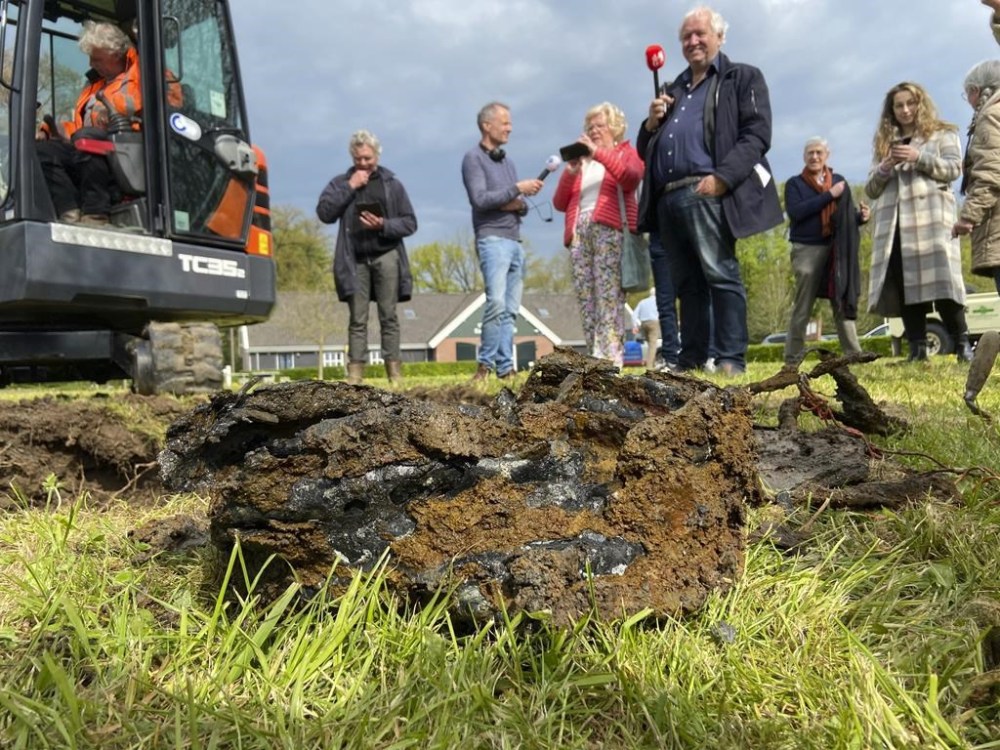
Municipal officials hope that the failure of the team — that included members of a local historical society and archeologists from the Vrije Universiteit Amsterdam — to find treasure will put an end to amateur sleuths visiting the village.
“I think there’s minimal chance of finding anything. We dug three holes here of places where we could find through the magnetometer. There was a signal, and none of these holes have found the treasure,” said archeologist Martijn Bink. “So I think this is all what we’ll do. We won’t go any further.”
The local municipality helped fund the latest search after the publication early this year of a hand-drawn map with a red letter X supposedly marking the spot where Nazi troops buried jewelry stolen from a blown-up bank vault.
The appearance of the map sparked a modern-day treasure hunt, with prospectors using metal detectors digging up sites around Ommeren despite a ban.
“A lot of people came digging here … without permission. Caused a lot of inconvenience for the residents,” said Pieter Neven of Buren municipality.
The treasure hunts began after the Dutch National Archive published a mountain of documents — as it does at the start of each year — including the map, which swiftly went viral.
“We’re quite astonished about the story itself. But the attention it’s getting … as well,” National Archive researcher Annet Waalkens said in January.
She said the story started in the summer of 1944 in the Nazi-occupied city of Arnhem — made famous by the star-studded movie “A Bridge Too Far” — when a bomb smashed a bank vault, scattering gold, jewelry and cash across a street.
German forces scooped up as much of the loot as they could and kept it in ammunition boxes, she said, citing an account by a German soldier interviewed by Dutch authorities after the war. As the Germans were pushed back by an Allied advance, they buried the ammunition boxes in Ommeren, according to the soldier’s account.
Dutch authorities recovered the map and searched Ommeren shortly after the war without finding anything. Then the scent went cold until publication of the map triggered the January hunt.
Monday’s archeological efforts also dug up nothing and may have buried the last hope of recovering the loot.
___
Corder reported from The Hague.