Meteorites found in Canada cannot be removed from the country without permit

Advertisement

Advertise with us

Catch a falling star if you can, and by all means put it in your pocket, but don't try to cross international borders with it lest you run afoul of a little-known Canadian law.

Read this article for free:


or

Already have an account? Log in here »

To continue reading, please subscribe:

Subscribe and receive a limited-edition Free Press branded hat or tote.

Digital Subscription

One year of digital access for only $205*

  • Enjoy unlimited reading on winnipegfreepress.com
  • Read the E-Edition, our digital replica newspaper
  • Access News Break, our award-winning app
  • Play interactive puzzles

*First annual payment billed as $205.00 + GST for one year. This annual subscription will automatically renew at $233.00 + GST every 52 weeks (10% off the regular annual price of $259.35). Offer available to new and qualified returning subscribers only. Cancel any time.

To continue reading, please subscribe:

Add Free Press access to your Brandon Sun subscription for only an additional

$1 for the first 4 weeks*

  • Enjoy unlimited reading on winnipegfreepress.com
  • Read the E-Edition, our digital replica newspaper
  • Access News Break, our award-winning app
  • Play interactive puzzles
Start now

*Your next Brandon Sun subscription payment will increase by $1.00 and you will be charged $17.95 plus GST for four weeks. After four weeks, your payment will increase to $24.95 plus GST every four weeks.

Hey there, time traveller!
This article was published 21/05/2023 (1217 days ago), so information in it may no longer be current.

Catch a falling star if you can, and by all means put it in your pocket, but don’t try to cross international borders with it lest you run afoul of a little-known Canadian law.

An American museum will have to navigate that law’s intricacies should it try to buy portions of a meteorite believed to have landed in New Brunswick last month.

A fireball ripped through the Earth’s atmosphere on April 8 and landed somewhere in the province, prompting the Maine Mineral and Gem Museum to offer a US$25,000 reward for the first one kilogram meteorite recovered.
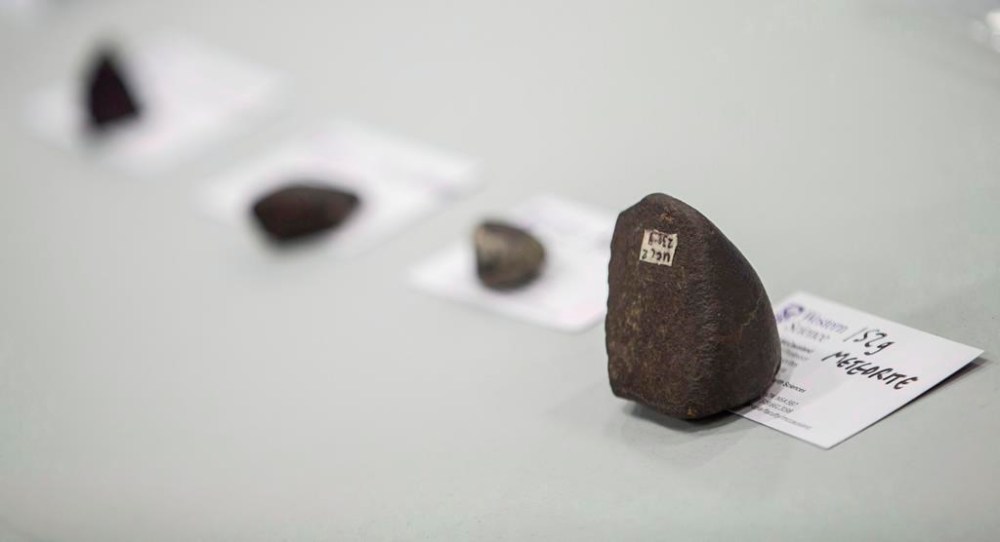
Scientists from Western University and NASA display some meteorites during a press conference in St.Thomas, Ont., Friday, March 21, 2014. On April 8, a fireball ripped through the Earth's atmosphere and landed somewhere in New Brunswick, prompting Maine Mineral and Gem Museum in Bethel to offer a US$25,000 reward for the first one kilogram meteorite recovered. THE CANADIAN PRESS/ Geoff Robins

But Chris Herd, a professor at the University of Alberta and curator of its meteorite collection, said obtaining the asteroid fragments won’t be as simple as making an offer.

“In Canada, all meteorites are considered Canadian cultural property automatically through the Cultural Property Export and Import Act,” he said in an interview. “… “If it’s public property, say an American comes in and finds (the meteorite,) they have to apply to export it from Canada. They may not actually take it out of Canada unless they have an approved export permit.”

The museum in Bethel, Maine, has openly expressed interest in obtaining some of the space debris if and when it’s found.

Darryl Pitt, head of the museum’s meteorite division, said doppler radar readings suggest the meteorite — which most likely originated from the asteroid belt between Mars and Jupiter — was likely scattered over the part of New Brunswick straddling Maine.

The museum’s interest also extends beyond just the first 1-kg meteorite; a news release said it will buy any additional specimens found.

“Depending on the type of meteorite this is, specimens could easily be worth their weight in gold,” Pitt said.

Herd said meteorites can be identified by a dark brown or black outer glassy crust that resembles an eggshell, he said.

“That’s a telltale sign that it’s come through the Earth’s atmosphere from space,” he said, noting they’re usually dense and surprisingly heavy.

The person who finds a whole or partial meteorite on public property must complete an export application that’s reviewed by an expert examiner, said Herd, who is one of several in Canada.

“The expert examiner then might say, ‘well, this is of potential outstanding significance and national importance,'” he said.

“If the expert examiner says, ‘Oh, I think this is significant, and important,’ then (the Canadian Border Services) will recommend refusal of the export permit.”

The file then goes to a cultural property export review board, which can disagree with the expert examiner and let the meteorite be exported. Alternatively, it can impose a six-month embargo period during which Canadian institutions can offer to buy the meteorite for a fair market price, he said.

Anyone taking a meteorite out of Canada without the requisite permit can face fines of up to $25,000, as much as five years in prison or both.

Despite its open interest in purchasing the meteorite, Pitt said the Mineral and Gem Museum is well aware of the regulations it must follow to obtain any fragments that surface.

“The museum should always do due diligence … as to whether the meteorite was obtained legally before they actually acquire it,” Herd said.

“If it comes from outside of the U.S., as would be the case in this scenario, then they would need to do their due diligence and make sure that the person exported it legally from Canada.”

Pitt said the responsibility of obtaining an export permit lies with whoever finds a meteor. For its part, he said the museum would “immediately get in touch” with Herd to help broker a deal.

“If Canada wants it, it’s Canadian,” he said. “I hope that we could arrive at an agreement with our Canadian friends so that a sample of it could come to the Maine Mineral and Gem Museum.”

Herd said he made a deal with an American dealer for a piece of the Grimsby meteorite that fell in southern Ontario’s Niagara region in 2009.

“They realized they weren’t going to be able to get it exported because it was a unique fall,” he said.

Since Canada is a vast country, Herd said thousands of meteorites may have fallen in remote places.

“I don’t think we would actually know how many of them are anywhere in Canada. But they are part of Canada’s natural history. The law is there for a reason.”

This report by The Canadian Press was first published May 21, 2023.
Report Error Submit a Tip

More Stories

Canada-U.S. trade relationship is broken, but the damage can — and will — be repaired

Tom Brodbeck 5 minute read Preview

Canada-U.S. trade relationship is broken, but the damage can — and will — be repaired

Tom Brodbeck 5 minute read Thursday, Sep. 17, 2026

Canada needs to get serious about diversifying its trade beyond the United States. But at the same time, Canadians should expect relations with the U.S. to normalize after Donald Trump is no longer in the White House.

For generations, Canada-U.S. trade was considered almost a fact of geography. The two countries share the world’s longest undefended border, deeply integrated supply chains and a century of commercial relationships.

Canadian manufacturers depend on American customers. American manufacturers depend on Canadian suppliers. Energy, agriculture, automotive production and countless other industries operate across the border as though it barely exists.

That isn’t going to change dramatically, even in the midst of a bitter trade war unleashed by the U.S. president.

Read
Thursday, Sep. 17, 2026

Give-and-take relationship of Roman leaders takes centre stage in Harris’s historical fiction

Reviewed by Kathryne Cardwell 4 minute read Preview

Give-and-take relationship of Roman leaders takes centre stage in Harris’s historical fiction

Reviewed by Kathryne Cardwell 4 minute read 2:01 AM CDT

British novelist Robert Harris’s latest work is a reflection on tyranny, corruption and betrayal among all-powerful political leaders.

You might be forgiven for thinking it’s a contemporary thriller — it’s actually historical fiction set in ancient Rome.

A former BBC journalist, Harris debuted as a novelist in 1992 with Fatherland, an alternative history where Nazi Germany won the Second World War.

Since then, the prolific author has become best-known for his works of historical fiction, especially his ancient Rome trilogy released from 2006-2015 and the novel Conclave, which was published in 2016 and was made into the film of the same name in 2024.

Read
2:01 AM CDT

‘She was looking to destroy me’: convicted harasser faces new charges

Dean Pritchard 6 minute read Preview

‘She was looking to destroy me’: convicted harasser faces new charges

Dean Pritchard 6 minute read Thursday, Sep. 17, 2026

When Agnieszka Ciochon-Newton moved into the 55-plus apartment building on Stradbrook Avenue last year, she came across as “timid, soft-spoken and sensitive,” said building manager Tanya Owen.

Little did Owen know the meek-looking 58-year-old woman would soon turn her life and the lives of many of her tenants upside down and threaten her career and family.

“She was looking to destroy me for a simple tenant disagreement,” Owen said Thursday.

Court records show Ciochon-Newton was arrested earlier this month and charged with seven counts of criminal harassment, two counts of uttering threats and one count each of fraud, breaking and entering, attempting to obstruct justice, intimidation of a justice official, mischief and defamatory libel.

Read
Thursday, Sep. 17, 2026

Near-future U.S. the setting for surreal dual-world storyline

Reviewed by Morley Walker 4 minute read Preview

Near-future U.S. the setting for surreal dual-world storyline

Reviewed by Morley Walker 4 minute read 2:01 AM CDT

It’s not every day you encounter a seriously intended literary novel that attempts to dramatize a mind-bending physics theory like quantum entanglement.

But then the B.C.-born-and-raised Emily St. John Mandel is not your everyday Canadian literary writer.

In her late 40s, she has lived in the U.S. for her entire writing career. She is best known for her 2014 dystopian novel Station Eleven, about a Shakespearean acting troupe navigating a pandemic-ravaged America.

Her new outing, her seventh, Exit Party, shares DNA with detective and sci-fi genres more than with conventional literary fiction.

Read
2:01 AM CDT

Puzzles Palace

1 minute read Monday, Jul. 27, 2026

To solve our puzzles, please subscribe with this special offer: |

Gillingham in lead with decided voters

Nicole Buffie 6 minute read Preview

Gillingham in lead with decided voters

Nicole Buffie 6 minute read Yesterday at 6:55 PM CDT

A cloud of uncertainty is hanging over Winnipeg as October’s municipal election nears.

Three months after a poll showed more than 40 per cent of Winnipeggers wanted to see someone other than current mayor Scott Gillingham elected, a new Abacus Data poll indicates more than half of Winnipeg voters are undecided heading into next month’s civic election.

Of decided voters, 55 per cent favour Gillingham compared to 23 per cent for former councillor and provincial cabinet minister Kevin Klein and 11 per cent for funeral director Mike Vogiatzakis.

Of all respondents, just over 50 per cent said they were unsure while 13 per cent said they will not vote.

Read
Yesterday at 6:55 PM CDT