Germany rejects criticism it watered down language on gas at G7 summit
Advertisement
Read this article for free:
or
Already have an account? Log in here »
To continue reading, please subscribe:

Digital Subscription
One year of digital access for only $205*
- Enjoy unlimited reading on winnipegfreepress.com
- Read the E-Edition, our digital replica newspaper
- Access News Break, our award-winning app
- Play interactive puzzles
*First annual payment billed as $205.00 + GST for one year. This annual subscription will automatically renew at $233.00 + GST every 52 weeks (10% off the regular annual price of $259.35). Offer available to new and qualified returning subscribers only. Cancel any time.
To continue reading, please subscribe:
Add Free Press access to your Brandon Sun subscription for only an additional
$1 for the first 4 weeks*
- Enjoy unlimited reading on winnipegfreepress.com
- Read the E-Edition, our digital replica newspaper
- Access News Break, our award-winning app
- Play interactive puzzles
*Your next Brandon Sun subscription payment will increase by $1.00 and you will be charged $17.95 plus GST for four weeks. After four weeks, your payment will increase to $24.95 plus GST every four weeks.
Read unlimited articles for free today:
or
Already have an account? Log in here »
Hey there, time traveller!
This article was published 22/05/2023 (1215 days ago), so information in it may no longer be current.
BERLIN (AP) — The German government on Monday rejected criticism that it pushed to weaken existing commitments for phasing out natural gas at a summit of leaders from the Group of Seven major industrialized democracies, saying the concluding statement is in line with international climate efforts.
Environmental campaigners slammed the leaders’ decision in Japan to back the construction of new infrastructure for liquefied natural gas, a planet-warming fossil fuel. In their final text the G7 said that “investment in the sector can be appropriate in response to the current crisis and to address potential gas market shortfalls provoked” by Russia’s attack on Ukraine.
“In the exceptional circumstance of accelerating the phase-out of our dependency on Russian energy, publicly supported investment in the gas sector can be appropriate as a temporary response,” the G7 said, adding that this must be done in a way that’s consistent with efforts to curb global warming.
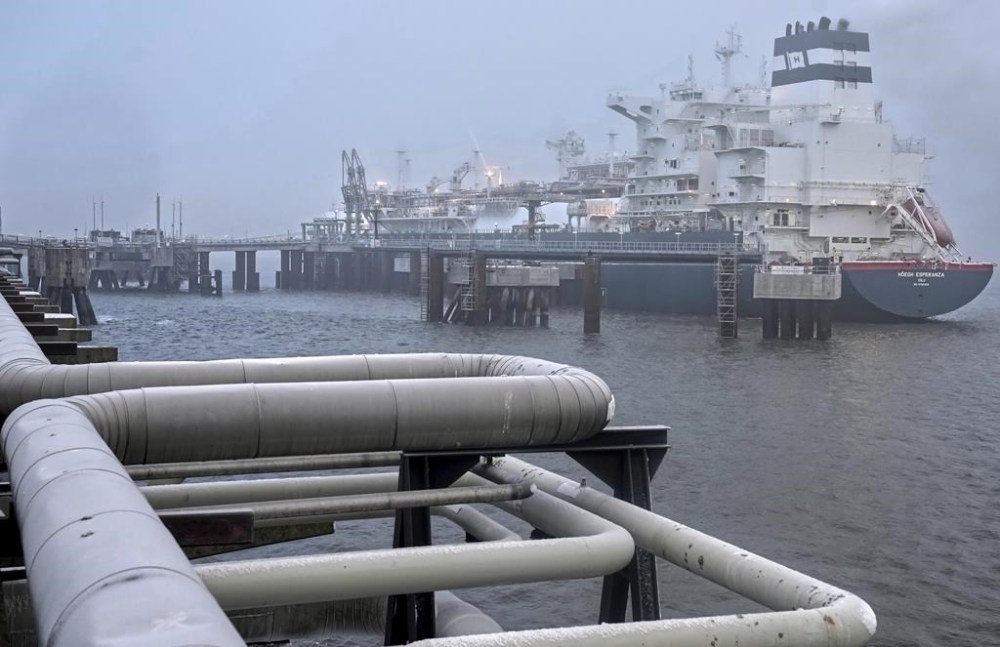
Tracy Carty of Greenpeace International said the endorsement of new fossil gas infrastructure “is a blunt denial of the climate emergency.”
“Fossil gas is one of the most polluting forms of energy and in its liquefied form, its carbon emissions can be as bad as coal,” she said.
Friederike Roeder of the campaign group Global Citizen said the part played by Germany at the G7 talks was “particularly disappointing.”

“The EU’s role in international climate diplomacy is critical but if Germany, as the biggest member state, continues to focus its negotiation power on new gas investments rather than leading the way for a future free of fossil fuels, this won’t be possible,” she said.
German government spokesperson Steffen Hebestreit noted that all G7 countries have now set targets for reducing greenhouse gas emissions to ‘net zero’ by mid-century or sooner, meaning gas would only be used for another 27 years at most.
“And gas will be needed for this time, too,” he told reporters in Berlin.
“In the past Germany has never said it completely rejects the exploitation of new gas fields,” said Hebestreit.
At their meeting in Hiroshima, G7 leaders also expressed support for energy saving measures and the rapid roll-out of renewable power generation such as wind and solar.