

Regulatory changes for railways are a bad idea
Advertisement
Read this article for free:
or
Already have an account? Log in here »
To continue reading, please subscribe:

Digital Subscription
One year of digital access for only $205*
- Enjoy unlimited reading on winnipegfreepress.com
- Read the E-Edition, our digital replica newspaper
- Access News Break, our award-winning app
- Play interactive puzzles
*First annual payment billed as $205.00 + GST for one year. This annual subscription will automatically renew at $233.00 + GST every 52 weeks (10% off the regular annual price of $259.35). Offer available to new and qualified returning subscribers only. Cancel any time.
To continue reading, please subscribe:
Add Free Press access to your Brandon Sun subscription for only an additional
$1 for the first 4 weeks*
- Enjoy unlimited reading on winnipegfreepress.com
- Read the E-Edition, our digital replica newspaper
- Access News Break, our award-winning app
- Play interactive puzzles
*Your next Brandon Sun subscription payment will increase by $1.00 and you will be charged $17.95 plus GST for four weeks. After four weeks, your payment will increase to $24.95 plus GST every four weeks.
Read unlimited articles for free today:
or
Already have an account? Log in here »
Hey there, time traveller!
This article was published 19/06/2023 (1193 days ago), so information in it may no longer be current.
A new regulation is under debate that threatens to reduce the utilization of the Asia-Pacific Trade Corridor.
Specifically, the federal government’s proposal in Bill C-47 to extend the regulated interswitching distance of the railways from 30 km to 160 km in the Prairie provinces. Extended interswitching is explained in “Battle rages over rail shipping rule,” Free Press June 12, 2023. This new regulation would open the door for traffic diversion from the Canadian railways to U.S. trade corridors with no reciprocal access to U.S. shipments.
Current interswitching regulation allows shippers to direct the railway that serves them, to deliver railcars to a competing railway at a fixed freight rate. The distance of 30 km allows most rail shippers to access both railways in Canada. In 2014, the regulated interswitching distance was extended to 160 km as a means of increasing rail service for an extraordinarily large grain harvest. This allowed grain, and all other shippers, within 160 km of the border to direct railcars to the U.S. lines.
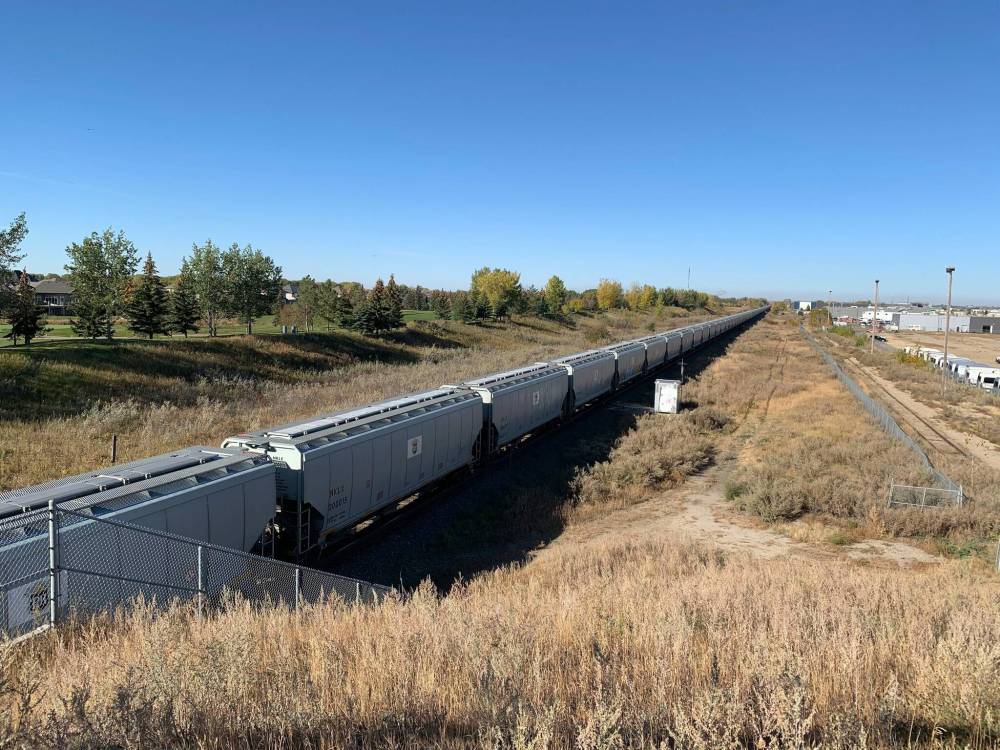
Russell Wangersky/Free Press/File
Changing interswitching rules for railways may drive rail traffic south to the U.S.
The Canada Transportation Act review panel, led by the Hon. David Emerson, concluded in 2016 that extended interswitching raised competitive concerns. Utilization is critical to the economics of trade corridors and gateways because so much of their costs are fixed.
Huge public and private investments in infrastructure require traffic volume to provide the revenues needed to maintain and upgrade roads, railways and port facilities.
Why the government of Canada would consider any regulation that would bleed traffic to competing U.S. railways has all the hallmarks of “rent-seeking” and regulatory capture. Nobel laureate George Stigler, identified this economic behaviour. A special interest group might like to receive a subsidy, but they recognize that these expenditures are easily cancelled if governments change. They prefer regulations that enshrine their economic advantage in law.
Following Stigler, the narrow benefits of extended interswitching for the vested interests on the Prairies are far exceeded by the widespread costs imposed by this regulation on the rest of the economy. In short, re-instating extended interswitching is an ill-advised policy at best.
First, let’s consider the benefits to rail shippers in the Prairie provinces. If they can have railcars delivered to the BNSF railway at a fixed rate, it would be easy for the BNSF to construct a freight rate for the delivery to Seattle or Portland that is less than the corresponding rate to Vancouver for the Canadian railways. The BNSF needs to consider only the costs of attracting this incremental traffic over their lines because their fixed costs are already paid for by U.S. shippers. Prairie shippers located close to the border, which is the majority, could obtain lower freight rates than the Canadian railways could match.
The cost of this increased U.S. competition would be borne by the entire Asia-Pacific Trade Corridor and Gateway. A railcar that goes through the U.S. robs traffic to the ports of Vancouver and Prince Rupert. Fewer ships call at these ports, less grain and other commodities are unloaded, stored, and transhipped. Consequently, fewer Canadian workers, unionized or other, are needed. The fuel revenues and taxes earned by provinces are reduced and less income tax is collected.
The revenues needed by the Canadian railways to maintain their infrastructure must come from somewhere. Grain shippers may be protected by the Maximum Revenue Entitlement (MRE) that effectively limits the railway freight rates for grain. But all non-grain traffic outside the extended interswitching distance could be charged more to make up the revenue shortfall. This could also apply to traffic from Eastern Canada that is going over the Canadian railways to the west coast ports.

Globalization in the 1990s forced new thinking on the economics of supply chains. Supply chains work best when each member cares about their buyer’s buyer and their seller’s seller. Additional costs or inefficiency created when one member of the supply chain seeks to advance their individual advantage can reduce the competitiveness of the entire supply chain.
In a global trading environment, the Canadian supply chains must compete against U.S., Australian, Argentine, and all other commodity suppliers. If regulations are passed that weaken the Canadian supply chains by raising costs or squeezing their volume of traffic, the entire Canadian economy suffers.
The industry lobby groups demanding extended railway interswitching can make a good case that lower railway freight rates are available to them if they access the U.S. corridors. But it is a fallacy of composition to think that the country could be better off by diverting traffic from the Canadian routes to competing U.S. trade corridors.
The government of Canada needs to be on guard to resist the regulatory capture described by George Stigler and to quash “rent-seeking” behaviour of Prairie rail shippers, not reward it.
Barry E. Prentice is a professor, and the director of the University of Manitoba Transport Institute