Scientists have finally ‘heard’ the chorus of gravitational waves that ripple through the universe

Advertisement

Advertise with us

NEW YORK (AP) — Scientists have observed for the first time the faint ripples caused by the motion of black holes that are gently stretching and squeezing everything in the universe.

Read this article for free:


or

Already have an account? Log in here »

To continue reading, please subscribe:

Subscribe and receive a limited-edition Free Press branded hat or tote.

Digital Subscription

One year of digital access for only $205*

  • Enjoy unlimited reading on winnipegfreepress.com
  • Read the E-Edition, our digital replica newspaper
  • Access News Break, our award-winning app
  • Play interactive puzzles

*First annual payment billed as $205.00 + GST for one year. This annual subscription will automatically renew at $233.00 + GST every 52 weeks (10% off the regular annual price of $259.35). Offer available to new and qualified returning subscribers only. Cancel any time.

To continue reading, please subscribe:

Add Free Press access to your Brandon Sun subscription for only an additional

$1 for the first 4 weeks*

  • Enjoy unlimited reading on winnipegfreepress.com
  • Read the E-Edition, our digital replica newspaper
  • Access News Break, our award-winning app
  • Play interactive puzzles
Start now

*Your next Brandon Sun subscription payment will increase by $1.00 and you will be charged $17.95 plus GST for four weeks. After four weeks, your payment will increase to $24.95 plus GST every four weeks.

Hey there, time traveller!
This article was published 28/06/2023 (1187 days ago), so information in it may no longer be current.

NEW YORK (AP) — Scientists have observed for the first time the faint ripples caused by the motion of black holes that are gently stretching and squeezing everything in the universe.

They reported Wednesday that they were able to “hear” what are called low-frequency gravitational waves — changes in the fabric of the universe that are created by huge objects moving around and colliding in space.

“It’s really the first time that we have evidence of just this large-scale motion of everything in the universe,” said Maura McLaughlin, co-director of NANOGrav, the research collaboration that published the results in The Astrophysical Journal Letters.

This undated photo provided by researchers in June 2023 shows the Arecibo Telescope in Puerto Rico. This and several other telescopes around the world were used to observe the slow gravitational waves — faint ripples made by massive black holes — that are constantly stretching and squeezing everything in the universe ever so slightly, described in a report released on Wednesday, June 28, 2023. (NAIC via AP)

Einstein predicted that when really heavy objects move through spacetime — the fabric of our universe — they create ripples that spread through that fabric. Scientists sometimes liken these ripples to the background music of the universe.

In 2015, scientists used an experiment called LIGO to detect gravitational waves for the first time and showed Einstein was right. But so far, those methods have only been able to catch waves at high frequencies, explained NANOGrav member Chiara Mingarelli, an astrophysicist at Yale University.

Those quick “chirps” come from specific moments when relatively small black holes and dead stars crash into each other, Mingarelli said.

In the latest research, scientists were searching for waves at much lower frequencies. These slow ripples can take years or even decades to cycle up and down, and probably come from some of the biggest objects in our universe: supermassive black holes billions of times the mass of our sun.

Galaxies across the universe are constantly colliding and merging together. As this happens, scientists believe the enormous black holes at the centers of these galaxies also come together and get locked into a dance before they finally collapse into each other, explained Szabolcs Marka, an astrophysicist at Columbia University who was not involved with the research.

The black holes send off gravitational waves as they circle around in these pairings, known as binaries.

“Supermassive black hole binaries, slowly and calmly orbiting each other, are the tenors and bass of the cosmic opera,” Marka said.

No instruments on Earth could capture the ripples from these giants. So “we had to build a detector that was roughly the size of the galaxy,” said NANOGrav researcher Michael Lam of the SETI Institute.

The results released this week included 15 years of data from NANOGrav, which has been using telescopes across North America to search for the waves. Other teams of gravitational wave hunters around the world also published studies, including in Europe, India, China and Australia.

The scientists pointed telescopes at dead stars called pulsars, which send out flashes of radio waves as they spin around in space like lighthouses.

These bursts are so regular that scientists know exactly when the radio waves are supposed to arrive on our planet — “like a perfectly regular clock ticking away far out in space,” said NANOGrav member Sarah Vigeland, an astrophysicist at the University of Wisconsin-Milwaukee. But as gravitational waves warp the fabric of spacetime, they actually change the distance between Earth and these pulsars, throwing off that steady beat.

By analyzing tiny changes in the ticking rate across different pulsars — with some pulses coming slightly early and others coming late — scientists could tell that gravitational waves were passing through.
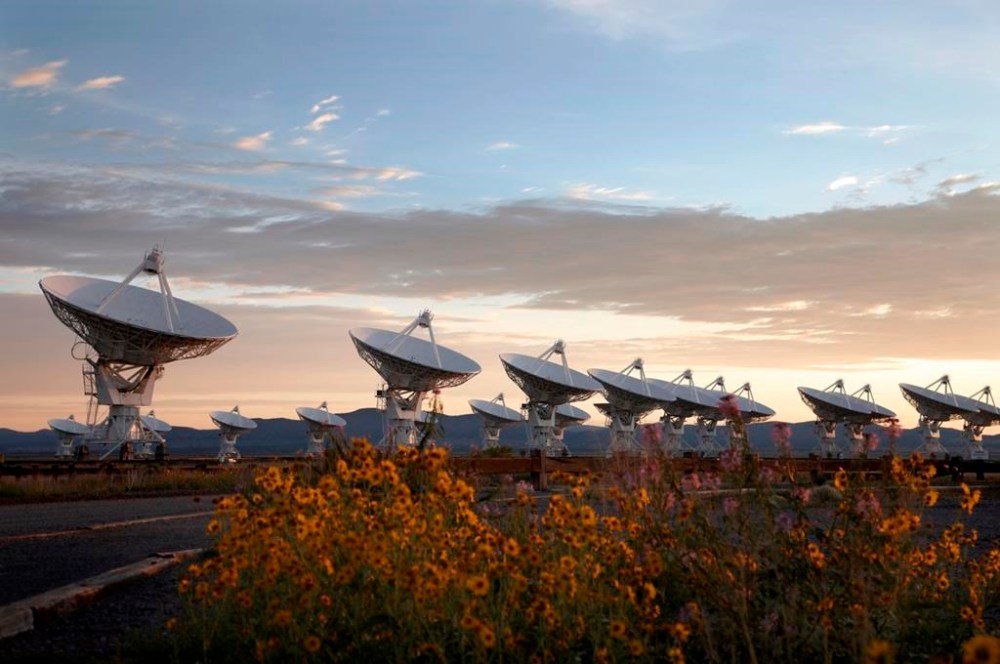
This undated photo provided by researchers in June 2023 shows the Very Large Array radio telescope in New Mexico. This and several other telescopes around the world were used to observe the slow gravitational waves — faint ripples made by massive black holes — that are constantly stretching and squeezing everything in the universe ever so slightly, described in a report released on Wednesday, June 28, 2023. (NRAO/AUI/NSF via AP)

The NANOGrav team monitored 68 pulsars across the sky using the Green Bank Telescope in West Virginia, the Arecibo telescope in Puerto Rico and the Very Large Array in New Mexico. Other teams found similar evidence from dozens of other pulsars, monitored with telescopes across the globe.

So far, this method hasn’t been able to trace where exactly these low-frequency waves are coming from, said Marc Kamionkowski, an astrophysicist at Johns Hopkins University who was not involved with the research.

Instead, it’s revealing the constant hum that is all around us — like when you’re standing in the middle of a party, “you’ll hear all of these people talking, but you won’t hear anything in particular,” Kamionkowski said.

The background noise they found is “louder” than some scientists expected, Mingarelli said. This could mean that there are more, or bigger, black hole mergers happening out in space than we thought — or point to other sources of gravitational waves that could challenge our understanding of the universe.

Researchers hope that continuing to study this kind of gravitational waves can help us learn more about the biggest objects in our universe. It could open new doors to “cosmic archaeology” that can track the history of black holes and galaxies merging all around us, Marka said.

“We’re starting to open up this new window on the universe,” Vigeland said.

___

The Associated Press Health and Science Department receives support from the Howard Hughes Medical Institute’s Science and Educational Media Group. The AP is solely responsible for all content.


Report Error Submit a Tip

More Stories

Special teams woes hurt Bombers in loss to Argos

Ken Wiebe 7 minute read Preview

Special teams woes hurt Bombers in loss to Argos

Ken Wiebe 7 minute read Yesterday at 8:06 PM CDT

They’ve been the most consistent of the three phases in the Winnipeg Blue Bombers arsenal this season.

A port in the proverbial storm, throughout this topsy-turvy campaign of ups-and-downs, the special-teams units have been supplying strength to a group that is still searching for consistency with only four games left in the regular season.

That’s what made this momentary lapse so costly in a 30-28 loss to the Toronto Argonauts on Friday at Princess Auto Stadium.

“We didn’t keep up our end of the bargain. And that hurts our football team, hurts our chances of winning games,” said Blue Bombers special teams ace Tanner Cadwallader. “And if we want to win close games. we’ve got to be a whole lot better than that. And we will. We’re going to come in (on Saturday for the film session) and go through it with a fine-tooth comb and just work a little bit harder.”

Read
Yesterday at 8:06 PM CDT

Prost! Raise a glass to Oktoberfest

Ben Sigurdson 4 minute read Preview

Prost! Raise a glass to Oktoberfest

Ben Sigurdson 4 minute read Yesterday at 2:01 AM CDT

As September comes to a close, a pair of local breweries are bringing some serious gemütlichkeit.

For the uninitiated, gemütlichkeit’s a word that doesn’t translate neatly from German to English, but which roughly means friendliness and good cheer.

Both Devil May Care Brewing Co. (155 Fort St.) and Kilter Brewing Co. (450 Rue Deschambault) are hosting Oktoberfest parties this weekend featuring food, music, games and, of course, plenty of beer.

Both breweries are rolling out special releases to coincide with their respective Oktoberfests — expect malty festbiers, marzens, rauchbiers and other German-inspired brews, served up in hefty steins alongside Bavarian-inspired fare. Devil May Care’s festivities run through to Sunday and feature eats by Freebird Kitchen, while Kilter keeps the party going through to Saturday, Oct. 3, and is offering pretzels and Oktoberfest-themed hot dogs. Lederhosen is encouraged.

Read
Yesterday at 2:01 AM CDT

Is a better Winnipeg on the horizon?

Tom Brodbeck, Rebecca Chambers, Niigaan Sinclair and Brent Bellamy 20 minute read Preview

Is a better Winnipeg on the horizon?

Tom Brodbeck, Rebecca Chambers, Niigaan Sinclair and Brent Bellamy 20 minute read Friday, Sep. 25, 2026

Four Free Press columnists weigh in on the challenges ahead and how the city can become better.

Read
Friday, Sep. 25, 2026

‘In Normandy, we remember’

Aaron Epp 4 minute read Preview

‘In Normandy, we remember’

Aaron Epp 4 minute read Yesterday at 6:23 PM CDT

Travelling nearly 7,000 km from his home in France to Winnipeg gave Gabriel Zaranski a new perspective on warfare.

“It’s very different to speak about war in school (than) to speak with real people who (have fought) in a war,” he said. “We can feel the emotion when they speak … The testimony has more impact when it’s real soldiers.”

Zaranski is one of 14 Grade 12 students from Bayeux, a town in France’s Normandy region, in Winnipeg this week for a learning tour.

The students, who attend Lycée Arcisse de Caumont high school, met on Saturday with veterans from the Queen’s Own Cameron Highlanders of Canada, a local military regiment, to discuss their studies and the regiment’s role in the Second World War.

Read
Yesterday at 6:23 PM CDT

Jets’ brass warming up to El Nino?

Mike McIntyre 7 minute read Preview

Jets’ brass warming up to El Nino?

Mike McIntyre 7 minute read Friday, Sep. 25, 2026

Decisions, decisions.

The Winnipeg Jets held their final dress rehearsal Friday night before the curtain rises next week on the new NHL season.

Unlike their first three exhibitions, this one in Denver featured competitive lineups that looked an awful lot like what we’ll see when the games start counting, with plenty of star power and veteran presence on both sides.

So what are we to make of the Jets’ 5-2 loss to the mighty Colorado Avalanche, who captured the Presidents’ Trophy last year and are once again a legitimate Stanley Cup contender?

Read
Friday, Sep. 25, 2026

Signs of local neo-Nazi recruiting efforts spark concern

Conrad Sweatman 7 minute read Preview

Signs of local neo-Nazi recruiting efforts spark concern

Conrad Sweatman 7 minute read Yesterday at 2:00 AM CDT

A far-right canvassing push in Manitoba this month is raising concerns among Winnipeg residents.

Stickers promoting Nationalist-13, a men’s-only neo-Nazi group also known as NS-13 based primarily in Hamilton, Ont., have appeared in Winnipeg and parts of southern Manitoba. The stickers bear national socialist branding and messages such as “White Man, Fight Back” and “White Community, Political Action, Training and Fitness.”

Winnipeg writer Jess Woolford recently encountered an NS-13 poster on Pembina Highway.

“It was appalling,” Woolford said. “It has the Nazi death heads covering people’s faces. It was pretty disturbing to come across this … I just didn’t expect to see it so blatantly displayed in my neighbourhood.”

Read
Yesterday at 2:00 AM CDT