Florida in hot water as ocean temperatures rise along with the humidity
Advertisement
Read this article for free:
or
Already have an account? Log in here »
To continue reading, please subscribe:

Digital Subscription
One year of digital access for only $205*
- Enjoy unlimited reading on winnipegfreepress.com
- Read the E-Edition, our digital replica newspaper
- Access News Break, our award-winning app
- Play interactive puzzles
*First annual payment billed as $205.00 + GST for one year. This annual subscription will automatically renew at $233.00 + GST every 52 weeks (10% off the regular annual price of $259.35). Offer available to new and qualified returning subscribers only. Cancel any time.
To continue reading, please subscribe:
Add Free Press access to your Brandon Sun subscription for only an additional
$1 for the first 4 weeks*
- Enjoy unlimited reading on winnipegfreepress.com
- Read the E-Edition, our digital replica newspaper
- Access News Break, our award-winning app
- Play interactive puzzles
*Your next Brandon Sun subscription payment will increase by $1.00 and you will be charged $17.95 plus GST for four weeks. After four weeks, your payment will increase to $24.95 plus GST every four weeks.
Read unlimited articles for free today:
or
Already have an account? Log in here »
Hey there, time traveller!
This article was published 10/07/2023 (1166 days ago), so information in it may no longer be current.
ORLANDO, Fla. (AP) — Record global ocean heating has invaded Florida with a vengeance.
Water temperatures in the mid-90s (mid-30s Celsius) are threatening delicate coral reefs, depriving swimmers of cooling dips and adding a bit more ick to the Sunshine State’s already oppressive summer weather. Forecasters are warning of temperatures that with humidity will feel like 110 degrees (43 degrees Celsius) by week’s end.
If that’s not enough, Florida is about to get a dose of dust from Africa’s Saharan desert that’s likely to hurt air quality.
The globe is coming off a week of heat not seen in modern measurements, the World Meteorological Organization said Monday, using data from Japan’s weather agency to confirm unofficial records reported nearly daily last week by the University of Maine’s Climate Reanalyzer. Japan reported the global average temperature on Friday was half a degree (0.3 degrees Celsius) warmer than its past record hottest day in August 2016.
Global sea surface temperatures have been record high since April and the North Atlantic has been off-the-charts hot since mid-March, meteorologists report as climate change is linked to more extremeand deadly events.
“We are in uncharted territory and we can expect more records to fall,” said WMO director of climate services Christopher Hewitt. “This is worrying news for the planet.”
Now it’s Florida’s turn.
Water temperature near Johnson Key came close to 97 degrees (36.1 degrees Celsius) Monday evening, according to a National Oceanic and Atmospheric Administration buoy. Another buoy had a reading close to 95 (35 Celsius) near Vaca Key a day earlier. These are about 5 degrees warmer than normal this time of year, meteorologists said.
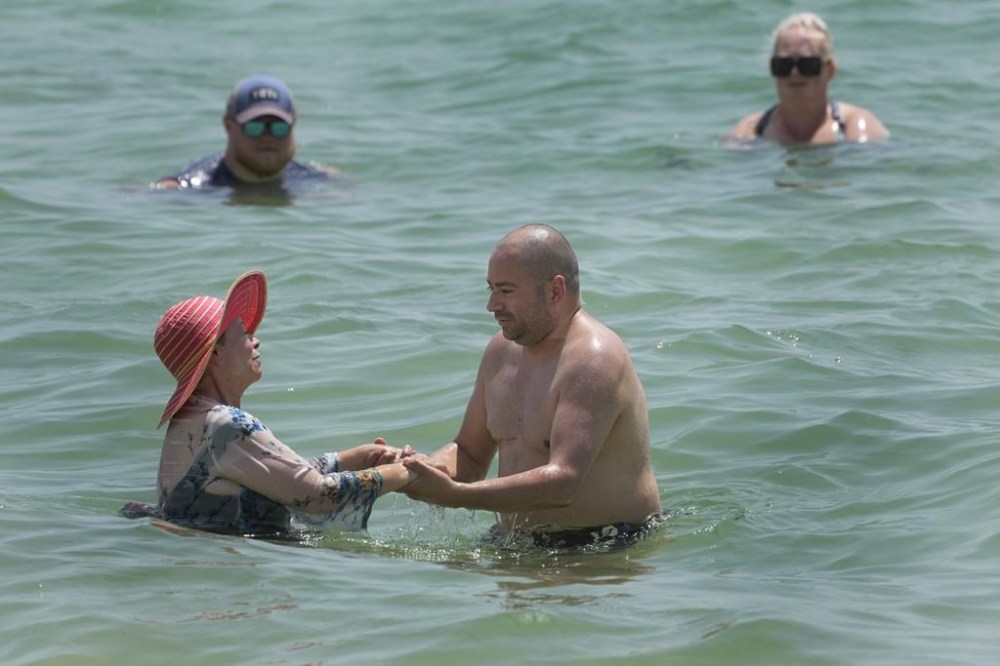
“That’s incredible,” said National Weather Service meteorologist Andrew Orrison. “The water is so warm you really can’t cool off.”
While the 95- and 96-degree readings were in shallow waters, “the water temperatures are 90 to 93 degrees Fahrenheit around much of Florida, which is extremely warm,” said University of Miami hurricane researcher Brian McNoldy. He said his 95-degree pool doesn’t cool him — it just leaves him wet.
Water temperatures across the Gulf of Mexico and Southwest Atlantic are 4 to 5 degrees (2 to 3 degrees Celsius) warmer than normal, Orrison said. Because the water is so warm, the air in Florida gets more humid and “that’s making things tougher or more oppressive for people who are going to be out and about,” he said.
The heat dome that baked Texas and Mexico for much of the early summer has oozed its way to Florida with sunshine, little to no cooling clouds or rain, but humidity worsened by the hot oceans, Orrison and McNoldy said.
Not only will it stick around for a while as weather patterns seem stuck — a sign of climate change, some scientists contend — “it may actually tend to get a little bit worse,” Orrison said, with extra heat and humidity that has NOAA forecasting a heat index around 110 by weekend.
It could be worse. Air temperatures of 110 are forecast for the U.S. Southwest, including Arizona, New Mexico and southeast California, Orrison said. Death Valley should see highs of 120 to 125 by the end of the week, and possibly a highly unusual 130.
At Hollywood Beach, south of Fort Lauderdale, Monday’s 91 degrees were about average and Glenn Stoutt said the breeze made him fine to do lunges with a 15-pound weighted ball and calisthenics — though he wore shoes on the blazing sand.
“It’s funny to watch the new people and the tourists get about halfway out and realize their feet are getting scorched,” Stoutt said. “They start running, but it doesn’t matter how fast you run, you need to get them in the water.”
Scientists worry about the coral in that warmed-up water.
“There’s a good chance of heat stress accumulating very early in the season so we could be looking at nasty bleaching,” said International Coral Reef Society’s Mark Eakin, a retired top NOAA coral reef scientist. Bleaching weakens coral; it takes extended heat to kill it.
“We are already receiving reports of bleaching from Belize, which is very alarming this early in the summer,” said scientist Liv Williamson of the University of Miami’s Coral Reef Futures Lab. She said global projections give a 90% chance for major bleaching on many reefs, including in Pacific Islands along the Equator, the eastern tropical Pacific in Panama, the Caribbean coast of Central America, and in Florida.
“This is only July, this heat will just keep accumulating and these corals will be forced to deal with dangerously warm conditions for much longer than is normal,” Williamson said in an email.
Coral bleaching and die-offs are becoming more frequent with climate change, especially during an El Nino, with Australia’s Great Barrier Reef losing half its coral during the last supersized El Nino in 2016, Williamson said.
Scientists say a new El Nino is part of the reason for the current heat, along with ever-increasing warming from the burning of coal, oil and natural gas.
Then there’s that Sahara dust.
With little rain to keep the soil grounded, it’s common this time of year for plumes of dust particles from the Sahara Desert to blow across the Atlantic on upper-level winds. It takes strong winds to push them all the way to Florida so it doesn’t happen often.
One plume settled over South Florida on Monday, and the next plume was expected later in the week, said Sammy Hadi, a meteorologist for the National Weather Service in Miami. The plumes typically stay two to three days, and dry the atmosphere so there are fewer of the afternoon rains that are typical for Florida summers.
One plus: sunlight bouncing off those dust particles produces more vivid sunrises and sunsets.
“In general, it makes the sunrises and sunsets more vibrant and beautiful,” Hadi said.
___

Terry Spencer contributed from Hollywood Beach. Borenstein reported from Washington. Follow Seth Borenstein at @borenbears and Mike Schneider at @MikeSchneiderAP on Twitter.
___
Follow AP’s climate and environment coverage at https://apnews.com/hub/climate-and-environment
___
Associated Press climate and environmental coverage receives support from several private foundations. See more about AP’s climate initiative here. The AP is solely responsible for all content.