Kimberly Palmer: What to consider before budgeting with the cash-stuffing method

Advertisement

Advertise with us

When Giovanna “Gigi” Gonzalez wanted to cut back on her food spending, the finance expert and money coach applied what is known as the “cash-stuffing” method of budgeting. She put the cash she allotted to food for the week into an envelope and limited her spending to that amount.

Read this article for free:


or

Already have an account? Log in here »

To continue reading, please subscribe:

Subscribe and receive a limited-edition Free Press branded hat or tote.

Digital Subscription

One year of digital access for only $205*

  • Enjoy unlimited reading on winnipegfreepress.com
  • Read the E-Edition, our digital replica newspaper
  • Access News Break, our award-winning app
  • Play interactive puzzles

*First annual payment billed as $205.00 + GST for one year. This annual subscription will automatically renew at $233.00 + GST every 52 weeks (10% off the regular annual price of $259.35). Offer available to new and qualified returning subscribers only. Cancel any time.

To continue reading, please subscribe:

Add Free Press access to your Brandon Sun subscription for only an additional

$1 for the first 4 weeks*

  • Enjoy unlimited reading on winnipegfreepress.com
  • Read the E-Edition, our digital replica newspaper
  • Access News Break, our award-winning app
  • Play interactive puzzles
Start now

*Your next Brandon Sun subscription payment will increase by $1.00 and you will be charged $17.95 plus GST for four weeks. After four weeks, your payment will increase to $24.95 plus GST every four weeks.

Hey there, time traveller!
This article was published 17/07/2023 (1157 days ago), so information in it may no longer be current.

When Giovanna “Gigi” Gonzalez wanted to cut back on her food spending, the finance expert and money coach applied what is known as the “cash-stuffing” method of budgeting. She put the cash she allotted to food for the week into an envelope and limited her spending to that amount.

“I could see when I had just 20 bucks left for the week, so it was really helpful,” she says.

Popularized through TikTok videos, cash stuffing has brought back the old-fashioned envelope system of budgeting: You divide up your cash into different envelopes, each dedicated to a category of spending or saving. “It’s a tried and true method,” says Gonzalez, who also founded The First Gen Mentor, a money course where she promotes financial literacy.

FILE - In this June 15, 2018 photo, twenty dollar bills are counted in North Andover, Mass. The cash-stuffing method of budgeting has revived the popularity of an old concept known as the envelope system. You divide up your cash for the week into labeled envelopes and use only what you have set aside for each purpose. (AP Photo/Elise Amendola, File)

If you’re considering joining the cash-stuffing movement yourself, here are some guideposts:

SET ASIDE PLANNING TIME

Cash stuffing requires an upfront time commitment because you need to plan your spending, withdraw your cash and then “stuff” it into labeled envelopes. That process could easily take an hour or two to get prepared for the week ahead.

“It’s an additional time commitment,” Gonzalez acknowledges, but the upside is that “you immediately feel more in control of your money.”

KEEP YOUR CASH SAFE

With so much cash on hand, it’s important to secure it, says Bruce McClary, senior vice president of membership and communications at the National Foundation for Credit Counseling. “There are all kinds of risks involved if you’re stuffing cash in places where you might forget it or heaven forbid something happens and the cash burns,” he says.

Tim Melia, a certified financial planner and founder at Embolden Financial Planning in Seattle, suggests keeping the cash envelopes in a fireproof safe that locks. He adds that while news about bank collapses likely contributed to the appeal of cash, an FDIC-insured bank account is still the safest place to store money. (The Federal Deposit Insurance Corp. insures up to $250,000 per depositor, per bank and per ownership category.)

CONSIDER A HYBRID APPROACH

Gonzalez likes the idea of cash stuffing for everyday expenses but then moving larger amounts for savings or something like a house down payment into a bank account. “I don’t want that money sitting in an envelope,” she says. Also, cash doesn’t earn interest, but if you move the money into a high-yield bank account, it can grow.

Melia says cash stuffing is a great way to get started with budgeting and see where your money is going for a month or so. “Then, transition to a spreadsheet and bank account,” he recommends, noting that the discipline of the cash-stuffing method can stick with you.

McClary points out that many banks allow you to create digital envelopes for different categories in the form of separate bank accounts. For example, you might have labeled accounts for travel savings, down payment funds and everyday expenses, as well as a “fun money” account.

“The money is still deposited with a financial institution and insured through the FDIC, but you are able to accomplish this kind of envelope approach and segment it into different spending categories,” McClary says.

Severine Bryan, a personal finance educator and accredited financial counselor candidate, uses an approach she calls “faux cash stuffing” because she doesn’t carry the bills around. Instead, she assigns set dollar amounts to different categories like food and transportation, makes sure not to exceed those dollar amounts, and uses her credit card to earn cash back while she spends.

“I’m not using cash, but it’s the same idea,” she says.

DECIDE WHETHER IT’S A GOOD FIT

For some fans of the cash-stuffing method, the appeal comes down to the fact that you’re touching real cash. “It feels more real and you’re more aware of your spending, whereas if you’re swiping a credit or debit card, or buying something on Amazon, it doesn’t feel real. It’s just the click of a button,” Gonzalez says.

McClary notes that others are drawn to the simplicity of the method. “It’s not overly complicated and you are less likely to end up in debt because it keeps you spending within your means.”

Bryan says that cash stuffing likely works best for people who are more visual. “If you don’t want the friction of writing numbers down, this method becomes more fun with colorful envelopes. It doesn’t even feel like budgeting,” she says.

SKIP THE ACCESSORIES

Even if you like the cash-stuffing method, you don’t need to purchase the accessories marketed by TikTok influencers, which include cute wallets and designer envelopes. Those extra expenditures could make for a rough start to budgeting, Melia warns.

All you need is a stack of envelopes and a pen to label them — and possibly a fireproof safe to keep all that cash secure.

______________________________

This column was provided to The Associated Press by the personal finance website NerdWallet. Kimberly Palmer is a personal finance expert at NerdWallet and the author of “Smart Mom, Rich Mom.” Email: kpalmer@nerdwallet.com. Twitter: @KimberlyPalmer.

RELATED LINK:

NerdWallet: How to budget using the ‘cash-stuffing’ envelope system https://bit.ly/nerdwallet-envelope-system
Report Error Submit a Tip

More Stories

You can’t hold a government accountable for what it won’t let you see.

That is the uncomfortable lesson from the dispute between Progressive Conservative health critic Kathleen Cook and Prairie Mountain Health over her recent attempt to visit the Dauphin Regional Health Centre.

Cook wanted to see the temporary emergency department that reopened Sept. 7 after flooding forced the hospital to close in July. She wanted to speak with officials about the reopening, the challenges they were facing and the work still required.

Prairie Mountain Health said no.

Nothing wrong with planting trees, but it won’t get province very far on path to net zero

Dan Lett 5 minute read Preview

Nothing wrong with planting trees, but it won’t get province very far on path to net zero

Dan Lett 5 minute read Monday, Sep. 14, 2026

Manitoba’s new plan to achieve net zero carbon emissions by 2050 is a lot of things. It’s detailed. It’s certainly comprehensive in scope. But when it is all said and done, it is still very much a work in progress.

Read
Monday, Sep. 14, 2026

Wind and batteries the best bet

James Wilt 5 minute read Preview

Wind and batteries the best bet

James Wilt 5 minute read 2:01 AM CDT

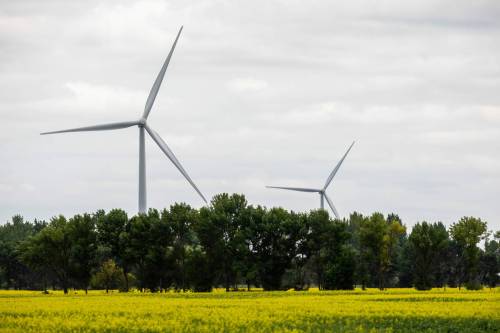
For years, Manitoba Hydro has claimed that we can’t rely on wind turbines during multi-day or even multi-week cold snaps. Although turbines can be equipped with cold-weather packages to operate down to –30 C, as at the St. Leon and St. Joseph wind farms, Hydro routinely warns of the possibility of a lengthy winter wind drought at the same time as electricity use peaks due to high heating demand.

This concern is largely why Hydro is pushing to build a 750 MW fossil gas-fired power plant in Brandon, rather than building more wind farms.

But new analysis by Alexander Hogeveen Rutter, a former energy modeller for Manitoba Hydro, shows that wind-generation reliability well exceeds assumptions and that, if combined with battery energy storage, it could meet even the most bullish load growth forecasts. (These findings were presented to the Public Utilities Board on Aug. 31, and the full report can be found on Climate Action Team Manitoba’s website.)

Hydro’s low estimate of wind generation stems from its erroneous assumption that all new wind farms will be built in the same locations as Manitoba’s two existing wind farms (St. Leon and St. Joseph). Because these two wind farms are only 100 kilometres apart, they have highly correlated wind speeds; when wind conditions are low at one site, they likely are at the other as well. This is not how new wind farms will be built in Manitoba. Instead, they will be located in different areas and use much taller turbines with higher generation potential than the existing wind farms.

Read
2:01 AM CDT

BRANDON — A 29-year-old man has been sentenced to 18 years in prison for sexually abusing and impregnating a 14-year-old girl in 2024.

“Sexual abuse of a child is inherently a grave violation of the child’s bodily integrity, dignity, and security, and in this case, the consequences were compounded by the victim’s pregnancy and the need to undergo a termination,” Brandon provincial court Judge Patrick Sullivan said on Tuesday.

The accused had pleaded guilty to two counts of sexual interference and two counts of breaching a court order banning him from contacting anyone under 18.

A publication ban prohibits the publication of information that could identify the 14-year-old, who is from a western Manitoba First Nation, and two other minors with whom he communicated.

Two drivers suffer minor injuries in Highway 8 crash

1 minute read Yesterday at 12:30 PM CDT

Two men sustained minor, but not life-threatening injuries after a crash on Highway 8 at Whytewold Road in the RM of St. Andrews Monday afternoon.

At 3:45 p.m. Selkirk RCMP responded to the two-vehicle collision, which happened after a vehicle travelling south on Highway 8 collided with a westbound vehicle that was crossing the highway from Whytewold Road.

The driver of the southbound vehicle, a 26-year-old man, and the driver of the westbound vehicle, a 24-year-old man, both from the RM of Gimli, were involved. The 24-year-old was ticketed for proceeding before safe to do so.

Federal Court awards OCN $27M, 62 years after construction of hydro dam

Nicole Buffie 5 minute read Preview

Federal Court awards OCN $27M, 62 years after construction of hydro dam

Nicole Buffie 5 minute read Yesterday at 6:34 PM CDT

The Federal Court has ordered Ottawa pay Opaskwayak Cree Nation $27 million over damages suffered due to the construction of the Grand Rapids hydro dam in the 1960s.

In a decision dated Sept. 3, Federal Court Justice Sébastien Grammond says the federal government had a fiduciary duty to protect the community from the impacts of the dam.

“When the Crown exercises a discretionary power over an Indigenous interest, it has a fiduciary duty and it must exercise the discretion in the best interests of the Indigenous group,” the ruling said. “Canada breached its fiduciary duty to OCN because it approved the (project) without ensuring that the impacts of the Grand Rapids dam on OCN’s traditional way of life were mitigated or compensated.”

The First Nation took the federal government to court in February over impacts on the community after the dam, located about 145 kilometres southeast of Opaskwayak Cree Nation, was installed on the Saskatchewan River in 1964. The case was heard over 14 days in a judge-alone trial in Winnipeg.

Read
Yesterday at 6:34 PM CDT