Tar balls are being found 100 miles downstream from Yellowstone River train derailment

Advertisement

Advertise with us

LAUREL, Mont. (AP) — Tar balls have shown up 100 miles (161 kilometers) downstream of a railroad bridge collapse last month that sent numerous tank cars carrying petroleum products plummeting into Montana's Yellowstone River, officials said Friday, as dropping water levels and rising temperatures hinder cleanup work.

Read this article for free:


or

Already have an account? Log in here »

To continue reading, please subscribe:

Subscribe and receive a limited-edition Free Press branded hat or tote.

Digital Subscription

One year of digital access for only $205*

  • Enjoy unlimited reading on winnipegfreepress.com
  • Read the E-Edition, our digital replica newspaper
  • Access News Break, our award-winning app
  • Play interactive puzzles

*First annual payment billed as $205.00 + GST for one year. This annual subscription will automatically renew at $233.00 + GST every 52 weeks (10% off the regular annual price of $259.35). Offer available to new and qualified returning subscribers only. Cancel any time.

To continue reading, please subscribe:

Add Free Press access to your Brandon Sun subscription for only an additional

$1 for the first 4 weeks*

  • Enjoy unlimited reading on winnipegfreepress.com
  • Read the E-Edition, our digital replica newspaper
  • Access News Break, our award-winning app
  • Play interactive puzzles
Start now

*Your next Brandon Sun subscription payment will increase by $1.00 and you will be charged $17.95 plus GST for four weeks. After four weeks, your payment will increase to $24.95 plus GST every four weeks.

Hey there, time traveller!
This article was published 21/07/2023 (1151 days ago), so information in it may no longer be current.

LAUREL, Mont. (AP) — Tar balls have shown up 100 miles (161 kilometers) downstream of a railroad bridge collapse last month that sent numerous tank cars carrying petroleum products plummeting into Montana’s Yellowstone River, officials said Friday, as dropping water levels and rising temperatures hinder cleanup work.

More than 66 tons (60 metric tonnes) of the black, gooey stuff have been removed from the river since the June 24 accident, officials said. Most of the spilled material — a binder for asphalt that sticks to river rocks and gets harder to handle as it warms — is expected to get left behind.

Cleanup crews working this week on an island near the town of Laurel pulled long, taffy-like pieces of the asphalt from among the river rocks. They used shovels to pull apart sandbanks where receding water levels revealed pockets of contamination. The globs — along with some rocks and sand — were bagged for disposal and carried away by power boat.
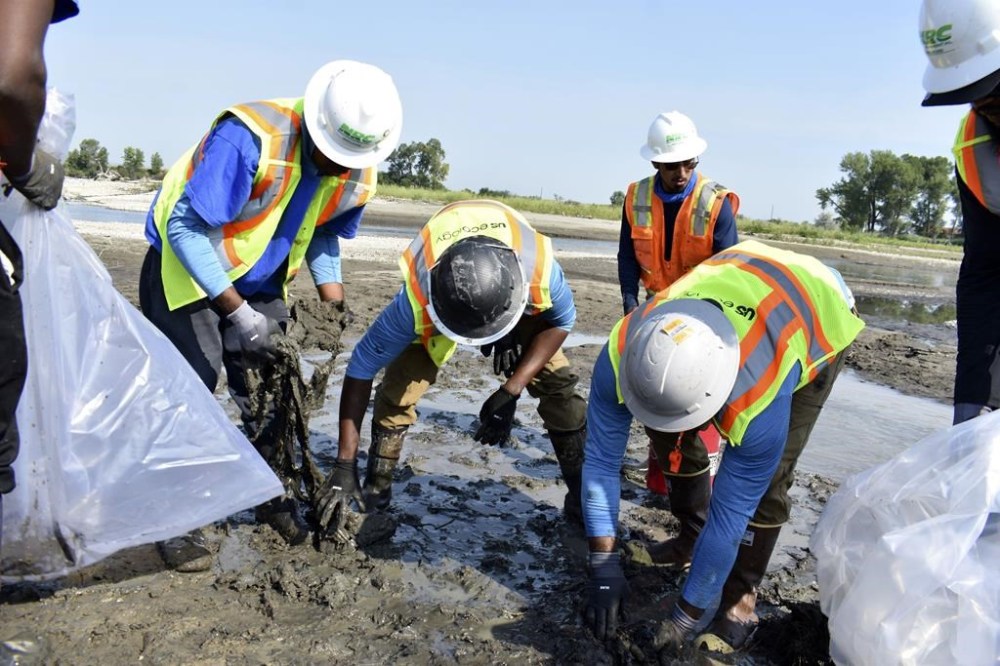
Cleanup workers load bags of oil products collected along the Yellowstone River onto a boat, Thursday, July 20, 2023, near Laurel, Montana. Tar balls have been found 100 miles downstream of the site of a June 24 bridge collapse and train derailment that sent hazardous material tank cars plummeting into the river. (AP Photo/Matthew Brown)

Navigating the river is getting harder by the day for the boats being used in the cleanup. And when temperatures peak in the afternoons, the asphalt becomes too soft to pick up, curtailing work. Smaller clumps and some asphalt enmeshed in river rocks will be left behind.

“Some of this oil will be left here,” said Andrew Graham, an environmental scientist and consultant for the cleanup. “There’s no way we’re going to get all of the asphalt off of the river….We’re really looking at the stuff that we can peel up and getting the bulk of the product off.”

Tar mats and tar balls from the spill have been found at more than three dozen locations, according to government records. That includes where the river passes through Montana’s largest city, Billings. The farthest site downstream is near Pompey’s Pillar National Monument.

Montana Rail Link of Missoula operated the train and is responsible for the cleanup.

The company predicted immediately after the spill that the petroleum products would “solidify rapidly.” Authorities now say the material could take much longer to harden.

Montana Rail Link is being acquired by Texas-based BNSF in a deal that will be finalized next year. Work to repair the bridge is ongoing and service along the route is expected to resume in coming days, Montana Rail Link spokesperson Andy Garland said.

State officials are preparing to notify Montana Rail Link that the spill violated Montana pollution laws, said Montana Department of Environmental Quality spokesperson Kevin Stone. The agency still is considering its enforcement options, and hasn’t yet determined at what point it will declare the cleanup sufficient, Stone said.

The Environmental Protection Agency previously estimated up to 250 tons (227 metric tonnes) of oil product entered the river from six asphalt binder tank cars. Agency spokesperson Beth Archer said Friday that officials still were determining a final figure. Garland did not respond to questions about the size of the spill.

Seven snakes and seven birds have been killed after coming into contact with tar mats or tar balls. One snake was cleaned and released.

Yet officials say the material is fairly benign if not touched and doesn’t pose a long-term health threat for the people who boat, swim and fish in the Yellowstone.

“It’s like a fouling issue,” said Graham. “Once it gets on you, your body temperature will warm it up and it gets sticky. You need to use baby oil to get it off. It’s very difficult to get off with soap and water.”
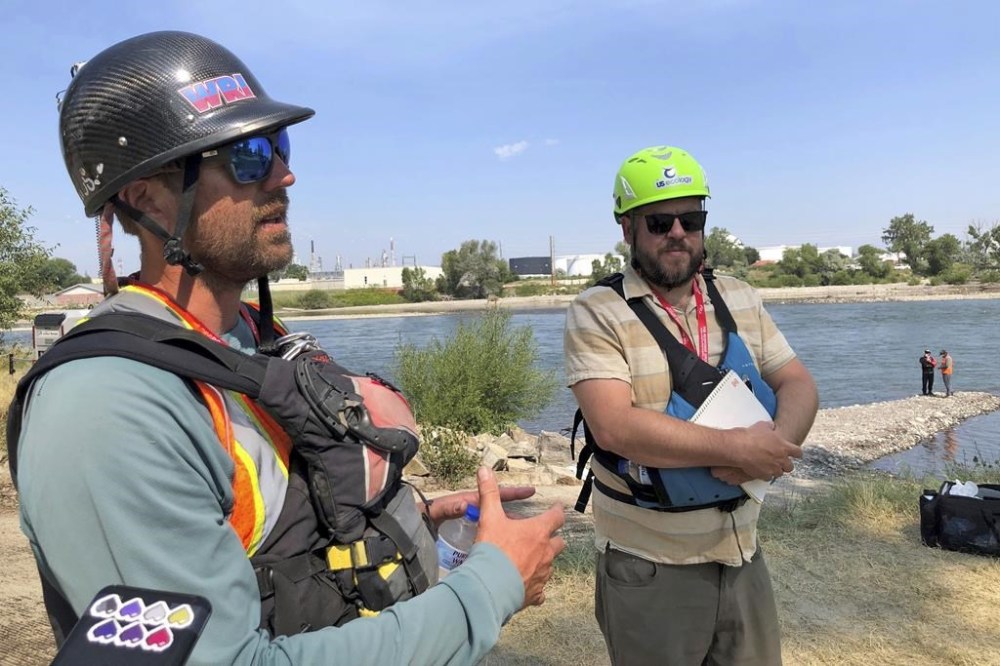
Cleanup group supervisor Cody Harris speaks about the recovery of oil product from a train accident last month as Kevin Stone with the Montana Department of Environmental Quality listens at a boat launch along the Yellowstone River, on Thursday, July 20, 2023, near Laurel, Mont. The material that spilled is a binder for asphalt that sticks to river rocks and gets harder to handle as it warms, complicating cleanup efforts. (AP Photo/Matthew Brown)

No drinking water contamination has been found.

A smaller amount of molten sulfur spilled from three tank cars. It hardened after being released and very little has been found on the river, according to Archer and others involved in the cleanup.

The cause of the bridge collapse remains under investigation, said Federal Railroad Administration spokesperson Daniel Green.

It happened at a time when the river was swollen with melting mountain snow and following a torrential rainfall. Yellowstone National Park is about 130 miles (209 kilometers) upstream and wasn’t impacted.

The derailment marked the Yellowstone’s third large petroleum spill in recent years, following crude oil pipeline breaks in 2011 and 2015. The Yellowstone has a shifting channel and its river bed can become severely scoured during flooding such as the region experienced last year.

Experts say those forces could have made the railroad bridge more unstable and contributed to its collapse.

No one was injured, but the accident added to growing scrutiny of the rail industry brought on by high-profile accidents including a February derailment in East Palestine, Ohio, that sparked a fire and evacuations and led to the eventual burning of hazardous materials to prevent an uncontrolled explosion.

Union leaders say freight train inspections are happening less often and are not as thorough as in the past due to staff cuts and time constraints.

Report Error Submit a Tip

More Stories

Bombers exact revenge in Banjo Bowl, lose Collaros to injury

Taylor Allen 6 minute read Preview

Bombers exact revenge in Banjo Bowl, lose Collaros to injury

Taylor Allen 6 minute read Saturday, Sep. 12, 2026

Redha Kramdi downplayed the significance of his return for the Winnipeg Blue Bombers.

“I don’t think I have that big of an impact,” said Kramdi on Tuesday, who watched the club go 2-4 while he was sidelined with a cast on his left hand.

It sounded silly at the time, and it’s even sillier now considering how exceptional the 29-year-old safety from Montreal was in Saturday’s 22nd edition of the Banjo Bowl.

Kramdi caused two turnovers — a forced fumble and an interception — to lead the Bombers to a 19-6 victory over the Saskatchewan Roughriders in front of a sell-out crowd at Princess Auto Stadium.

Read
Saturday, Sep. 12, 2026

Summer success sends Brezden to the Black Sea

Laurie Nealin 5 minute read Preview

Summer success sends Brezden to the Black Sea

Laurie Nealin 5 minute read 3:35 PM CDT

Breken Brezden got off to a flying start as a new figure skating season dawned in August making the Manitoban one to watch, once again, among the sport’s elite in Canada.

The Dauphin athlete pocketed a silver medal in Montreal, then notched a win in Waterloo, outscoring a handful of Canada’s higher ranked women along the way.

In Montreal, Brezden, 20, topped the standings in the free skate portion of the competition and, with a total score of 171.03, exceeded the 166 benchmark Skate Canada set for international assignments.

“I’m quite happy with how my summer competitions went,” said Brezden, who trains in Hamilton, Ont.

Read
3:35 PM CDT

Downtown no place to be after dark, huge majority of Winnipeggers say in survey

Joyanne Pursaga 8 minute read Preview

Downtown no place to be after dark, huge majority of Winnipeggers say in survey

Joyanne Pursaga 8 minute read Friday, Sep. 11, 2026

Most Winnipeggers are afraid to walk alone downtown and believe the city needs more police officers, a new survey finds.

Winnipeg Police Service released its 2026 citizen survey Friday.

Downtown safety appears to remain a major concern, with just 44 per cent saying they feel very or reasonably safe walking alone in the area during the day. The number plummets to eight per cent overall at night, down from nine per cent in 2024, the last time the survey was conducted.

This year, 14 per cent of men felt very or reasonably safe walking alone downtown at night, compared to just three per cent of women.

Read
Friday, Sep. 11, 2026

Port of Churchill expansion could chase belugas away, U of M researcher says

Nicole Buffie 4 minute read Preview

Port of Churchill expansion could chase belugas away, U of M researcher says

Nicole Buffie 4 minute read Yesterday at 9:07 AM CDT

As plans to expand the Port of Churchill into a four-season trade corridor gathers momentum, a University of Manitoba researcher has published a report on what ship traffic could mean for the beluga whales that gather in the Churchill River estuary each summer.

Veronica Coppolaro said more vessels in the waterways bring a risk that belugas will stop using the estuary for migration, which would impact the ecological landscape, tourism and communities that rely on the animals for food and cultural purposes.

“There are studies showing that (noises) change the way they swim, they change the way (the whales) are vocalizing, they change their main activity, and so this (expansion) can have consequences at different levels,” she said.

The Churchill river estuary is a marine habitat where the Churchill River empties into Hudson Bay. During the summer months belugas gather in the area to feed and give birth.

Read
Yesterday at 9:07 AM CDT

‘Kind and gentle giant’: man, 21, killed in animal attack on Manitoba First Nation

Chris Kitching 4 minute read Preview

‘Kind and gentle giant’: man, 21, killed in animal attack on Manitoba First Nation

Chris Kitching 4 minute read Updated: 2:43 PM CDT

The family of a 21-year-old man who was fatally attacked by an animal in western Manitoba is waiting for answers, after investigators ruled out a bear attack based on their preliminary findings.

Moses Campeau was walking on a road to a friend’s house in Sapotaweyak Cree Nation, about 600 kilometres northwest of Winnipeg, when he was fatally injured Sept. 9, his mother, Paula Campeau, said Monday.

“Moses was a kind and gentle giant,” she said. “He was a person who (people) would ask to come and help them, and he would go without even hesitating.”

Manitoba RCMP said officers from the Swan River detachment found the man on a community road after receiving a report of a suspicious death at about 3:10 a.m. The scene was held and the RCMP’s major crime services took over the investigation.

Read
Updated: 2:43 PM CDT

Staying away to keep the heat on

Editorial 4 minute read Preview

Staying away to keep the heat on

Editorial 4 minute read 2:00 AM CDT

It’s a tough sell these days for U.S. tourism groups seeking to attract Canadian visitors as tension, tariffs and traded verbal barbs continue to rise between the two countries.

Read
2:00 AM CDT