

Philippine president vows to defend territory, announces amnesty for rebels in key speech
Advertisement
Read this article for free:
or
Already have an account? Log in here »
To continue reading, please subscribe:
Monthly Digital Subscription
$0 for the first 4 weeks*
- Enjoy unlimited reading on winnipegfreepress.com
- Read the E-Edition, our digital replica newspaper
- Access News Break, our award-winning app
- Play interactive puzzles
*No charge for 4 weeks then price increases to the regular rate of $19.00 plus GST every four weeks. Offer available to new and qualified returning subscribers only. Cancel any time.
Monthly Digital Subscription
$4.75/week*
- Enjoy unlimited reading on winnipegfreepress.com
- Read the E-Edition, our digital replica newspaper
- Access News Break, our award-winning app
- Play interactive puzzles
*Billed as $19 plus GST every four weeks. Cancel any time.
To continue reading, please subscribe:
Add Free Press access to your Brandon Sun subscription for only an additional
$1 for the first 4 weeks*
*Your next subscription payment will increase by $1.00 and you will be charged $16.99 plus GST for four weeks. After four weeks, your payment will increase to $23.99 plus GST every four weeks.
Read unlimited articles for free today:
or
Already have an account? Log in here »
Hey there, time traveller!
This article was published 24/07/2023 (872 days ago), so information in it may no longer be current.
MANILA, Philippines (AP) — Philippine President Ferdinand Marcos Jr. on Monday underscored his administration’s resolve to defend the country’s territory through diplomacy in a key speech but did not mention China, with which it has had an escalating series of conflicts in the disputed South China Sea.
Marcos also announced in his state-of-the-nation speech to Congress that he would offer an amnesty to armed insurgents and would crack down on smugglers and hoarders of agricultural products, whom he blamed for steep spikes in food prices.
Despite an array of problems and uncertainties sparked in part by the war in Ukraine, Marcos said the dedication and patriotism he had seen among Filipino workers in and out of government have kept him optimistic.
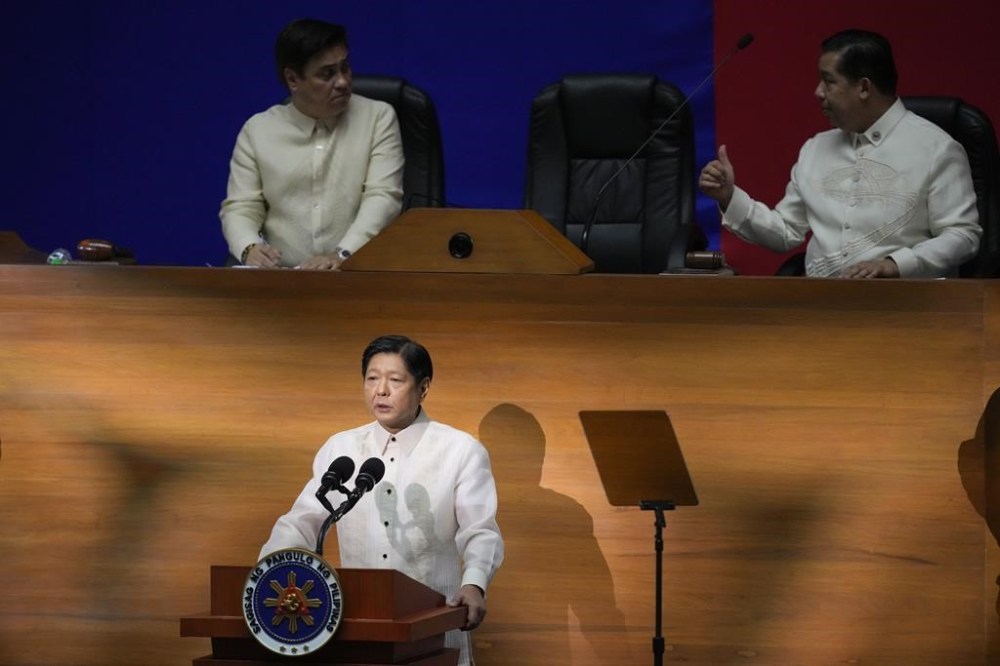
“With this in my heart, I know that the state of the nation is sound, and is improving,” Marcos said to applause from lawmakers and top government officials in the heavily secured House of Representatives.
Marcos outlined reforms pursued by his administration to boost the economy following the coronavirus pandemic. He cited last year’s 7.6% economic growth rate, which he said was the country’s highest in 46 years despite weak prospects worldwide.
“We are still considered to be among the fastest-growing economies in the Asian region and in the world,” he said.
Critics, however, hit Marcos for not mentioning human rights issues, including his refusal to cooperate with the International Criminal Court in its investigation of large numbers of killings under his predecessor Rodrigo Duterte’s brutal campaign against illegal drugs.
More than 6,000 mostly poor suspects died in Duterte’s police-enforced crackdown based on police pronouncements, but human rights groups say the real death toll was much larger. Police have acknowledged that dozens of suspects have been killed in the campaign since Marcos took office in June last year but said they had violently fought law enforcers.
Marcos has refused to bring the Philippines back into the ICC, in a decision that favored Duterte but was attacked by human rights activists.
Duterte withdrew the Philippines from The Hague-based court in 2019 in a move rights activists said was an attempt to evade accountability and prevent an international probe into the killings in the drug crackdown. The ICC, however, continues to have jurisdiction over alleged crimes committed when the Philippines was still a member state of the court.
Marcos, 65, took power in June last year in a landslide victory that was among the most dramatic political comebacks in recent history. His father was ousted as a dictator accused of widespread human rights violations and plunder in a 1986 pro-democracy uprising that became a harbinger of change at the time in authoritarian regimes worldwide. He has refused to apologize and has steadfastly defended his father’s legacy.
In February, Marcos approved an expansion of the U.S. military presence in the Philippines to add four new bases from five existing sites under a 2014 Enhanced Defense Cooperation Agreement between the longtime treaty allies. The move, which Marcos said would boost the Philippines’ coastal defense, dovetails with the Biden administration’s efforts to strengthen an arc of military alliances in the Indo-Pacific to better counter China.
China warned the move “will drag the Philippines into the abyss of geopolitical strife and damage its economic development at the end of the day.” But Philippine officials said the move was not aimed at China.
“Our journey to progress requires not only unity and social cohesion amongst our people. It is also imperative that our nation remains intact and inviolable,” Marcos said in a clear reference to Manila’s long-simmering territorial disputes with Beijing. “We will protect our sovereign rights and preserve our territorial integrity, in defense of a rules-based international order.”
“With our national interest paramount, we will always pursue constant dialogue and diplomatic approaches to the resolution of any issue that may arise,” he said.
Marcos’s moves to reaffirm ties with Washington was a key turnaround from the often-hostile approach Duterte took toward the United States.
On government efforts to deal with decades-long insurgencies, Marcos said without elaborating that he would grant amnesty to rebels who have decided to return to normal life.
That may apply to armed fighters of the largest Muslim rebel group in the country’s south, the Moro Islamic Liberation Front, which signed a 2014 autonomy deal with the government. An unspecified number of rebels in the group still have not been amnestied. Separate peace talks with communist rebels broke down in Duterte’s time.
Since assuming the presidency, Marcos has taken more than a dozen foreign trips, including to the United States and China, to seek investments and boost trade. He is scheduled to leave for Malaysia on Tuesday for a three-day visit.
The government said the foreign trips are crucial to back up economic reforms and initiatives, including a bill that Marcos signed into law last week creating the country’s first sovereign wealth fund, which aims to pool money for infrastructure and other projects. But opponents said the trips, including one that took him to Singapore to watch Formula One races in October, reflected misplaced priorities given problems at home, including soaring food prices early in his presidency.
Marcos vowed Monday to crack down on smuggling and hoarding, which he blamed for soaring food prices.
“We will not allow this. The days of those smugglers and hoarders are numbered,” he said to applause.
___
Associated Press journalists Joeal Calupitan and Aaron Favila contributed to this report.