

Niger junta’s 3-year transition plan is a ‘provocation,’ says West African regional bloc
Advertisement
Read this article for free:
or
Already have an account? Log in here »
To continue reading, please subscribe:

Digital Subscription
One year of digital access for only $205*
- Enjoy unlimited reading on winnipegfreepress.com
- Read the E-Edition, our digital replica newspaper
- Access News Break, our award-winning app
- Play interactive puzzles
*First annual payment billed as $205.00 + GST for one year. This annual subscription will automatically renew at $233.00 + GST every 52 weeks (10% off the regular annual price of $259.35). Offer available to new and qualified returning subscribers only. Cancel any time.
To continue reading, please subscribe:
Add Free Press access to your Brandon Sun subscription for only an additional
$1 for the first 4 weeks*
- Enjoy unlimited reading on winnipegfreepress.com
- Read the E-Edition, our digital replica newspaper
- Access News Break, our award-winning app
- Play interactive puzzles
*Your next Brandon Sun subscription payment will increase by $1.00 and you will be charged $17.95 plus GST for four weeks. After four weeks, your payment will increase to $24.95 plus GST every four weeks.
Read unlimited articles for free today:
or
Already have an account? Log in here »
Hey there, time traveller!
This article was published 24/08/2023 (1104 days ago), so information in it may no longer be current.
NIAMEY, Niger (AP) — The West African bloc ECOWAS rejected the proposal by Niger’s mutinous soldiers for a three-year transition to democratic rule, with a commissioner describing the slow timeline as a provocation.
The door for diplomacy with Niger’s junta remained open but the bloc is not going to engage in drawn-out talks that lead nowhere, Abdel-Fatau Musah, the ECOWAS commissioner for peace and security, told The Associated Press in an interview Wednesday.
“It is the belief among the ECOWAS heads of state and also the commission that the coup in Niger is one coup too many for the region and if we allow it then we are going to have a domino effect in the region and we are determined to stop it,” Musah said. While direct talks and backchannel negotiations are ongoing, he said the door to diplomacy wasn’t open indefinitely.
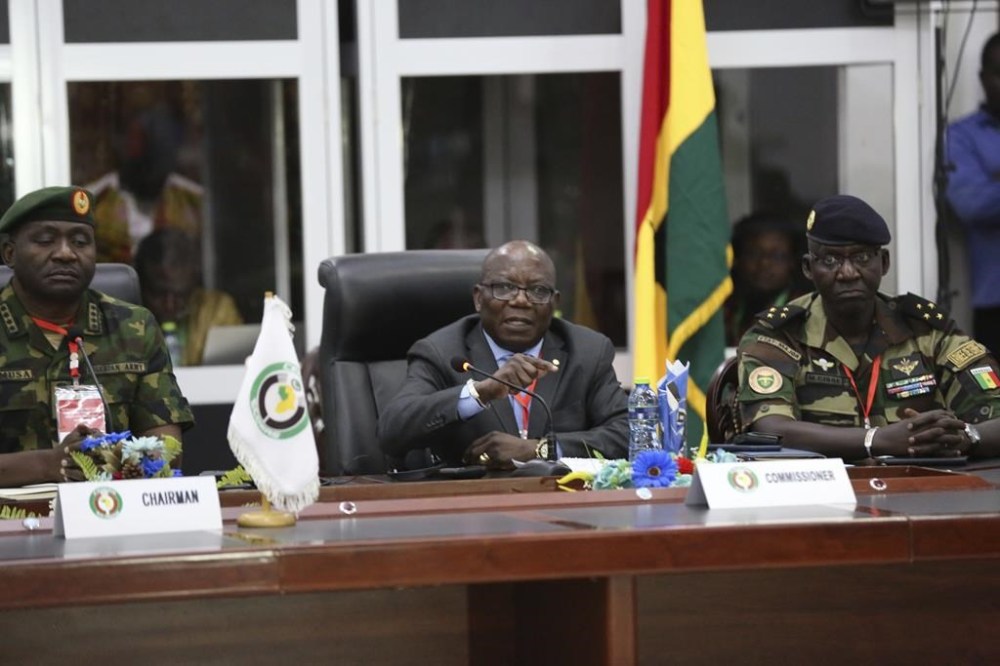
“We are not going to engage in long, drawn out haggling with these military officers … We went down that route in Mali, in Burkina Faso and elsewhere, and we are getting nowhere,” Musah said.
His comments came days after an ECOWAS delegation met the head of Niger’s military regime, Gen. Abdourahmane Tchiani, for the first time since the mutinous soldiers ousted President Mohamed Bazoum in July.
After last week’s meetng, Musah said the ball is now in the junta’s court.
The junta has been keeping Bazoum and his wife and son under house arrest, and ECOWAS has demanded Bazoum be freed and constitutional order restored.
ECOWAS has used Niger as a red line against further coups after several in the region, including two each in Mali and Burkina Faso since 2020.
The bloc has imposed severe economic and travel sanctions and threatened the use of military force if Bazoum is not reinstated, but the junta has dug in. It has appointed a new government and said it will return the country to democratic rule within several years.
Niger was seen as one of the last democratic countries in the Sahel region below the Sahara Desert that Western nations could partner with to beat back a growing jihadi insurgency linked to al-Qaida and the Islamic State group. France, other European countries and the United States have poured hundreds of millions of dollars into providing equipment and training for Niger’s military and in the case of France have conducted joint operations.
Since the coup those military operations have been suspended while both sides decide what to do. France and the U.S. have some 2,500 military personnel in the country and the U.S. operates two key drone and counter-terror bases.
Musah said ECOWAS was not discussing military plans with any external partners and everything it was planning is based on the resources of member states. Earlier this month, ECOWAS said 11 of its 15 member states had agreed to intervene militarily if talks didn’t work.
ECOWAS is banking on a combination of external pressure through sanctions and internal unrest within Niger’s security forces and the fact that Tchiani, the junta’s leader, met with ECOWAS face to face after multiple attempts, is a sign that the coup leaders are feeling the pressure, said Nate Allen, an associate professor at the Africa Center for Strategic Studies.
“Nonetheless, it is clear that the two sides remain very far apart and the risk of conflict is high,” he said.
Related Articles
Niger’s junta invites Mali and Burkina Faso to aid its defense, asks the French ambassador to leave
Advertisement Advertise With Us
Advertisement Advertise With Us