Growing wildfire risk puts pressure on insurance industry: experts

Advertisement

Advertise with us

TORONTO - Canadian insurers are grappling with the higher risk of wildfires as this year's fire season breaks records, and experts say rising premiums are just one way the industry is seeking to adapt to the changing landscape.

Read this article for free:


or

Already have an account? Log in here »

To continue reading, please subscribe:

Subscribe and receive a limited-edition Free Press branded hat or tote.

Digital Subscription

One year of digital access for only $205*

  • Enjoy unlimited reading on winnipegfreepress.com
  • Read the E-Edition, our digital replica newspaper
  • Access News Break, our award-winning app
  • Play interactive puzzles

*First annual payment billed as $205.00 + GST for one year. This annual subscription will automatically renew at $233.00 + GST every 52 weeks (10% off the regular annual price of $259.35). Offer available to new and qualified returning subscribers only. Cancel any time.

To continue reading, please subscribe:

Add Free Press access to your Brandon Sun subscription for only an additional

$1 for the first 4 weeks*

  • Enjoy unlimited reading on winnipegfreepress.com
  • Read the E-Edition, our digital replica newspaper
  • Access News Break, our award-winning app
  • Play interactive puzzles
Start now

*Your next Brandon Sun subscription payment will increase by $1.00 and you will be charged $17.95 plus GST for four weeks. After four weeks, your payment will increase to $24.95 plus GST every four weeks.

Hey there, time traveller!
This article was published 25/08/2023 (1107 days ago), so information in it may no longer be current.

TORONTO – Canadian insurers are grappling with the higher risk of wildfires as this year’s fire season breaks records, and experts say rising premiums are just one way the industry is seeking to adapt to the changing landscape.

“The more losses, the more of these events, the higher the risk and the higher insurance premiums will trend,” said Craig Stewart, vice-president of climate change and federal issues at the Insurance Bureau of Canada.

Thousands of residents in British Columbia and the Northwest Territories were forced to evacuate their homes in recent weeks as hundreds of wildfires raged on. More than 15 million hectares have been burned so far this year by almost 5,800 fires, according to the Canadian Interagency Forest Fire Centre Inc.
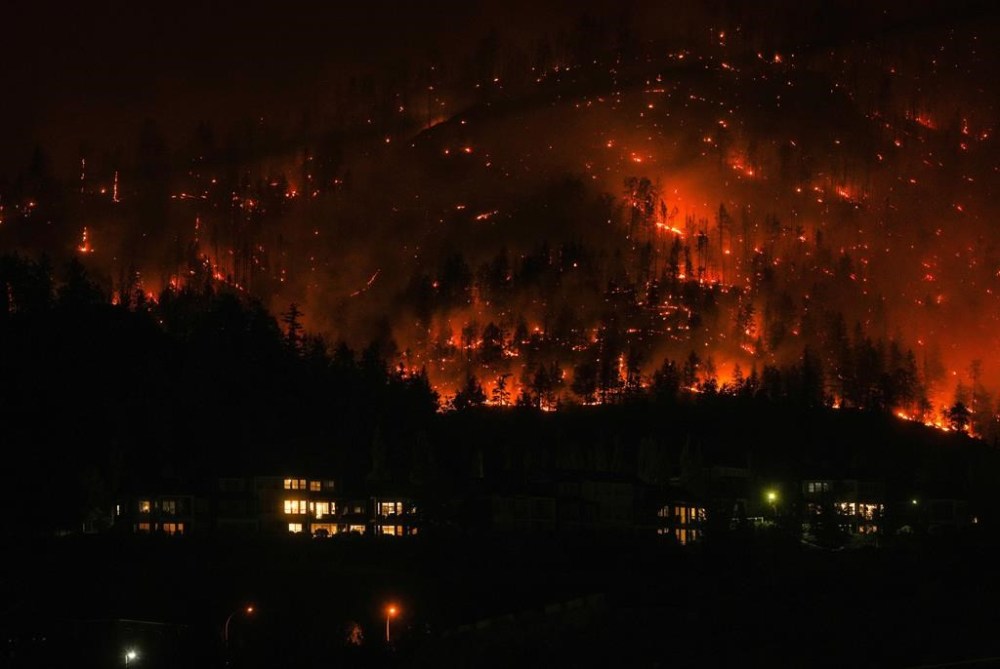
The McDougall Creek wildfire burns on the mountainside above houses in West Kelowna, B.C., on Friday, August 18, 2023. Canadian insurers are grappling with higher risk of wildfires amid a record-breaking season, and experts say rising premiums are just one part of how the industry is seeking to adapt to an ever-changing new normal. THE CANADIAN PRESS/Darryl Dyck

Nadja Dreff and Marcos Alvarez at DBRS Morningstar estimated in a reportthis week that total wildfire-related insured losses in Canada for the third quarter of 2023 will be between $700 million and $1.5 billion, which they called “manageable” for insurers.

“However, the wildfire season is not yet over and there is the potential for any of the fires to intensify and further pressure Q3 2023 results, especially if the fires affect densely populated regions, economic hubs, or key infrastructure. Larger and more frequent weather-related losses will continue to pressure property insurance prices higher in the near term,” they said.

Historically, wildfire damage has been a lot less common than flooding, said Kathryn Bakos, director of climate finance and science at the Intact Centre on Climate Adaptation.

But when it does happen, it tends to be significantly worse on average in terms of damage, she said.

“We’re seeing this right now in Kelowna, with the fires in Northwest Territories. When you have a wildfire event, you have catastrophic loss of the home,” she said.

The 2016 Fort McMurray fire is perhaps the best example of this — while flooding tends to account for a large chunk of losses every year, the Fort McMurray fire is the largest-ever insurance loss in the country, said Bakos, accounting for almost three quarters of total insured losses that year.

“What climate change means in the medium and longer term is more extreme. So you’re going to have more heat, dryness and less rain in the system, as well as more rain and storm surges,” Bakos said.

Annual catastrophic insurable loss claims have risen as a result, she said.

As fire risks rise, insurers are increasingly looking at communities’ fire defences and taking them — or a lack thereof — into consideration for premiums, said Stewart.

No single event drives insurance premiums up, but overall trends do, said Stewart. Insurers price risk, and the risk of major weather events is rising, he said.

Prices have been rising faster in the Western provinces, said Stewart: “Wildfires and floods are driving the premiums higher in the places where we’re seeing these trends now.”

In the U.S., which is seeing similar trends in extreme weather, some companies are deciding that it’s just not worth the risk. Recently some major insurers stopped offering new policies in California and other states amid rising extreme weather trends.

Those U.S. insurers left markets in part because state regulations prevented them from passing on the higher costs of increased risk, noted Stewart, making such a move less likely in Canada.

While Canadian insurers show no signs of exiting markets right now, what’s happening in the U.S. should serve as a warning signal, Bakos said, and an opportunity for companies to look at how to maintain the insurability of Canadian homes.

“We know what to do. We just have to do it,” she said.

Insurers incentivize consumers to decrease their risk of fire in order to save on their policy, said Stewart. They also offer incentives to consumers in communities with certain protections, helping indirectly pressure their communities to take those steps as well.

“Those incentives likely now need to be re-examined and expanded so that homeowners have a greater array of incentives to protect them and to encourage them to retrofit their homes to be more resilient to fire, flood, wind and other perils,” he said.

“The industry is actually taking a hard look at incentives right now in conversation with governments across the country.”

The industry is also looking at how to elevate consumer awareness of risk, said Stewart, adding that more government support is needed for both awareness and incentivization.

“The federal government needs to play much more of a leadership role in wildfire modelling, risk modelling, in providing resources to communities to develop wildfire community action plans, and to design retrofit programs,” he said.

This report by The Canadian Press was first published Aug. 25, 2023.

Report Error Submit a Tip

More Stories

Back to school means increased costs for parents, post-secondary students

Joel Schlesinger 6 minute read Preview

Back to school means increased costs for parents, post-secondary students

Joel Schlesinger 6 minute read 2:01 AM CDT

In the words of advice for students from Thornton Melon: “It’s rough out there. Move back in with your parents.”

As comedian Rodney Dangerfield’s character alluded to in the 1986 comedy Back to School, it is indeed a tough financial environment as students head back to the classroom in 2026.

A Capital One Canada survey found families are struggling with costs, with nearly six in 10 parents surveyed stating back-to-school expenses are higher than expected.

It’s not just tuition, new clothes and supplies. Extracurricular activities — like hockey, figure skating, ringette, soccer, dance, etc. — also ramp up, involving tuition-sized payments.

Read
2:01 AM CDT

NDP minister needs lesson in political civility

Dan Lett 5 minute read Preview

NDP minister needs lesson in political civility

Dan Lett 5 minute read Yesterday at 2:40 PM CDT

Families Minister Nahanni Fontaine’s decision to intercede in Winnipeg’s mayoral election may be surprising to some political observers. To others, however, it is entirely on brand.

On Tuesday, Fontaine posted a video on social media in which she expressed concern that former city councillor and Progressive Conservative cabinet minister Kevin Klein was entering the race to challenge incumbent Mayor Scott Gillingham.

The caption on the video was blunt: “I mean, really, who chooses to work for Count Dracula?”

“Kevin Klein once worked for Peter Nygard. Peter Nygard is Canada’s equivalent to (American sex offender) Jeffrey Epstein — had his own little island, did unspeakable, disgusting things to women and girls … anyways, I just thought that Winnipeggers would want to know that Kevin Klein, at one point, worked for Peter Nygard,” she says in the video.

Read
Yesterday at 2:40 PM CDT

$8.7-million detox centre called ‘high-priced drunk tank’

Carol Sanders 4 minute read Preview

$8.7-million detox centre called ‘high-priced drunk tank’

Carol Sanders 4 minute read Updated: Yesterday at 6:08 PM CDT

The new facility to detain people in a drug psychosis for up to 72 hours is operating the way it should, the government said Friday, even though just 26 people have been held for that purpose since it opened.

“The (protective care centre) is doing what it’s meant to do: support people, meet them where they’re at, provide a caring environment,” Addictions Minister Bernadette Smith said after updated data were posted online.

The vast majority of those detained at the 20-room facility at 190 Disraeli Fwy. were recovering from alcohol intoxication, the update shows.

In total, 4,425 people were detained from the time the site opened on Dec. 2, 2025, until June 30, for an average of less than five hours.

Read
Updated: Yesterday at 6:08 PM CDT

Politicians who harp on Klein’s history with Nygard do so at their own peril

Tom Brodbeck 5 minute read Preview

Politicians who harp on Klein’s history with Nygard do so at their own peril

Tom Brodbeck 5 minute read Yesterday at 1:13 PM CDT

It was probably the easiest prediction to make in Winnipeg politics this week: the moment Kevin Klein officially entered the mayoral race, someone would bring up Peter Nygard.

Sure enough, they did.

And it was led by Klein’s chief political opponent in this race, Mayor Scott Gillingham, who called Klein a “fixer” for the convicted sex offender.

None of this is particularly surprising.

Read
Yesterday at 1:13 PM CDT

Letters, Sept. 4

7 minute read Preview

Letters, Sept. 4

7 minute read Updated: Yesterday at 8:22 AM CDT

I do think it’s important to stand up and be heard — and that is why I want to add my voice to the chorus of folks condemning U.S. Defence Secretary Pete Hegseth for his recent social media post that very obviously drew attention in a negative way to the physical stature of two Canadian cadets at a military training course.

Read
Updated: Yesterday at 8:22 AM CDT

Frequency of private plasma donations called into question

Marsha McLeod and Rylee Gerrard 9 minute read Preview

Frequency of private plasma donations called into question

Marsha McLeod and Rylee Gerrard 9 minute read Yesterday at 12:47 PM CDT

Two weeks after the death of a second plasma donor in Winnipeg at a privately run collection site, provincial and territorial health officials compiled a list of urgent questions for Health Canada.

A health department official in Nova Scotia, which leads the Provincial Territorial Blood Liaison Committee, wrote in mid-February to the federal regulator that their members had expressed “a great deal of curiosity tempered with concern” and forwarded two dozen questions, according to documents obtained by the Free Press.

Under a section titled “MANITOBA ESTABLISHMENT INCIDENTS,” the provinces wanted to know: “What requirements are in place to ensure Grifols is ensuring collections frequency (does) not exceed the limit under the Health Canada licence?” and “Is Health Canada able to identify whether Grifols Canada has a donor system across establishments? (e.g., can identify when a donor last donated and where, similar to their operations in the United States).”

“Does the situation of two high-severity incidents in one Province or at establishments run by a relatively new entity to Canada, within a short period of time, initiate any additional protocols?”

Read
Yesterday at 12:47 PM CDT