The rocky route westward
Heartbreak and hard work along the nascent Dawson Road
Advertisement
Read this article for free:
or
Already have an account? Log in here »
To continue reading, please subscribe:

Digital Subscription
One year of digital access for only $205*
- Enjoy unlimited reading on winnipegfreepress.com
- Read the E-Edition, our digital replica newspaper
- Access News Break, our award-winning app
- Play interactive puzzles
*First annual payment billed as $205.00 + GST for one year. This annual subscription will automatically renew at $233.00 + GST every 52 weeks (10% off the regular annual price of $259.35). Offer available to new and qualified returning subscribers only. Cancel any time.
To continue reading, please subscribe:
Add Free Press access to your Brandon Sun subscription for only an additional
$1 for the first 4 weeks*
- Enjoy unlimited reading on winnipegfreepress.com
- Read the E-Edition, our digital replica newspaper
- Access News Break, our award-winning app
- Play interactive puzzles
*Your next Brandon Sun subscription payment will increase by $1.00 and you will be charged $17.95 plus GST for four weeks. After four weeks, your payment will increase to $24.95 plus GST every four weeks.
Read unlimited articles for free today:
or
Already have an account? Log in here »
Hey there, time traveller!
This article was published 01/09/2023 (1141 days ago), so information in it may no longer be current.
In the summer of 2022, Winnipegger Terry Doerksen and his wife Patty, along with Zik the ox pulling their replica Red River Cart, retraced the 800-odd kilometres of the historic Red River Trail, from Winnipeg to St. Paul, Minn. A new journey beckons for the Doerksens, this time along the Dawson Road.

By the time you read this, Patty and I will be heading from Lake of the Woods towards Winnipeg on the Dawson Road. I’ll be carrying a lumpy grey object on my cart and wearing a red jacket. If my sleuthing deductions are accurate, both items have travelled this road before.
That lumpy thing
I found said object a few years ago when I was snooping around in the Whitemouth River where the bridge for Dawson Road used to cross. My metal detector had picked up a couple of big nails from the bridge itself, with the paint still on them. And then I saw a strange object in the shallow water. At first I thought it was some welding slag but it didn’t beep my detector. And was welding even a thing in the 1870s? After running this mystery by a few friends, I came to the conclusion that it must be a slab of Tyndall stone — mottled limestone quarried just north of Winnipeg. Tyndall stone is considered one of the most beautiful building stones in the world but my piece had become barely recognizable. More than a century at the bottom of the Whitemouth had caused most of the softer tan material to wear away, and what was left was mostly the harder grey stuff.
A lumpy rock might not be that cool on its own, except for the knowledge that Simon Dawson, the builder of this road, had written about the high quality of Manitoba limestone for building purposes, and also noted he sent samples of various Manitoba rocks back to Ottawa. (When the new Parliament Buildings were built, a lot of Tyndall stone was used to adorn the interior.)
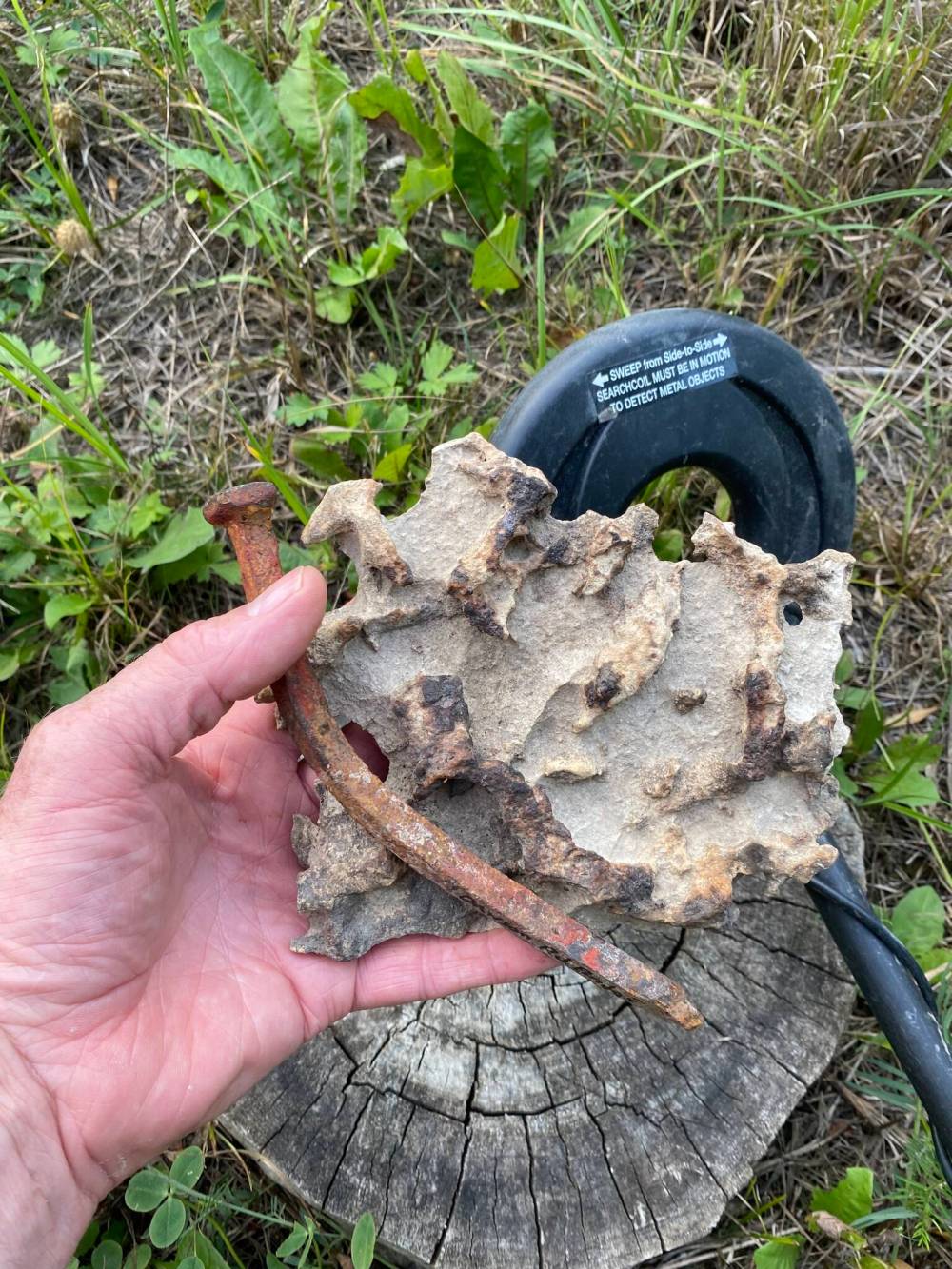
So here’s my story. Simon Dawson was desperate to prove his new road was good for something, and an ox cart loaded with geological samples he had collected was making its way east from Fort Garry. As it bumped its way over the Whitemouth River bridge a piece of stone abandoned the load. Fortunately, it wasn’t the only one of its species. Enough made the whole trip to Ottawa to prove the value of the Dawson Road and convince the architects of the Parliament Buildings as to their choice of decorative stone. And I still got something “real” to bring with me as I retraced that journey!
Wolseley won’t wait
It seems ironic that Wolseley Avenue gets blocked off to traffic so peace-loving Wolseley-ites can take leisurely weekend strolls or bike rides through their neighbourhood. Col. Garnet Wolseley himself exhibited a lot of road rage in trying to get to Winnipeg as fast as he could. In 1870, a year before the “Tyndall Stone Incident,” Wolseley and his 1,200 men were commissioned by the brand new Canadian government to head west, quell the Red River Resistance and take down Louis Riel. Wolseley had been promised that Dawson Road was ready for him and his men, but when he arrived at the tiny depot we now call Thunder Bay, he was aghast at what he saw. The road wasn’t even close to being able to handle the heavy traffic of an army and all its machines of mass destruction.
Wolseley paused long enough to share his uncensored opinion with Simon Dawson about his so-called “road.” Then he began storming about. He let his soldiers know they were now road-builders and put them to work to force a proper passage through the long miles of unwelcoming wilderness. It seems the Colonel wasn’t completely unprepared for this speed bump to his schedule. A number of Royal Engineers had travelled in his company and they could give guidance to men who might know how to use a gun but not a shovel.
A smile finally broke across Wolseley’s face when, three months after leaving “Thunder Bay” he landed at the Northwest Angle — right where Patty and I started our own journey yesterday.
Upon landing we found a cavalcade of harnessed oxen and Red River carts awaiting us, to carry our stores, etc. overland a distance of 110 miles to Fort Garry. This mode of conveyance was new to many of us and the various nondescript outfits with their long black-haired drivers were objects of great interest. The outfits were closely examined but not a vestige of iron found upon either carts or harness. The carts were soon loaded with our stores and dispatched in advance of the column.
If he had realized it would have taken just one word from Louis Riel and these Métis truckers would have dispatched him, Wolseley might not have enjoyed his cross-cultural experience as much.
Mystery of the red jacket
A few years ago I stumbled across a great garage sale in St. Boniface. Garage sale greatness is measured by the amount of ancient stuff being sold. An old red jacket caught my eye. It had a ratty silk lining and velvet on the sleeves. The homeowner informed me that the insignia was that of the Royal Engineers. “All the brass buttons have disappeared but I have a bunch of new ones I can give you.” So I bought the jacket for $30, got a tailor to sew on the buttons, and then got it dry-cleaned. Even with all that love, it still looked like it was a century-and-a-half old. As I did my own research, I realized the guy was right — it belonged to a Royal Engineer and I realized it must have come down the Dawson Road with the Wolseley expedition. But why would the owner have left it behind when he headed back east?
Of all the cowboy songs that were sung around campfires on a cattle drive in the Wild West, only one originated in Canada: Red River Valley.
From this valley they say you are going,
We will miss your bright eyes and sweet smile,
For they say you are taking the sunshine,
That has brightened our pathway awhile.
People who study these kind of things feel the historical setting of the song must be when the Wolseley expedition was staying at Fort Garry by the forks of the Red and Assiniboine rivers.
So consider a while ere you leave me,
Do not hasten to bid me adieu,
But remember the Red River Valley
And the Red River girl who loved you.
According to the interpretation, one of Wolseley’s soldiers fell in love with an Indigenous girl. But now his company was being called back east and this was breaking the young girl’s heart. Here’s the problem I have with this view: The Wolseley soldiers only hung around here for two months before heading back home. Not a lot of time for a deep love affair to develop. However, the Royal Engineers stayed for a full six months before returning. Enough time for the young man to feel like he wanted to make a commitment before he left:
So remember the valley you’re leaving,
How lonely, how drear it will be;
Remember the heart you are breaking,
And be true to your promise to me.
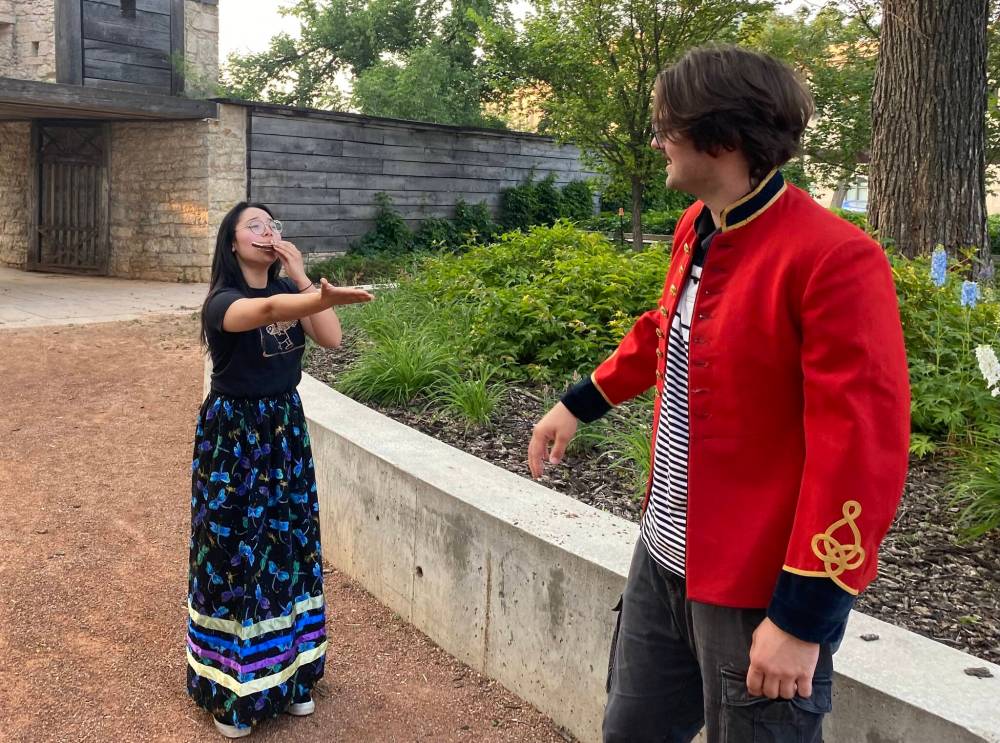
A few weeks ago I made a strange request of Chanice, our Anishinaabeg boarder. Her boyfriend was coming to visit from Ontario and I asked if we could do a little photo shoot at Upper Fort Garry. We bought some milkshakes at V.J.’s and walked over to the fort. There I told them a story. A story of a Royal Engineer from Ontario who fell in love with an Indigenous Red River girl. Of how he had to leave, but to console his sweetheart he made a promise to return. And then to show he was serious, he gave her a token. It was his dearest possession and the symbol of his livelihood. His red jacket. The very same jacket that I just happened to have with me. Chanice and Jareth were the perfect models as they re-enacted the scene.
Related Articles
Honouring Louis Riel on the road between the Whitemouth and the Red
Advertisement Advertise With Us
Advertisement Advertise With Us