As Africa opens a climate summit, poor weather forecasting keeps the continent underprepared
Advertisement
Read this article for free:
or
Already have an account? Log in here »
To continue reading, please subscribe:

Digital Subscription
One year of digital access for only $205*
- Enjoy unlimited reading on winnipegfreepress.com
- Read the E-Edition, our digital replica newspaper
- Access News Break, our award-winning app
- Play interactive puzzles
*First annual payment billed as $205.00 + GST for one year. This annual subscription will automatically renew at $233.00 + GST every 52 weeks (10% off the regular annual price of $259.35). Offer available to new and qualified returning subscribers only. Cancel any time.
To continue reading, please subscribe:
Add Free Press access to your Brandon Sun subscription for only an additional
$1 for the first 4 weeks*
- Enjoy unlimited reading on winnipegfreepress.com
- Read the E-Edition, our digital replica newspaper
- Access News Break, our award-winning app
- Play interactive puzzles
*Your next Brandon Sun subscription payment will increase by $1.00 and you will be charged $17.95 plus GST for four weeks. After four weeks, your payment will increase to $24.95 plus GST every four weeks.
Read unlimited articles for free today:
or
Already have an account? Log in here »
Hey there, time traveller!
This article was published 03/09/2023 (1109 days ago), so information in it may no longer be current.
NAIROBI, Kenya (AP) — Much of the world takes daily weather forecasts for granted. But most of Africa’s 1.3 billion people live with little advance knowledge of what’s to come. That can be both deadly and expensive, with damage running in the billions of dollars.
The first Africa Climate Summit opens Monday in Kenya to highlight the continent that will suffer the most from climate change while contributing to it the least. Significant investment in Africa’s adaptation to climate change, including better forecasting, will be an urgent goal. At the heart of every issue on the agenda, from energy to agriculture, is the lack of data collection that drives decisions as crucial as when to plant — and when to flee.
The African continent is larger than China, India and the United States combined. And yet Africa has just 37 radar facilities for tracking weather, an essential tool along with satellite data and surface monitoring, according to a World Meteorological Organization database.
Europe has 345 radar facilities. North America, 291.
“The continent, at large, is in a climate risk blind spot,” said Asaf Tzachor, a researcher at the Center for the Study of Existential Risk at the University of Cambridge. In August, he and colleagues warned in a commentary for the journal Nature that climate change will cost Africa more than $50 billion every year by 2050. By then, Africa’s population is expected to double.
The widespread inability to track and forecast the weather affects key development choices, their commentary said: “There is no point investing in smallholder farms, for example, if floods are simply going to wash them away.”
Kenya, the host of the climate summit, is one of the few countries in Africa seen as having a relatively well-developed weather service, along with South Africa and Morocco. Kenya has allocated about $12 million this year for its meteorological service, according to the national treasury. In contrast, the U.S. National Weather Service budget request for fiscal year 2023 was $1.3 billion.
The vast expanse of the 54-nation African continent is relatively unserved and unwarned.
“Despite covering a fifth of the world’s total land area, Africa has the least developed land-based observation network of all continents, and one that is in a deteriorating state,” the WMO said in 2019.
And because of a lack of funding, the number of observations by atmospheric devices usually used with weather balloons decreased by as much as 50% over Africa between 2015 and 2020, a “particularly serious issue,” the WMO said in a report last year.
Fewer than 20% of sub-Saharan African countries provide reliable weather services, the report said. “Weather stations are so far apart that their data cannot be extrapolated to the local level due to the varying terrain and altitude.”
Now, 13 of the most data-sparse African countries, including Ethiopia, Madagascar and Congo, are getting money to improve weather data collection and sharing from a United Nations-created trust fund, the Systematic Observations Financing Facility. An older funding mechanism with many of the same partners, Climate Risk & Early Warning Systems, has supported modernizing meteorological systems in a half-dozen West and Central African countries.
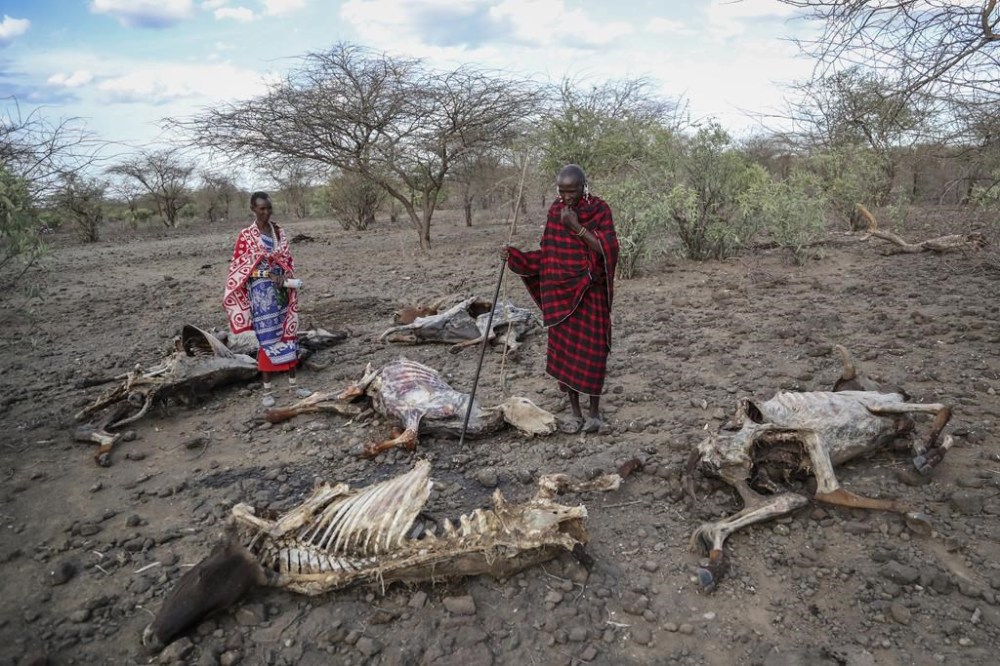
And it’s not just forecasting. As climate shocks such as Somalia’s worst drought in decades become more common, better recording of weather data is a critical need for decision-making.
“For many people in the West, accurate weather forecasts often make lives more convenient: ‘Shall I take an umbrella along?’ In Africa, where many people depend on rain-fed agriculture, that is all a bit sharper,” said Nick van de Giesen, a professor of water resources management at Delft University of Technology in the Netherlands. “With a changing climate, traditional methods to determine, say, the onset of the rainy season are becoming less reliable. So farmers regularly sow after a few rains, after which rains may fail and seeds will not germinate.”
That can be devastating during the current global food security crisis.
Van de Giesen is the co-director of the Trans-African Hydro-Meteorological Observatory, a project that has helped to set up about 650 low-cost local weather monitoring stations in collaboration with schools and other entities across 20 African countries. Not all of those surface monitoring stations are operational because of issues including threats by extremist groups that limit access for maintenance in areas such as Lake Chad.
“To be clear, TAHMO can never be a replacement of efficient and effective national weather services,” van de Giesen said, adding that many African governments still don’t have the needed resources or funding.
In countries like Somalia and Mozambique, with some of the continent’s longest and most vulnerable coastlines, the lack of effective weather monitoring and early warning systems have contributed to thousands of deaths in disasters such as tropical storms and flooding.
After Cyclone Idai ripped into central Mozambique in 2019, residents told The Associated Press they had received little or no warning from authorities. More than 1,000 people were killed, some swept away by floodwaters as loved ones clung to trees.
Cyclone Idai was the costliest disaster in Africa, at $1.9 billion, in the period from 1970 to 2019, according to a WMO report on weather extremes and their economic and personal tolls.
The lack of weather data in much of Africa also complicates efforts to link certain natural disasters to climate change.
Earlier this year, a collection of climate researchers known as World Weather Attribution said in a report that limited data made it impossible to “confidently evaluate” the role of climate change in flooding that killed hundreds of people in Congo and Rwanda around Lake Kivu in May.
“We urgently need robust climate data and research in this highly vulnerable region,” their report said.
Last year, the researchers expressed similar frustration in a study of erratic rainfall and hunger in West Africa’s Sahel region, citing “large uncertainties” in data.
They urged investments as simple as a network of rain gauges, saying that even small shifts in rainfall can affect millions of people.
___
Associated Press climate and environmental coverage receives support from several private foundations. See more about AP’s climate initiative here. The AP is solely responsible for all content.