Some US airports strive to make flying more inclusive for those with dementia
Advertisement
Read this article for free:
or
Already have an account? Log in here »
To continue reading, please subscribe:

Digital Subscription
One year of digital access for only $205*
- Enjoy unlimited reading on winnipegfreepress.com
- Read the E-Edition, our digital replica newspaper
- Access News Break, our award-winning app
- Play interactive puzzles
*First annual payment billed as $205.00 + GST for one year. This annual subscription will automatically renew at $233.00 + GST every 52 weeks (10% off the regular annual price of $259.35). Offer available to new and qualified returning subscribers only. Cancel any time.
To continue reading, please subscribe:
Add Free Press access to your Brandon Sun subscription for only an additional
$1 for the first 4 weeks*
- Enjoy unlimited reading on winnipegfreepress.com
- Read the E-Edition, our digital replica newspaper
- Access News Break, our award-winning app
- Play interactive puzzles
*Your next Brandon Sun subscription payment will increase by $1.00 and you will be charged $17.95 plus GST for four weeks. After four weeks, your payment will increase to $24.95 plus GST every four weeks.
Read unlimited articles for free today:
or
Already have an account? Log in here »
Hey there, time traveller!
This article was published 07/09/2023 (1118 days ago), so information in it may no longer be current.
PHOENIX (AP) — Andrea Nissen is trying to prepare her 65-year-old husband, who has Alzheimer’s disease, for a solo flight from Arizona to Oklahoma to visit family. She worries about travelers and airport officials misinterpreting his forgetfulness or habit of getting in people’s personal space, and feels guilty about not being able to accompany him.
“People say, ‘He has dementia. You can’t let him go by himself,’” Nissen said.
But attending a dementia-friendly travel workshop in July helped ease some of those fears. She learned about the resources available at Phoenix Sky Harbor International Airport and what assistance airlines can offer when asked.
It was the first time the city of Phoenix hosted such a workshop, making it the latest U.S. city pledging to make flying friendlier for people with dementia.
Over 14 million people are expected to check into airports nationwide for Labor Day weekend and, inevitably, some will be travelers with dementia or another cognitive impairment. Nearly a dozen airports — from Phoenix to Kansas City, Missouri — in the last few years have modified their facilities and operations to be more dementia-friendly, advocates say. They’ve added amenities like quiet rooms and a simulation center where travelers with dementia can learn about flying or get a refresher.
Looking for a gate, trying to remember flight times or following terse commands from Transportation Security Administration agents while in line with others can overwhelm someone with dementia. Symptoms like forgetting words can be mistaken for being under the influence of alcohol or drugs.
But most large U.S. airports are behind the curve on serving travelers with dementia when compared with some airports in Australia and Europe.
While dementia is not specifically mentioned in the Americans with Disabilities Act, the law defines disability as an individual with a physical or mental “impairment that substantially limits” major life activities. The Air Carrier Access Act, which Congress passed in 1986, specifically addresses airlines’ treatment of people with disabilities. Among the provisions is making it illegal to discriminate against travelers because of a disability and providing assistance with boarding, deplaning and making connecting flights.
Still, no airport is compelled by law to make changes, said Sara Barsel, a former special education teacher and founder of the Dementia-Friendly Airports Working Group, which lobbies for airports and airlines to enact dementia-inclusive policies.
Part of the reason she suspects there aren’t more quiet rooms or family restrooms with adult changing tables is because that doesn’t generate revenue, she said.
“I don’t know what their constraints are in terms of economics. I know what the impact is and the impact is that there’s less for people who need quiet spaces,” said Barsel, who is based in Roseville, Minnesota.
The group, which was founded in 2018 by experts in dementia and Alzheimer’s, helped add lanyard and other programs to airports. London’s Gatwick Airport created the Hidden Disabilities Sunflower lanyard program in 2016, which is now in over 200 airports globally. Light green lanyards with a sunflower pattern are issued to anyone who wants to subtly indicate they or a travel companion has dementia or a not-as-visible disability. The lanyards let airport and airline personnel know the traveler may need more attention and information repeated.
One of the first airports the group reached out to was the Missoula Montana Airport, which became certified as a “sensory inclusive” facility in March. The group went over issues that can arise with lighting, floor design and noise. It also incorporated the sunflower lanyards.
“It’s already a high-stress, anxiety-driven environment for anyone not suffering from a hidden disability,” said airport Deputy Director Tim Damrow. “One reason people come here to Montana is for friendly people and obviously for the amazing scenery. We wanted to make sure that everyone is welcomed and treated with the dignity and respect they deserve.”
Candice Kirkwood, of Indianapolis, experienced what she said was her worst nightmare in 2001 when her parents were flying through the Dallas Fort Worth International Airport. Her mother, Marjorie “Margie” Dabney was wearing a badge to signal she needed extra help because she had Alzheimer’s, and the couple was being helped by an airline attendant.
The attendant helped Kirkwood’s father, who used a wheelchair, to the restroom, and when they returned, Dabney was gone.
“It played every day in my mind,” Kirkwood said. “What could I have done differently? I didn’t get to say goodbye to her.”
Human remains that were found six years later and 15 miles (24 kilometers) away in a remote area were identified as Dabney through the use of DNA. Local police said she died of blunt force trauma, which could have been caused by a fall or an object striking her. The case remains unsolved.
Dabney’s now late husband, Joe, settled a lawsuit with American Airlines for an undisclosed sum in 2003.
Kirkwood said she still harbors distrust of airlines.
“I don’t want anybody to ever have to go through what I went through,” she said. “It’s like once my mother faded away, nobody seemed like they ever cared to talk about it.”
Representatives for the airline did not immediately respond to requests for comment on any changes to accommodate travelers with cognitive impairment.
Dallas Fort Worth International Airport, however, is launching the sunflower lanyard program in mid-September. All frontline employees who interact with customers and volunteer ambassadors will receive formal training on how to engage with travelers donning the lanyards. Its inception has been a long time coming, according to airport spokesperson Heath Montgomery.
“We’re continuing to evolve the way we interact with customers from all walks of life,” Montgomery said.
Jan Dougherty, a registered nurse who has written a book on traveling with dementia and led the Phoenix workshop, said it’s unfortunate that people with dementia have gone missing. With the right support, she said they can travel safely.
“So many people early on (after diagnosis) are capable of travel with some accommodation,” she said. “We’re still an ageist society.”
The need for accommodations will become more prevalent as more Americans move into retirement age. The Centers for Disease Control and Prevention predicts nearly 10 million adults among those 65 years or older will have dementia by 2060. Experts, however, say dementia often is underdiagnosed.
Similarly, more than 6 million people nationwide have Alzheimer’s disease, which is expected to hit 13 million by 2050, according to the Alzheimer’s Association. Overall, 55 million worldwide are currently living with Alzheimer’s and other forms of dementia.
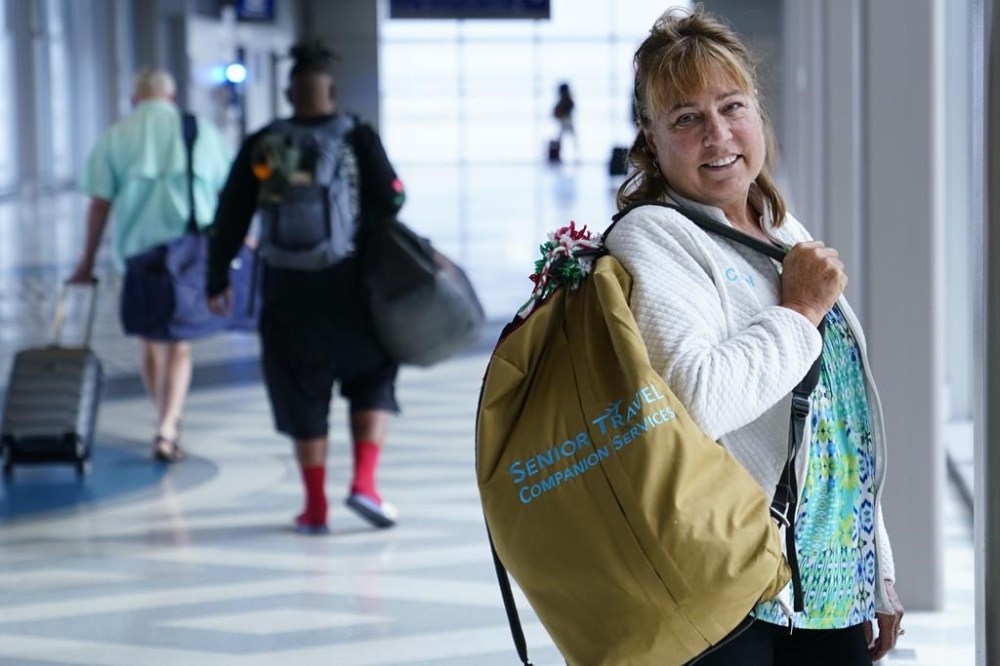
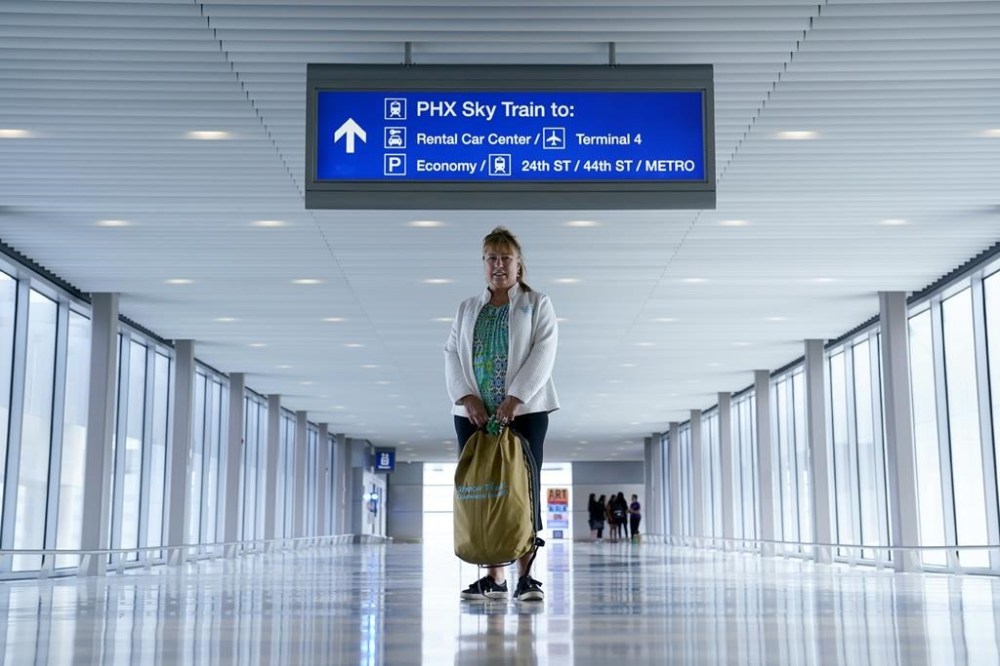
Carol Giuliani, who is part of the airports working group, can testify to the growing need. For the past eight years, she has worked as a travel companion for senior citizens with dementia. She has accompanied seniors on flights, vacations or relocations in 42 states and 12 foreign countries. Giuliani wears a company jacket and has a sunflower lanyard for her client. She also has explanation cards for security agents to “put a little TLC in the TSA.”
“Ninety percent of the time it’s a family member that hires me,” said Giuliani, while seated at Phoenix Sky Harbor after escorting an elderly man on a flight. “The one I did today, (the wife) was like ‘thank you, thank you, thank you!’… I know how to pace it so that he gets safely and comfortably back home.”
___
This story has been updated to correct that dementia isn’t covered by the Americans with Disabilities Act. While dementia is not specifically mentioned, the law defines disability as an individual with a physical or mental “impairment that substantially limits” major life activities.